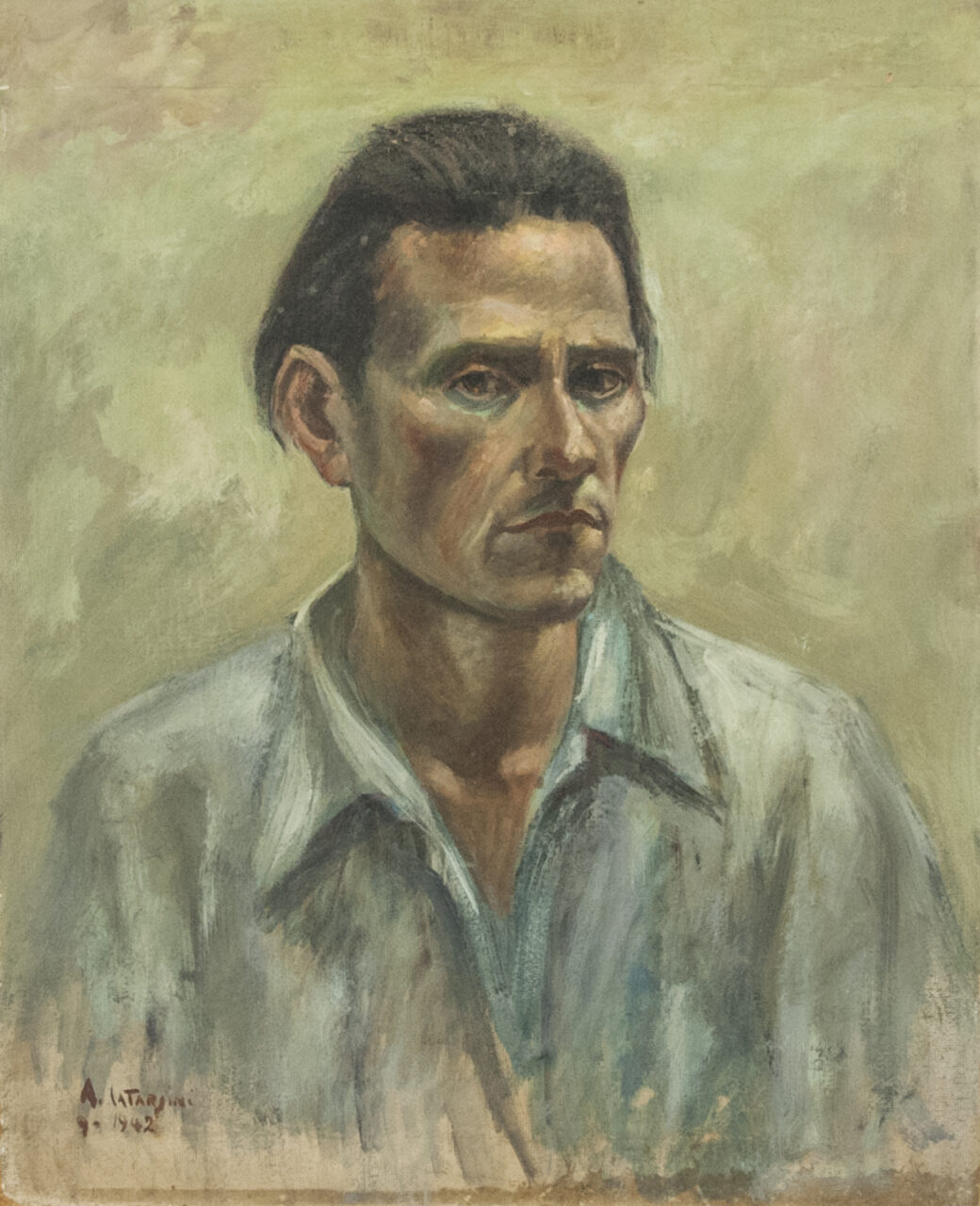
Autoritratto
- Year
- 1942
- Medium
- olio su tavola
- Dimensions
- cm 59x47
- Number in the travelling exhibition
- 61
61. Autoritratto (Self-Portrait), 1942, oil on panel, cm 59 x 47
In this work, created at the height of World War II, Catarsini conveys a profoundly human and vulnerable image of himself. The half-length painting is not only a chronicle of his appearance, but also a reflection of the tensions and worries of those difficult years. The artist’s face is turned slightly to the right, but his gaze is directed straight at the viewer, filled with thought. His features are marked: his face is hollow, his cheekbones are high and pronounced, and the corners of his lips curve downward in an expression of composed suffering. His thick black hair, combed back, reveals a slight receding hairline, framing a broad forehead.
Catarsini wears a light-colored shirt with a pointed collar, left slightly open at the chest in a gesture of everyday ease. The figure almost seems to blend in with the surrounding environment: the background is solid, a yellowish and whitish hue, and the artist uses delicate brushstrokes of blue on the shirt to make it discreetly emerge from this luminous yet rarefied atmosphere. The seriousness of the gaze immediately communicates the mood of the moment. It is the portrait of a man experiencing the uncertainty of conflict and the danger to himself and his loved ones, transforming his face into the silent tale of an entire era of hardship.
INSIGHTS
In the catalog for the exhibition The Artist in the Mirror. Alfredo Catarsini: Self-Portraits from 1930 to 1985, held in 2022 at the Academy of Drawing Arts in Florence, President Cristina Acidini emphasizes Catarsini’s thoughtful and severe personality, also expressed in his literary work, with his novel Giorni neri (Black Days), inspired by the dramatic events of the Second World War in the Freddana Valley near Lucca. She comments: … “The vigorous and assertive young man of the 1930s, modeled like a polychrome statue from his sculpted hair to his torso compressed in shirts and T-shirts, transforms in the postwar period into a mature and disenchanted man, at times sadly introspective, as if touched by bitterness. Catarsini depicts himself with a receding hairline and a lined face; he accepts and narrates the impending old age with the serene poise of great spirits unafraid to expose the decay of their bodies.” A self-portrait of his from 1934 has been at the Uffizi Gallery since 2005.