Baracca sulla spiaggia
- Year
- 1952
- Medium
- olio su tela
- Dimensions
- cm 57x76
- Number in the travelling exhibition
- 65
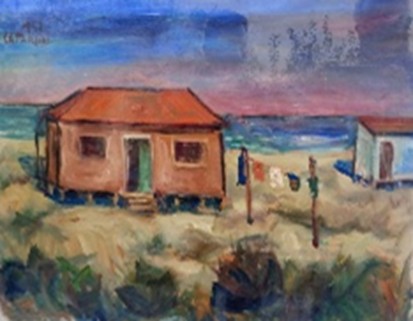
65 Baracca sulla spiaggia, 1952, oil on canvas, cm 57 x 76
In this horizontal canvas, Catarsini portrays the wild coastline south of Viareggio, in the protected area of the Macchia lucchese. It is a pristine landscape where nature reigns supreme. The lower part of the painting is occupied by the sandy strip, rich with dune vegetation that heralds the awakening of spring.
Moving upward, the sand becomes more intensely yellow until it meets the blue of the sea in the background. On the horizon, the sky lights up with the typical colors of sunset: a stripe of bright red rests on the waterline, gradually fading into cooler shades of blue and azure.
Two huts stand out in the scene. The larger one, on the left, is an ochre-colored structure with a red roof, characterized by a central green door and two small symmetrical windows. Not far away, towards the far right, there is a smaller, whitish-colored hut, also with a red roof and a small door. Between the two buildings, a line stretched between two wooden poles holds three clothes hanging out to dry, adding rhythm and color to the composition: a vibrant red, white, and blue triptych. The composition conveys the quiet and vibrant light of a precious ecosystem, dear to the artist, where land and sea merge under a colorful sky. This work also embodies Catarsini’s signature metaphysical silence. Despite the absence of a human figure, its presence is obvious: the clothes blowing in the wind and the huts bear witness to a daily life that silently animates the landscape.
INSIGHTS
Despite his most innovative works, the artist always returns to his landscapes, to works dedicated to the sea and the beaches of Versilia, with a touch of expressionism. One of the main themes of his painting is, in fact, his relationship with his native land, which he has made known in Italy and abroad: Viareggio, with its busy docks, silent canals, pine forests, and the poignant and bare Versilia coastline, the landscapes of an extraordinary territory that has enchanted artists and poets. Viareggio and its sea are his school of life and painting. Not the touristy, seaside Viareggio, but the Viareggio of the still unspoiled docks and beaches between the pine forest and the sea—those landscapes that, in Paloscia’s words, constitute “the true lifeblood” of Catarsini’s pictorial discourse.