Cantiere
- Year
- 1942
- Medium
- olio su tela
- Dimensions
- cm 53,5 x 66
- Number in the travelling exhibition
- 64
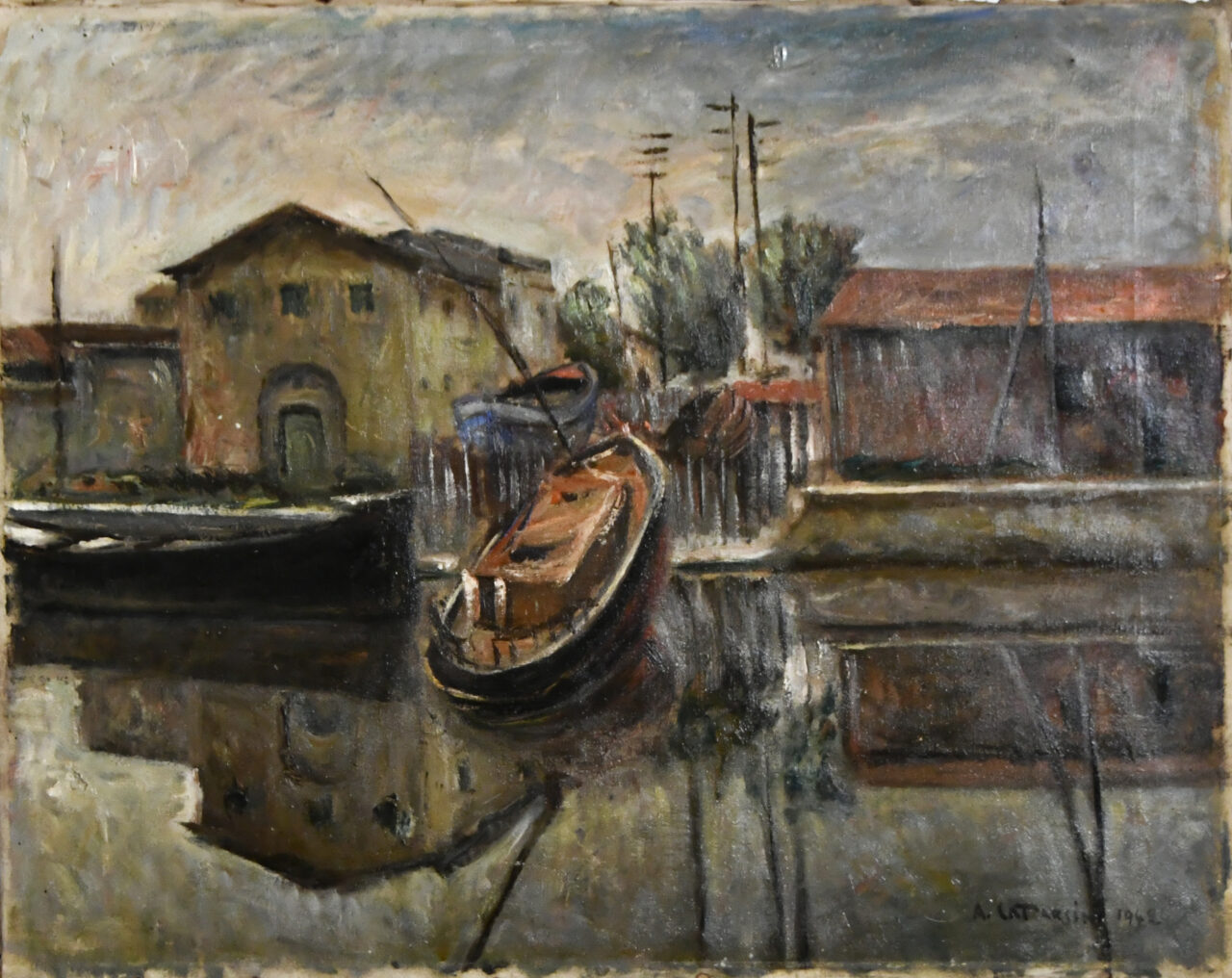
64. Cantiere 1942, oil on canvas, cm 53.5 x 66
This horizontal painting depicts the solemn moment of a launch: the ship slides into the water stern-first, its keel raised to the right, leaving the hull almost vertical. The absence of human figures creates a striking contrast between the dynamic action and the suspended silence of the shipyard. The dock wall divides the canvas into two exact halves. In the upper half is the dock wall and the bow, flanked by the shipyard buildings: a vertical yellow ochre structure to the left of the hull and a brown building with a red roof to the right, separated by a green tree. Above them, a blue sky streaked with light white streaks.
In the lower half, the stern touches the water and the canal mirrors the scene. This “doubling” demonstrates Catarsini’s fascination with reflective surfaces—water, glass, mirrors—capable of multiplying shapes and colors, making the composition hypnotic and profoundly captivating. The work marks the beginning of a formal exploration the artist developed in those years, which he would later call Riflessismo.
INSIGHTS
Between the mid-1930s and the 1940s, Catarsini’s paintings are characterized by bold brushstrokes that define solid volumes, both in figures and in quiet landscapes. Perspective and composition are meticulously crafted, and the environment once again serves as a backdrop to human action, even though, as in this work, the workers are not present. During this period, views of the Viareggio shipyards, as a theater of labor, frequently appear in his exhibitions. Catarsini had been interested in this subject since the 1920s, portraying his city through its streets, canals, and docks, seeing shipyards as places where imposing wooden structures were being built. In the summer of 1936, at the Kursaal in Viareggio, he achieved his first success with “Velieri in cantiere,” purchased by the Ministry of Popular Culture for the Galleria Nazionale d’Arte Moderna in Rome. Also in 1936, he exhibited in Seravezza and presented two fresco landscapes in Florence, demonstrating his commitment to new pictorial trends, which was also confirmed in his religious painting with the mural “The Marriage of Mary” in Viareggio. In the fall of 1937, he exhibited another “Cantiere” in Naples, where the prows of two large sailing ships tower over the buildings.