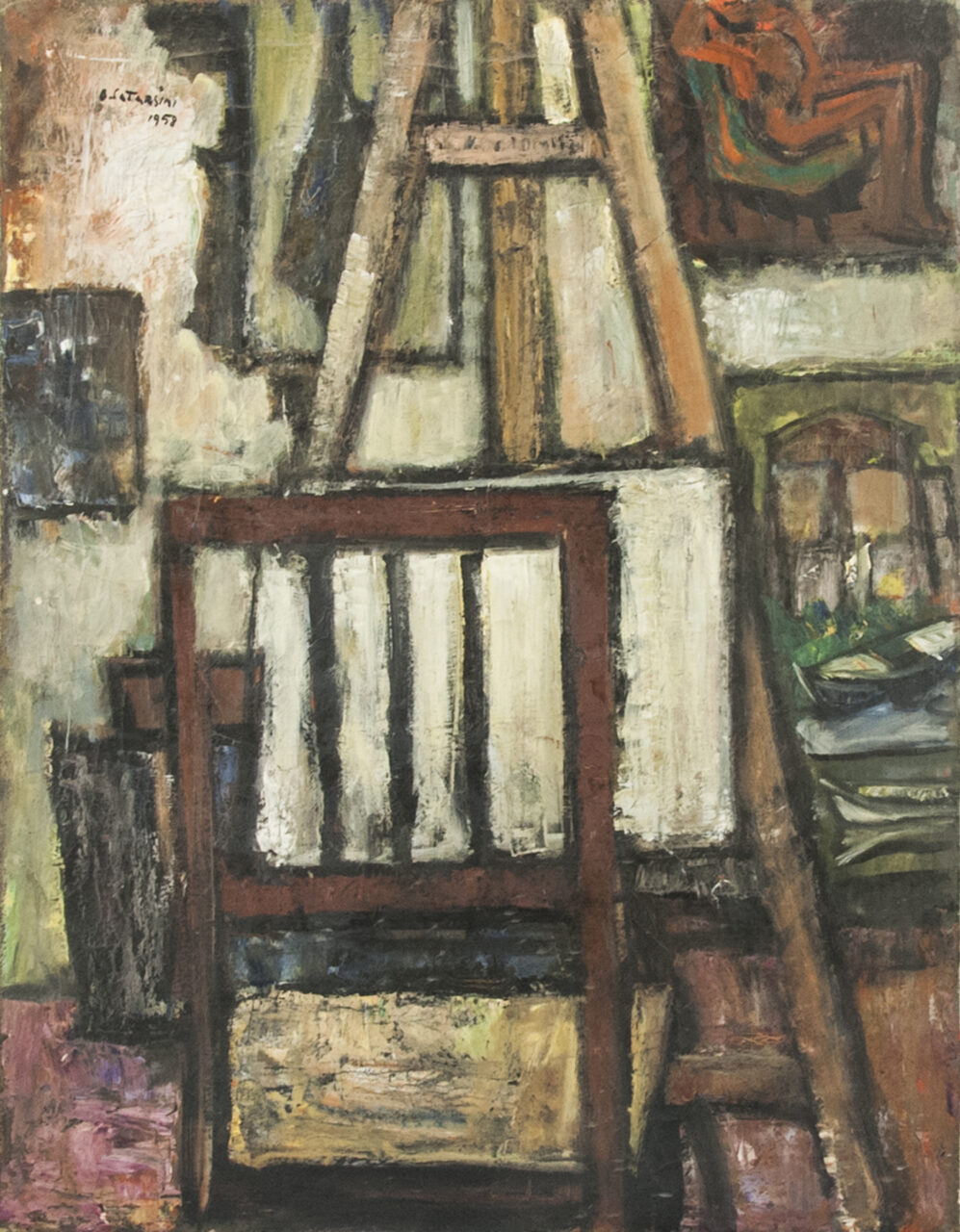
Cavalletto nello studio
- Year
- 1958
- Medium
- olio su tela
- Dimensions
- cm 81 x 63
- Number in the travelling exhibition
- 71
71. Cavalletto nello Studio, 1958, oil on canvas, cm 81 x 63
In this vertical canvas, we return to the interior of the studio at Villa Paolina Bonaparte. While the previous work (catalog no. 69) described the furnishings, this painting takes us to the heart of the room, focusing on the “tools of the trade” placed right in the center of the space: the chair, the easel, the hanging works, and the works in progress.
The painting is striking for the density of its construction. Catarsini fills every inch of its surface with a dense interweaving of horizontal, vertical, and oblique lines. These signs, marked by dark outlines, approach, overlap, and intersect, creating a mosaic of geometric spaces that the color then fills and defines. Although the subject is figurative and recognizable, the formal exploration typical of Reflexism takes precedence here. The reality of the studio is deconstructed and reconstructed through an almost kaleidoscopic lens. The result is a harmonious and dynamic composition, where the chair and easel are not just objects, but vectors of lines and chromatic interplay.
The vibrant palette and precise lines make the scene modern and comprehensible. It is a work that invites the viewer—or whoever follows its description—to perceive the rigorous, almost mathematical order that Catarsini sought even in the creative chaos of his studio.
INSIGHTS
At the entrance to Villa Paolina Bonaparte, a totem illustrating the Viareggio stops of the “I luoghi di Catarsini” (The Places of Catarsini) walk, created in 2023 in collaboration with the Italian Touring Club, is displayed. Alfredo Catarsini’s studio is a rare gem: it is the only studio of a 20th-century painter preserved in a public space. Located in the attics of the north tower of the Villa Museo Paolina Bonaparte, it is accessed via a short staircase from the main floor.
On the entrance door, an emblematic sign welcomes visitors: “Whoever enters honors me, whoever does not enter does me a favor.” It was the Maestro’s frank way of inviting those who sincerely loved art to engage in dialogue, discouraging time-wasters.
The studio is divided into two connecting rooms that maintain a timeless atmosphere. The first room houses the historical archive, including posters from his numerous exhibitions. The second, the heart of his creative work, houses easels, tubes of paint, a typewriter, and original drawings, including a precious sketch for the frescoes in San Martino in Freddana. Due to climatic reasons, the studio is highly sensitive to seasonal temperatures; the collection of 30 works donated by his children Mity and Orazio over 20 years ago to the Municipality of Viareggio is currently divided. A significant portion (15 works) is temporarily on display at the Marconi Library in Piazza Mazzini, a key stop on the “I Luoghi di Catarsini” (The Places of Catarsini) walk.