I funai
- Year
- 1951
- Medium
- olio su tela
- Dimensions
- cm 72 x 57
- Number in the travelling exhibition
- 75
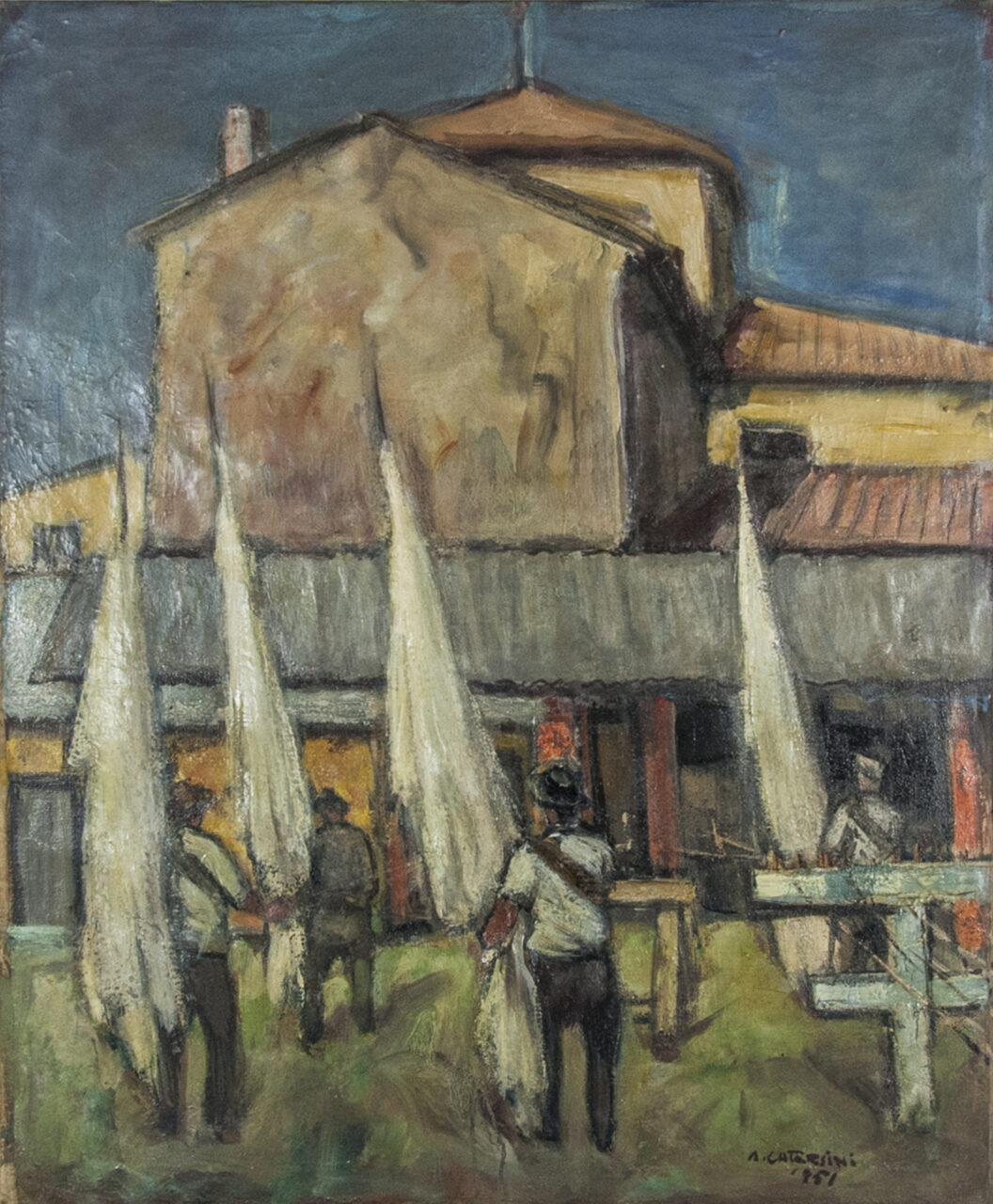
75. I funai, 1951, oil on canvas, 1951, cm 72 x 57
In this vertical canvas, Catarsini celebrates the manual labor of the Viareggio artisans who wove ropes for boats. The work is the pinnacle of his mastery and a precious historical testimony to a now extinct craft. The scene depicts four men seen from behind, arranged on two levels. They wear brown trousers, three of them white shirts, and one wears a hat. Each holds a long stick resting on the ground to their left. The ropemakers are captured in their characteristic backward movement, a ritual gesture necessary to weave the fibers and transform them into ropes. In front of the workers stands a multi-level architectural complex, with low, lean-to buildings and tall, white and yellowish buildings that rise to occupy the upper edge of the painting.
The blue sky frames the outline of the buildings, sharply defined by bold black outlines. This bold graphic line defines not only the architecture, but also the wooden structures and the figures of the ropemakers in the lower section, giving the work an almost monumental solidity. The true visual fulcrum is the stark white of the hemp. Supported by poles, the fiber rises like a patch of pure light, towering to double the height of the men and terminating in a distinctive pointed shape.
INSIGHTS
This painting represents not only the pinnacle of his technical mastery, but also a precious historical testimony to a traditional craft in Viareggio at the time. It celebrates the manual labor of the funai, the craftsmen who wove ropes for boats. The skillful use of black to emphasize the forms and white for the raw material transforms a moment of everyday work into a rhythmic composition, where color replaces traditional drawing. Unlike the works of Mechanical Symbolism, here the human figure and its physical effort are the absolute protagonists, in a perfect balance between man and his environment. The technique is still a skillful gesture of the hands, not a dominant “machine.” It is a hymn to the dignity of work and the identity of a community tied to the sea.