La sartina
- Year
- 1951
- Medium
- olio su tela
- Dimensions
- cm 60,5 x 50
- Number in the travelling exhibition
- 57
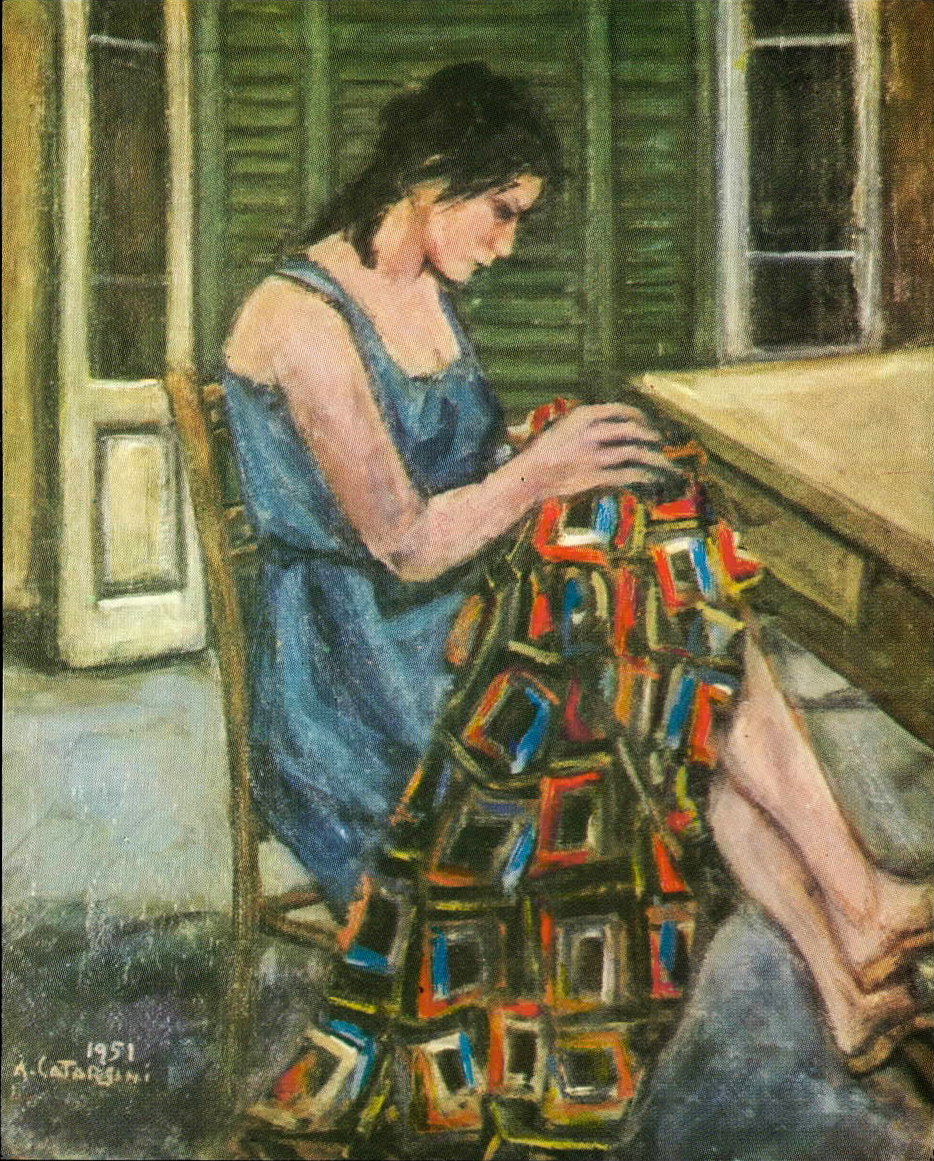
57. La sartina, 1951, oil on canvas, cm 60.5 x 50
In this 1951 canvas, Catarsini portrays a young woman learning the art of sewing under the guidance of the artist’s wife, who had set up a fashion school in one wing of the house. The work thus becomes a testament to the industrious atmosphere that reigned there. It is summer, and the student is on the terrace, sitting three-quarters to the right, her head bowed and her gaze fixed on the cloth she holds in her hands. Her pose is one of extreme concentration: her legs crossed under the table and her feet firmly planted suggest the stability necessary for precision work. The young woman wears a sleeveless, low-cut blue dress. The true visual protagonist, however, is the fabric she is sewing: a cloth with a complex geometric pattern of small red, blue, white, and brown squares that creates a splash of color. In the background, two large windows, divided by a shutter, form a grid of vertical and horizontal lines. Catarsini creates a play of references: the rigorous geometry of the square drape harmonizes with the straight lines of the windows and the table, while the figure of the girl, with her soft curves, breaks this rigidity, bringing the painting to life. The canvas is saturated, every space filled with bold brushstrokes. There is no void, just like in other works set in the studio.
INSIGHTS
In 1920s Viareggio, in the shadow of the sixteenth-century Matilde Tower, love blossomed between Alfredo Catarsini and Giuseppina Rossi, who soon came to be known as Alfreda to everyone. They met at the home of a neighbor, Angelina, known as Angiò del Tofanelli, who supported them because their relationship was hindered by her family, a lineage of sea captains, who viewed the young “painter” with suspicion. Undaunted, the two found an original way to finance their future: they created a traveling library, borrowing books from house to house to raise money for their trousseau.After her marriage, Alfreda’s talent for sewing became the family’s economic engine. She founded a renowned fashion school that became the beating heart of the house, catering to both workers and high-society clients. Her designs graced the galas, balls, and most prestigious ceremonies in Versilia, providing the stability that allowed Alfredo to devote himself entirely to his art, his studies, his relationships, his awards, and his exhibitions. They were a loving, close-knit, and complicit couple, two courageous visionaries capable of challenging the mentality of the time to build, together, a destiny dedicated to art, beauty, and their two children, Mity and Orazio. Alfreda’s farewell, at the age of seventy, left an unfillable void. Catarsini chose to capture that silence in a stark and painful image: the 1973 “Self-portrait in stone” (catalog no. 47).