L’atelier
- Year
- 1954
- Medium
- olio su compensato
- Dimensions
- cm 35x50
- Number in the travelling exhibition
- 69
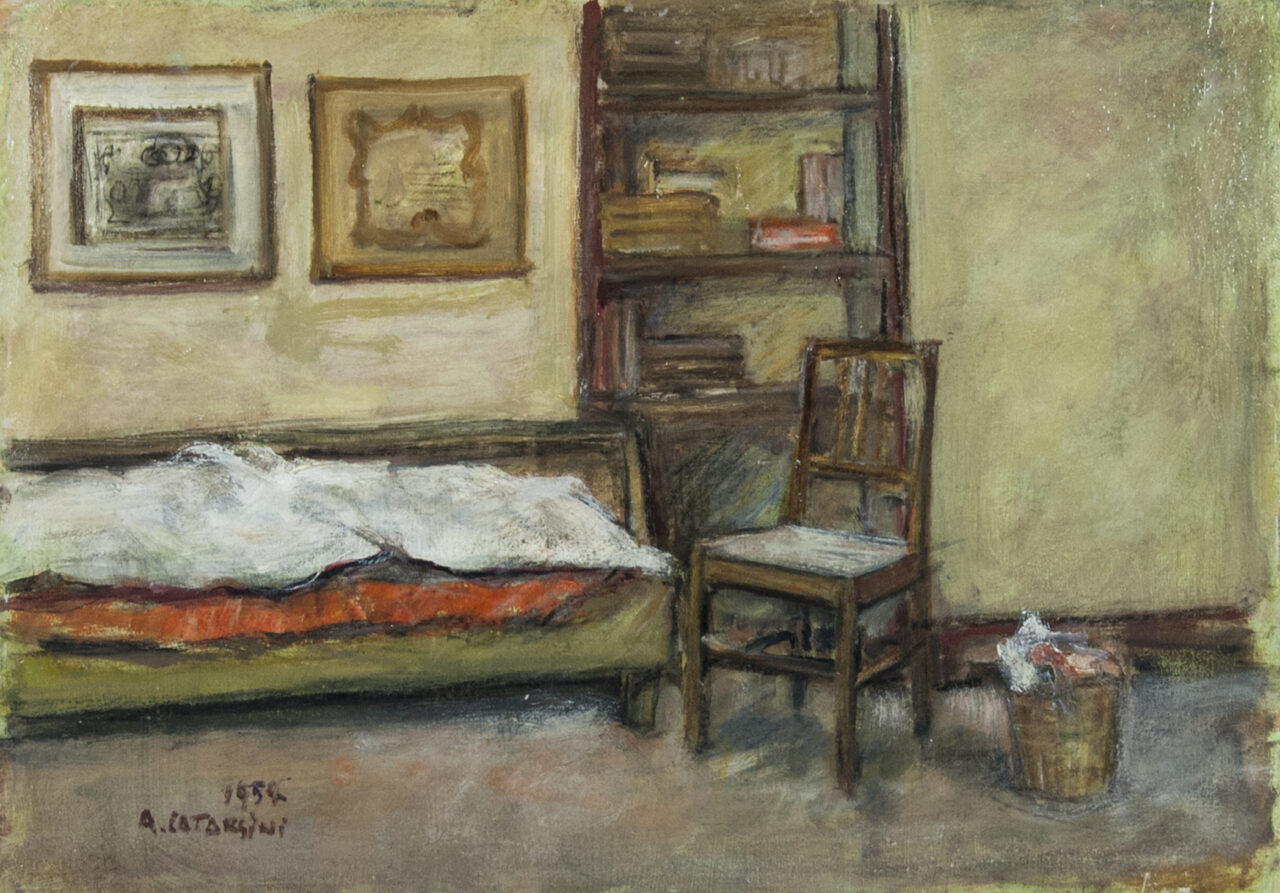
69. L’Atelier, 1954, oil on plywood, cm 35 x 50
This horizontal work opens the doors to a special place: a wall of Catarsini’s studio inside the Villa Museo Paolina Bonaparte in Viareggio. More than a celebration of art, the painting seems to portray the silent soul of the room, a corner where time seems to have stood still. At the bottom left is a green sofa, with a blanket forming a clear horizontal red line and a white drape draped over it. On the yellowish wall above, two framed diplomas hang, signs of the Maestro’s long career. To the right, the verticality of the room is defined by a built-in bookcase filled with volumes and newspapers. The foreground on the right is occupied by simple, humble objects: a wooden chair and a wastepaper basket. The floor is terracotta, but its natural color is veiled by a whitish patina, almost as if the artist wanted to depict the very dust that settles on things in the silence of work. The palette evokes the atmosphere that still greets visitors to the atelier today. Although the easels or brushes are missing (which we’ll find in other works), these furnishings represent the “companions” of Catarsini’s daily life. A historical detail: today the green sofa is gone, replaced by some shipping crates, making this painting a precious visual testimony of how the studio looked in the 1950s.
INSIGHTS
ALFREDO CATARSINI’S WORKSHOP IN THE VILLA OF PAOLINA BONAPARTE
This Viareggio stop touches on one of the most interesting sites on the Catarsini Places Walk: Alfredo Catarsini’s studio, located in the attics of the Villa Museo Paolina Bonaparte. Catarsini moved to this palace after his previous studio, located in some rooms of the Palazzo Comunale (formerly the Casino Reale) on Via Regia, was bombed during the Second World War. The studio preserves the artist’s important archive and traces of his work and life: drawings, exhibition posters, easels, palettes, brushes, documents, photos, catalogs, articles, drawings, art books, letters, diplomas, and honors. It also contains manuscripts, drafts, and articles, because he was not only a painter, but also a man of letters and a thoughtful and sensitive man of culture. Visiting it allows you to reconstruct his personality and the most salient events of his long life, entirely dedicated to art. Cristina Acidini writes:….And while the painter’s figure loses its sharp edges and his hair turns white under his Parisian-style beret, while his career as a teacher and artist leads him through personal and autonomous experiments (with Mechanical Symbolism and Reflexism, without abandoning the figure and landscape of Viareggio), the studio takes on that lived-in look, crowded with tools and memories, that strikes visitors… In today’s studio, the emotion of encountering a place that holds the testimony of an artist with a strong and decisive personality, of a longevity that allowed him to span much of the twentieth century, participating in its fluctuating artistic currents, is strong. Works that come and go, cartoons preserved after use in fresco workshops, paintings selected and prepared for exhibitions—in Florence, Venice, Rome, and elsewhere—paintings that return, drawings that accumulate in reams, articles, reviews, brochures (all material that seems important at the time and then ends up on a CV or forgotten) and, of course, canvases, frames, and tools of the trade. Painting possesses Catarsini and is present to him relentlessly: in his portraits, a canvas painted on the easel can appear, a painting within a painting, a fragment of the Viareggio studio incorporated forever into a painting that will make its way into the world. There, the plaster on the walls fades, the white paint on the roof peels off, revealing patches of wood and brick… The transition from everyday life to the museum has recreated, in the new terms of an orderly narrative, what was once an environment lived in bustling confusion.”