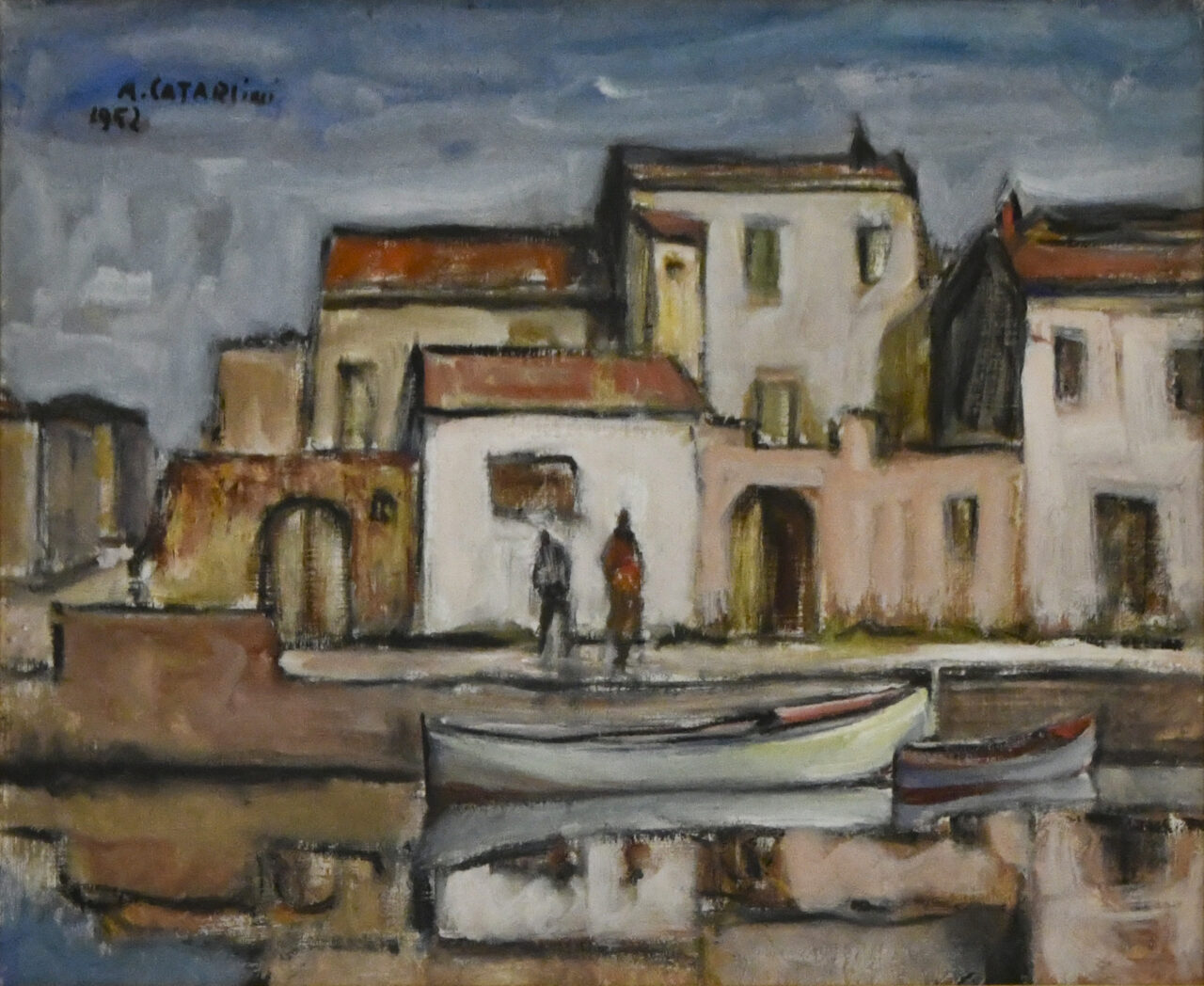
Lungo canale
- Year
- 1952
- Medium
- olio su tela
- Dimensions
- cm 40 x 50
- Number in the travelling exhibition
- 83
83. Lungo Canale, 1952, oil on canvas, cm 40 x 50
In this luminous horizontal canvas, Catarsini returns to one of his most cherished views: the Burlamacca Canal, near the Matilde Tower, the place of his childhood.
As in other works from this period, the composition is divided symmetrically: the upper half of the painting is dominated by a row of historic sixteenth-century houses, clearly delineated by a dark border. The buildings, of varying heights, are painted in light, luminous hues—soft white, yellow, and ochre—and crowned by characteristic red roofs. The passage arches, a typical architectural element that connected the city to the dock, stand out. On the dock, in a rare moment of everyday life, a man and a woman stand out. In front of them, a gozzo (a traditional fishing boat) is moored with its bow facing to the right, a symbol of the neighborhood’s maritime life. The lower half is entirely occupied by water, which acts like a mirror, evocatively reflecting the colors and shapes of the houses above.
INSIGHTS
Alfredo Catarsini was born on January 17, 1899, in the shadow of the sixteenth-century Matilde Tower, in the heart of old Viareggio. The dock, with its boats under construction and the industrious comings and goings of workers, was his first and inexhaustible source of inspiration. Here he developed, breathing the air of the coastal artists and following in the footsteps of his chosen mentor, Lorenzo Viani. From the 1920s onwards, he developed a personal synthesis between Futurist modernity, Magic Realism, and the teachings of the Macchiaioli. His horizons, however, soon broadened: while still very young, he made a crucial trip to Paris. It was 1914 when, in a café in Montmartre, he met Amedeo Modigliani; the famous artist, leafing through his sketchbook, encouraged his talent, pushing him to continue a research that would never end. A writer and painter, Catarsini has lived almost a century of art, always remaining faithful to his roots while knowing how to dialogue with the European avant-garde, positioning himself today as a necessary bridge between tradition and technological modernity.