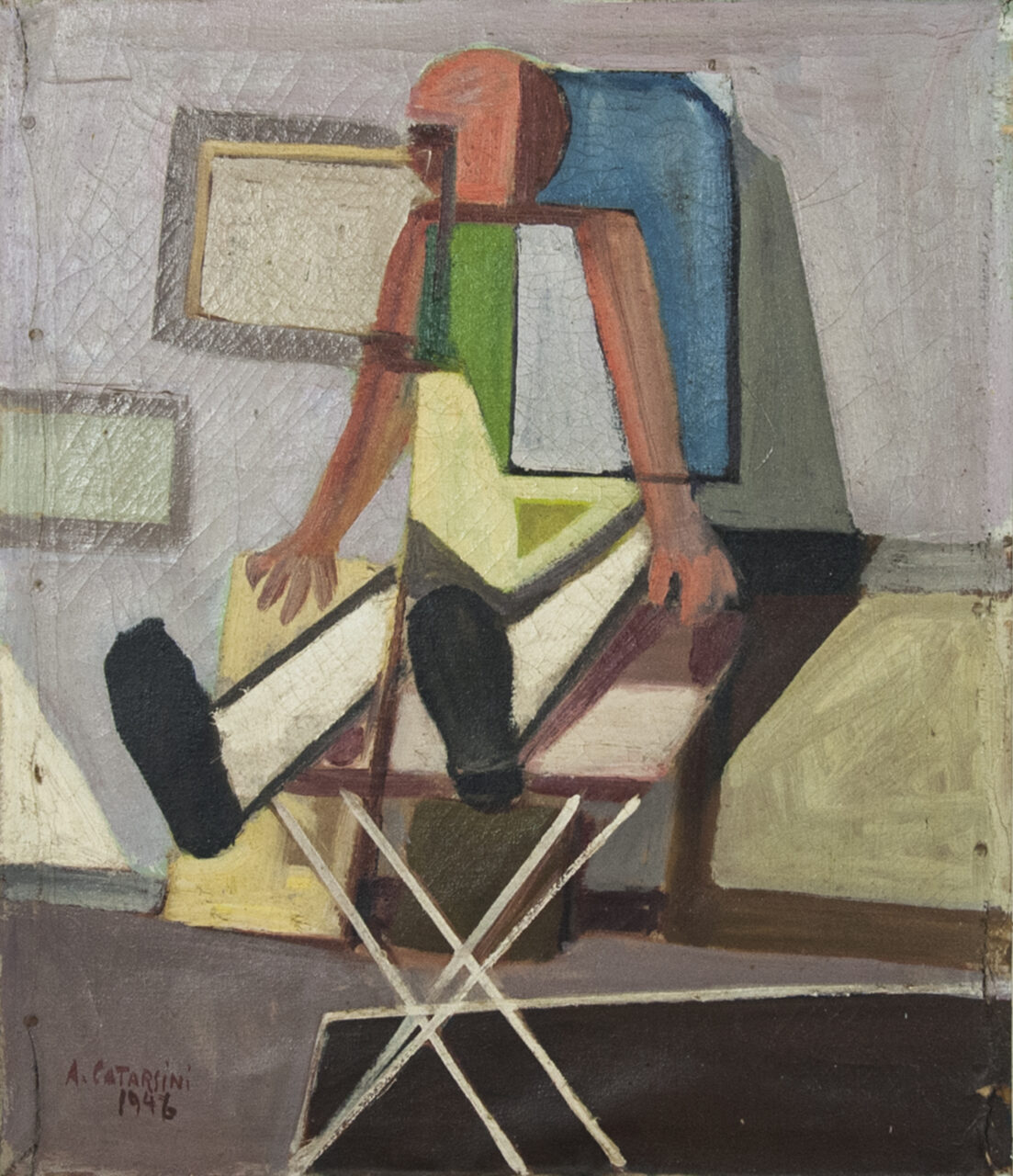
Manichino nello studio
- Year
- 1946
- Medium
- olio su tela
- Dimensions
- 47 x 40
- Number in the travelling exhibition
- 70
70. Manichino nello Studio, 1946, oil on canvas, cm 47 x 40
This vertical work marks a moment of profound experimentation for Catarsini: his Riflessismo (Reflexism). Through the study of reflections on the mirrors or windowpanes of his studio, the artist breaks down reality, creating an interlocking array of sculpted forms in bright colors and sharp contours. The scene is dominated by a wooden mannequin, seated on a typical goat-shaped workbench. The figure is curious and stylized: it has a faceless oval head and pink arms. The legs, white and stiff because they lack knees, are stretched forward and end in small black shoes. A bold black border defines the entire silhouette, clearly separating it from the background.
Around the mannequin is a series of empty square frames. Two rest on the floor, while three hang on the wall. Instead of enclosing a painting, these frames frame simple spaces of color, as if the painting itself had become pure geometry. The work is striking for its strong color contrasts. The corner of the studio is transfigured: what we see is the superposition of real objects and their reflected images, intertwined in a harmonious interplay of squares and straight lines. It is a silent, almost suspended world, where the mannequin seems the sole inhabitant of a space made only of light and color.
INSIGHTS
After the war, Catarsini broke with tradition to embrace absolute freedom of expression. His Riflessismo was born, an original language that transformed the studio into an optical laboratory: observing reality filtered and reflected by glass, the artist discovered a universe of overlapping forms and unexpected perspectives. Catarsini did not portray objects, but “visual events.” As suggested by the Surrealists, he sought the fantastic in the everyday, capturing the ambiguity between what is real and what is reflected. Strong chromatic contrasts “sculpt” the forms that emerge from this play of mirrors, destabilizing the common vision and inviting the observer to question the very nature of reality. This phase of bold and courageous ferment was not merely a stylistic exploration, but the necessary prelude to the subsequent invention of his highly original Simbolismo meccanico