Maternità nera
- Year
- 1962
- Medium
- olio su tela
- Dimensions
- cm 70 x 50
- Number in the travelling exhibition
- 76
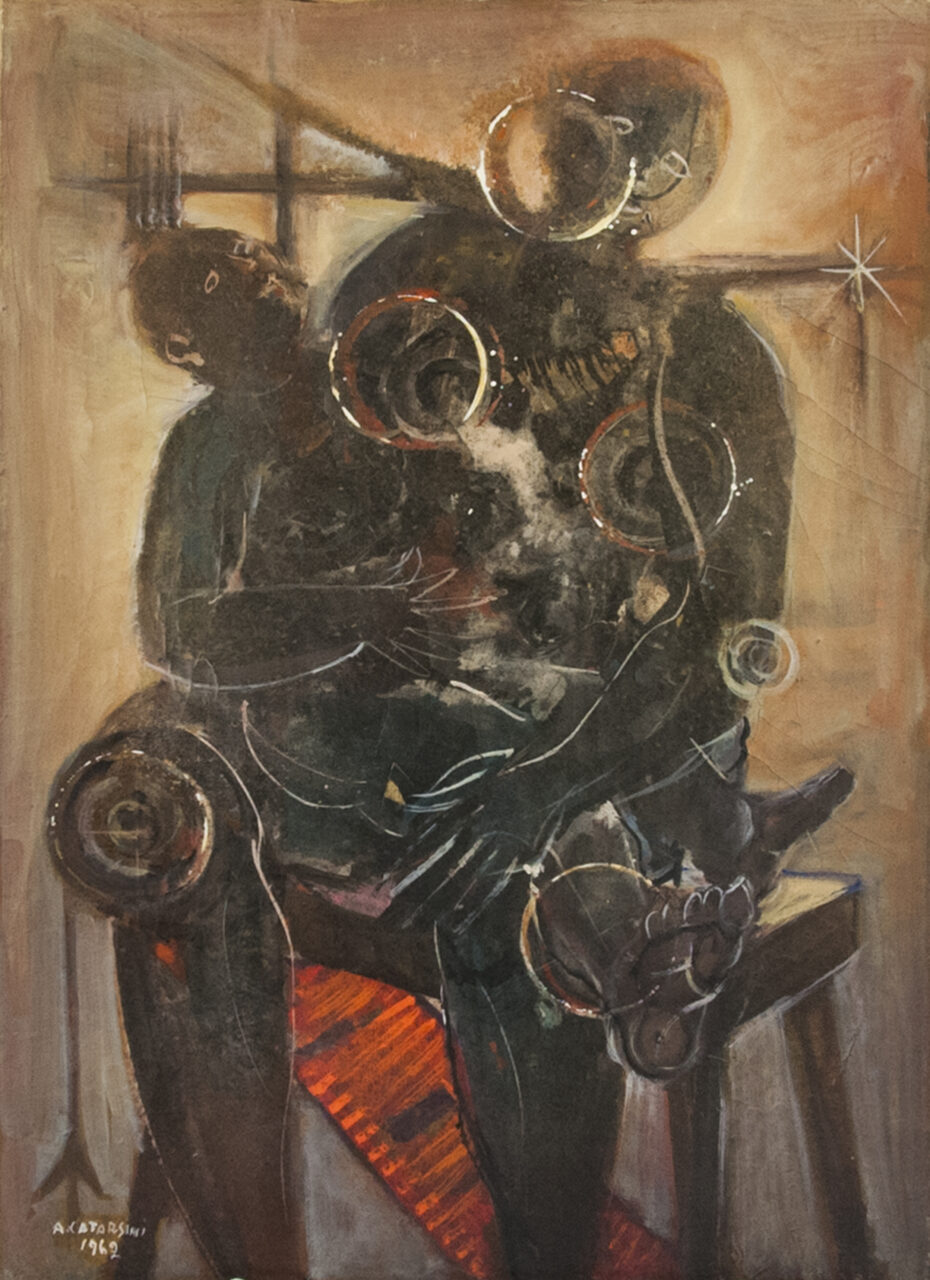
76. Materintà nera, 1962, oil on canvas, cm 70 x 50
This vertical work blends the imagery of the “Fantastic Figures” (catalog no. 26) with the geometry of the “Mechanical Composition” (catalog no. 27). At the center of the scene, a dark figure sits on a stool: her face is turned to the left, while she holds a child on her lap, whose torso is turned to the left and whose legs are turned to the right.
Both figures are not depicted realistically, but are surrounded by circular brushstrokes that suggest their faces, arms, and knees, leaving the task of completing the image to the imagination.
The key elements of the composition: Movement: A whirlwind of circles crosses the canvas. Among them, five resemble veritable magnifying glasses placed on focal points: the face, the breasts, and the knees. Light: The background, in brown and ochre tones, releases a luminosity that starts from the center, just behind the main figure, and radiates outward. Color: The palette focuses on the chromatic mix and the light that envelops the black silhouettes. A single accent of pure color, a slanted band of red, crosses the space behind the figure’s legs.
We are faced with a profoundly innovative work, where the traditional subject of motherhood is transformed and reinterpreted through a mechanical and visionary lens.
INSIGHTS
Catarsini never ceases to amaze us. Just when we think we’ve deciphered his world of seascapes, portraits, and mechanical gears, the artist surprises us with a unique composition that breaks away from the dominant themes of the 1960s. The originality of this work is even more striking when we consider the theme of motherhood: a subject present in the master’s oeuvre, yet not frequent. To understand its innovative scope, simply compare it to Maternity from 1954: in that more traditional painting, the mother sits in an armchair, holding her sleeping daughter close, her expression sadly serene and lost in thought. A protective embrace, classic and realistic.
In this new work, however, the feeling transforms into vision. The tenderness of the gesture does not fade, but is reworked through a dynamic and imaginative language, demonstrating Catarsini’s ability to constantly evolve and look at the same feeling with ever-new eyes.