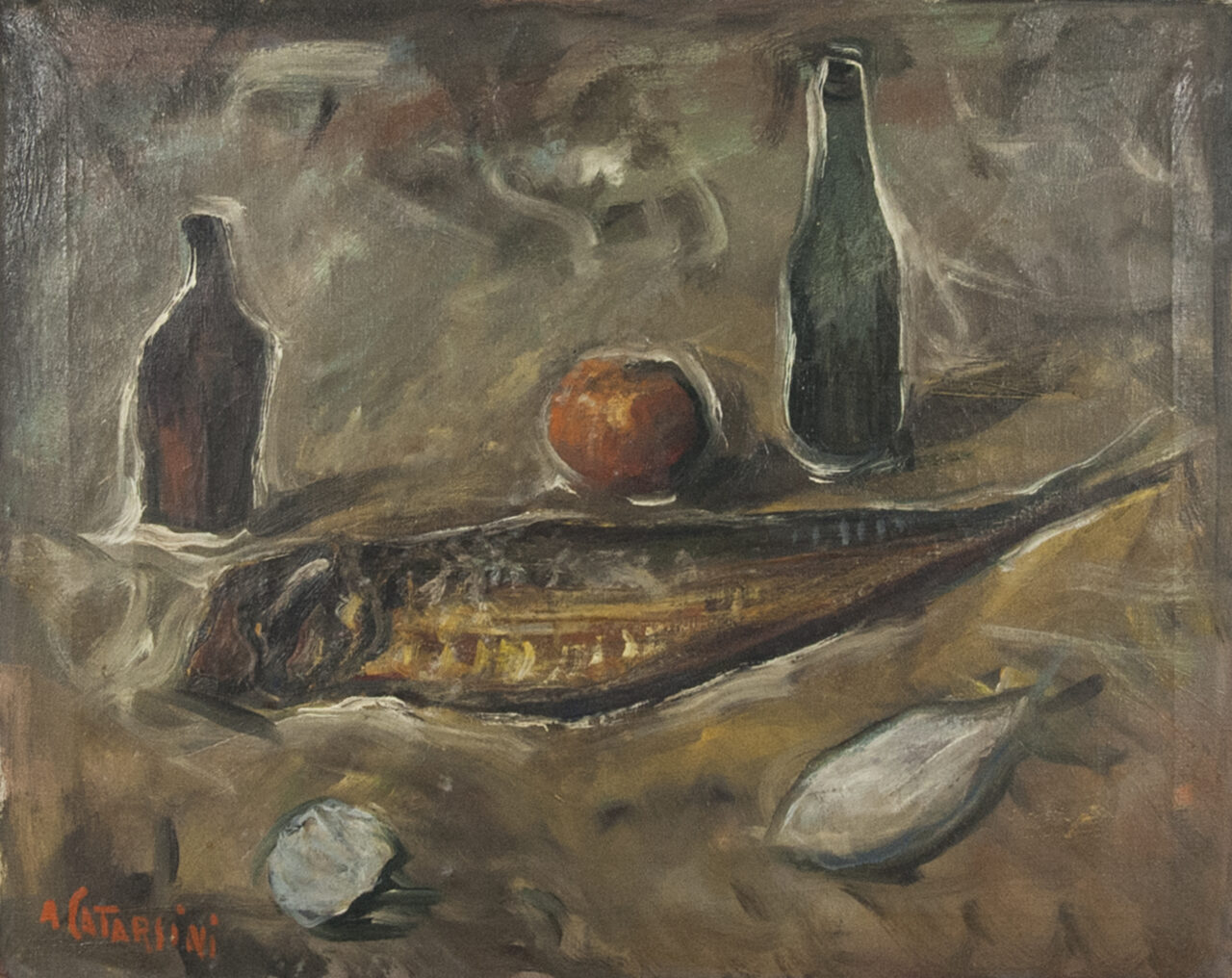
Natura morta con aringa
- Year
- 1950
- Medium
- tempera su tela
- Dimensions
- cm 44 x 54
- Number in the travelling exhibition
- 73
73. Natura morta con aringa, ca. 1950, tempera on canvas, 44 x 54 cm
This horizontal composition departs from traditional realism: the objects do not rest on a table, but seem to float in the void against a dark background, animated by free brushstrokes and defined by thin white lines that trace their contours. The undisputed protagonist is a herring, lying on its side in the center of the canvas. The fish occupies almost the entire horizontal space, its snout pointing to the left and its tail to the right. Lower down, in front of the herring, we find two bright, whitish shapes: on the left, the curved shape of a shell and on the right, the stylized profile of another small fish. Above the herring, the scene is populated with other elements that create a vertical rhythm. At the exact center, the round shape of an orange stands out. Two bottles stand out on either side: on the left, above the herring’s head, a short, squat brown bottle; on the right, above the tail, a greenish bottle, taller and more slender. The palette is warm and earthy, dominated by ochre and brown tones with yellowish accents. The use of white lines to separate the objects from the dark background gives the work a sense of lightness and mystery, typical of Catarsini’s metaphysical exploration.
INSIGHTS
Throughout his career, Catarsini cultivated a constant dedication to still life. Through the study of composition and form, he managed to capture the “silent essence” of everyday objects, elevating them to small poetic marvels. In these works, the ordinary becomes extraordinary thanks to a new and refined chromatic appearance.
Although in the 1950s, economic prosperity was bringing richer foods to Italian tables, in this painting the artist chooses to portray a herring. In Viareggio, this fish is popularly called “salacchino”: once a humble and savory food, it was the emblem of the poor table of port workers. By choosing this subject, Catarsini pays homage to the dignity of popular roots, transforming a symbol of deprivation into a protagonist.