Simbolismo meccanico composizione
- Year
- 1972
- Medium
- olio su tela
- Dimensions
- cm 70 x 50
- Number in the travelling exhibition
- 66
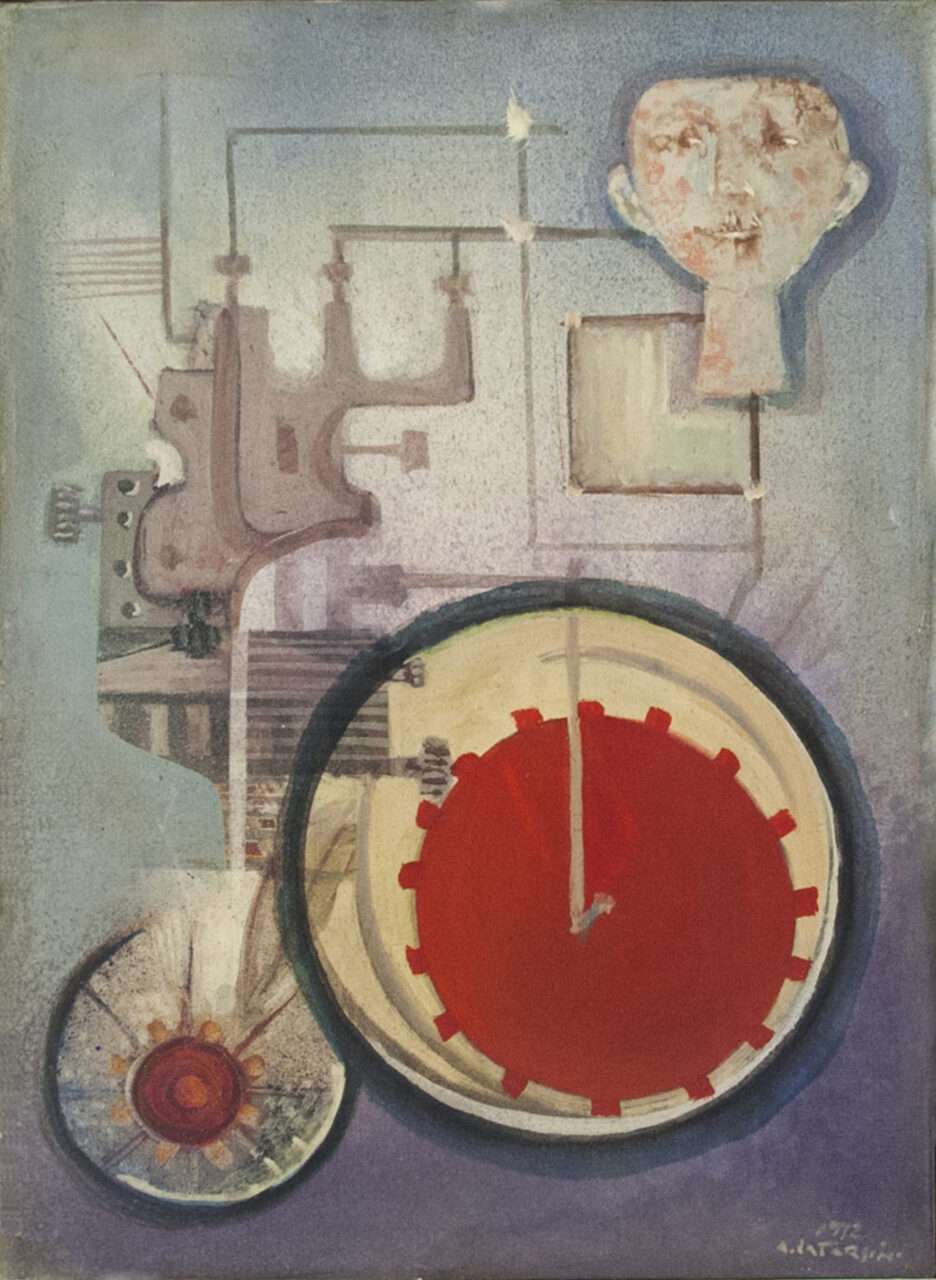
66. Simbolismo meccanico composition 1972, oil on canvas, cm 70 x 50
The painting unfolds vertically against a luminous background that fades from the brown of the base to the bright gray-blue of the upper part. The shapes are defined by sharp black edges, a hallmark of some of Catarsini’s works. Two cogwheels dominate the lower section: On the right, a large red wheel with a vertical line emanating from it, similar to the hand of a clock. On the left, a smaller wheel with a blurred central spoke. From these gears, a complex network of lines, tubes, and containers branches off, rising upward, occupying the center of the scene. The entire system of tubes converges toward the upper right corner, connecting directly to the head of a young man. His ivory-colored face has essential features: a nose, mouth, and eyes, prominent ears, and a flat crown. His expression is absent: neither happy nor sad, almost as if he were a product of the process itself or a component of a mechanism. Although painted in 1972, the work seems to anticipate the digital age. Through this “Mechanical Symbolism,” Catarsini shows us the alienation of the human being, now trapped and crushed by an invasive and dominant technology. For Catarsini, the inclusion of the human figure in Mechanical Symbolism is not an aesthetic choice, but a philosophical cry of alarm. If at first his “machines” were the absolute protagonists (symbols of reconstruction and progress), later man enters the scene, not as dominators, but as part of the mechanism.
INSIGHTS – The work is famous for its frequent exhibitions and for being among the Mechanical Symbolist works chosen by the students participating in the 22nd Catarsini Prize 2024 to create a tactile reinterpretation, such as the one exhibited in the Experiential Laboratory at Palazzo Orsetti in Lucca, a stop on the Path to the Places of Catarsini. Indeed, it exerts a magnetic appeal on today’s young people, who are surprised to recognize its disarming relevance. The students saw in Catarsini’s absent face and connecting tubes a perfect metaphor for their daily lives, made up of screens, algorithms, and digital connections. For them, the work is not a relic of the past, but a living language. Catarsini saw modern man as “trapped”: he no longer uses the machine; he is absorbed by it. While the world celebrated the technological boom, Catarsini sensed its dark side. The human figure serves to provide a tragic scale of measurement: without man, the machine would be merely an object; with man imprisoned within it, the machine becomes a nightmare. It is the story of a humanity that, trying to simplify its life with technology, ends up complicating it until it is tragically crushed.