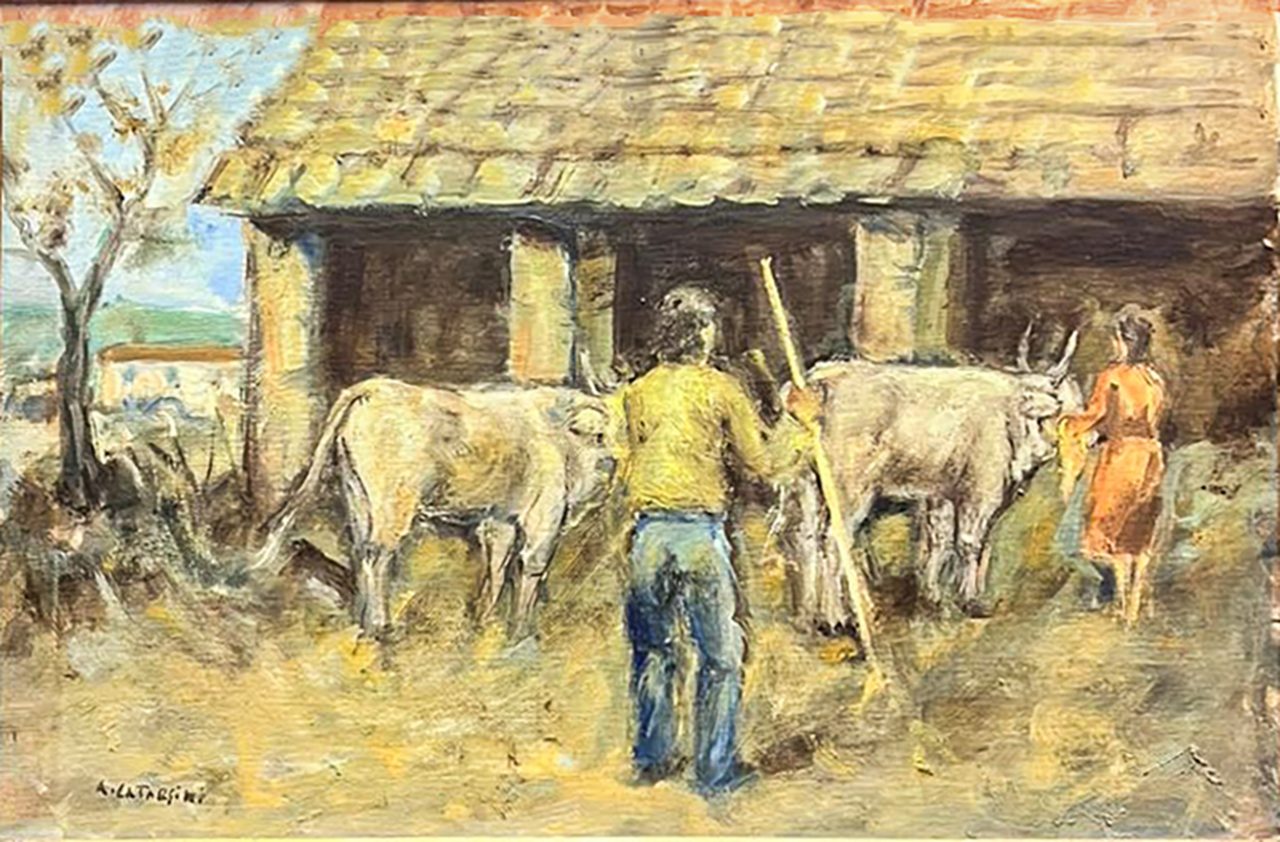
Verso la stalla
- Year
- senza data
- Medium
- olio su tela
- Dimensions
- 40x60
- Number in the travelling exhibition
- 63
63. Verso la stalla, undated, oil on canvas, cm 40 x 60
In this horizontal canvas, Catarsini captures a ritual moment of rural life: the animals’ return at sunset. The atmosphere is dominated by muted colors and a warm light that announces the end of the day. At the center of the painting, the white and ochre façade of the stable is punctuated by three openings divided by columns. Two cows, seen in profile to the right, are moving toward these entrances. Their yellowish-white coats match the color of the walls, creating a chromatic harmony between the animals and the architecture. In the foreground, a farmer leads the cattle: he wears blue trousers and a light-colored shirt, and holds a stick in his right hand. To his right, slightly ahead, a female figure in an ochre-colored dress appears to be touching the muzzle of one of the cows with a gentle gesture. The composition opens to the left side of the stable, revealing the expanse of countryside where the cows have been grazing, with a bare tree and, further away on a knoll, a yellow farmhouse surrounded by pale, dull green vegetation.
The entire work conveys a sense of calm weariness and serene return, typical of that “small world” that Catarsini always observed with profound respect.
INSIGHTS
Alfredo Catarsini had a deep love for the rural world, which he portrayed for decades with a gaze imbued with tenderness and respect. In the post-war period, the countryside still surrounded the artist’s home (now the headquarters of his Foundation), stretching between poplar groves and cultivated fields that faded towards the large pine forest and the sea, bordering Lido di Camaiore. With the economic boom of the 1960s, urbanization radically transformed that landscape, prompting the painter to gradually abandon this subject. Despite the changes to the territory, evidence of this connection remains alive in some key stops on the “I Luoghi di Catarsini” journey: At La Brilla (Massarosa), you can admire a splendid view of the local countryside, where the light of Versilia meets the land. At Palazzo Orsetti (Lucca), an evocative “marine pond” is preserved, a work that depicts the wild, humid environment typical of the Tuscan coast.
Although the city has taken over today, just a few kilometers away you can find the countryside that rises towards the hills and the Apuan Alps, the same horizon that Catarsini was able to capture in his paintings.