Catarsini and Forte dei Marmi
5 – CATARSINI AND FORTE DEI MARMI
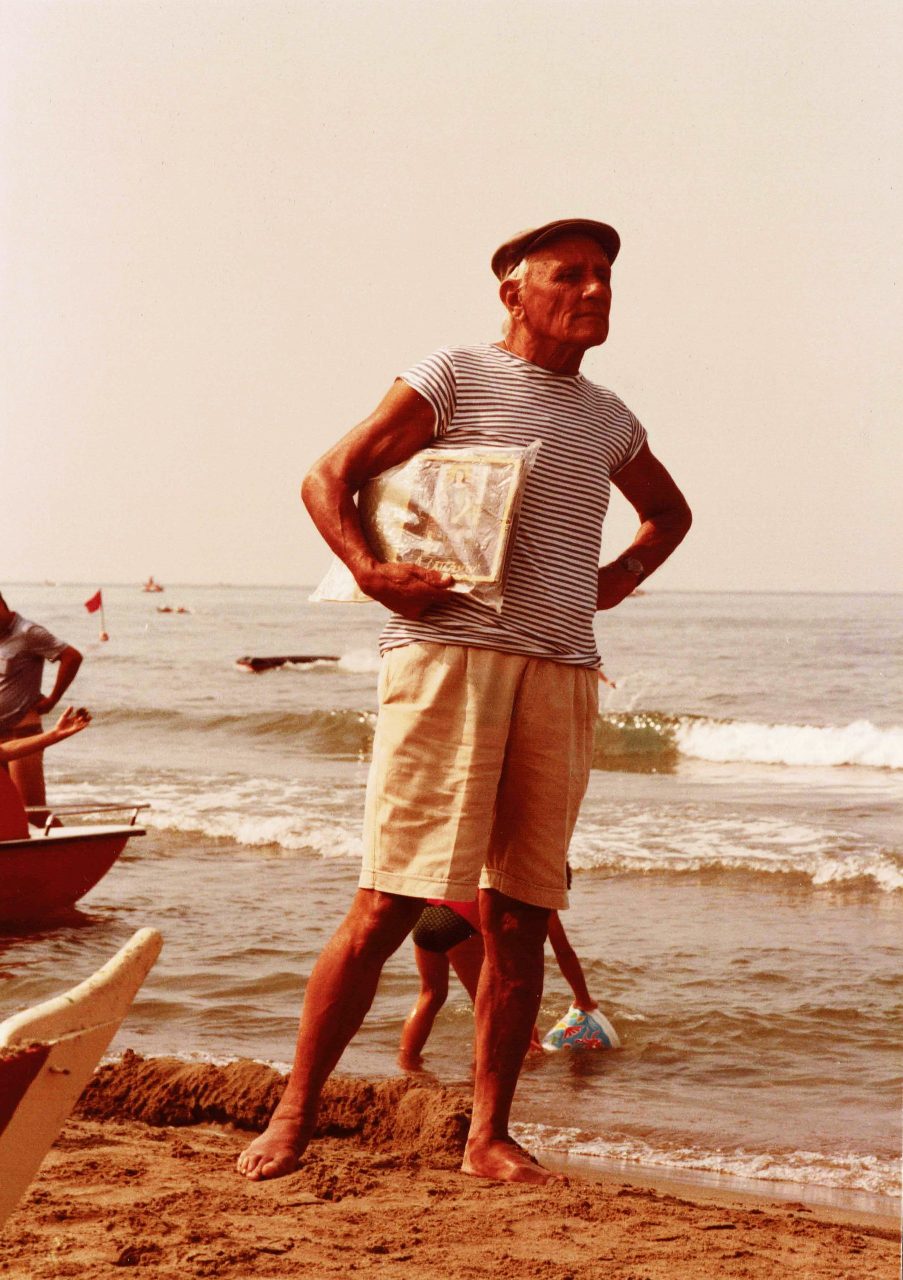
FROM THE PREMIO VIAREGGIO TO THE KURSAAL EXHIBITIONS, FROM THE QUARTO PLATANO TO LA CAPANNINA AND LA BUSSOLA: THE TWENTIETH-CENTURY SPLENDOURS OF THE VERSILIAN COAST, BY AND WITH CATARSINI
It has been said that Catarsini stood in his Viareggio and his Versilia as at the centre of a compass rose. And he knew it: he used to say, «but where would you have me go, when they all come here anyway!»
Versilia, for its setting and its extraordinary landscape, enchanted poets and painters. The artistic discovery of Versilia begins in the eighteenth century. Both through the Lucchese noble families and through the use of marble, abundant in the Apuan Alps, Viareggio and the hinterland of Pietrasanta offered landscapes as an alternative to city life. The age of sea bathing had not yet come, yet the sea and the Versilian countryside promised clear skies and a pleasant climate.
And painters painted a nature made of sand dunes, pine woods, low hills covered with olives, lakes.
At the end of the nineteenth century sea bathing became fashionable. So, besides Viareggio, the rest of the coast was discovered, and the newly born Forte dei Marmi. The Macchiaioli who frequented the Caffè Michelangelo in Florence preferred to paint the Livorno seascapes. But around Giacomo Puccini, who had come to live at Torre del Lago on Lake Massaciuccoli, a colony of post-Macchiaioli formed, well populated and electric, with Plinio Nomellini, Ferruccio Pagni and the Tommasi brothers. Thanks to these presences a large number of local painters then arose. Two Versilian painters drew near the group, taking part too in the «fine arts» of Lucca and Florence: Lorenzo Viani and Moses Levy, who came to stand alongside the colony of «outside» artists who regularly spent their holidays here — Carrà, Soffici, De Chirico and his brother Savinio. Both favoured by the friendship of Nomellini and Pagni, they made very different artistic choices: Viani was fired by German expressionism and, looking also to Goya, chose political commitment and social denunciation, making strongly polemical, marked paintings. Moses Levy, a Tunisian Jew trained with the French Fauves, devoted himself instead to bathing scenes and fashionable landscapes.
In the wake of Viani and Levy another painter arose, Alfredo Catarsini, who knew both deeply, and he painted from life, en plein air: boatyards, seascapes, landscapes. When the young Alfredo Catarsini began to paint there were, then, many reference points. Frequenting Paris, he came to know Futurism and the other avant-gardes. But then his creative intelligence led him to bring together other tendencies and other experiences.
Meanwhile a passion for the sea landscape was exploding across the whole of Versilia. So there gathered at the «Poveromo», between Forte dei Marmi and Marina di Massa, artists and intellectuals such as Giorgio De Chirico, Achille Funi, Giuseppe Viner, Arturo Dazzi, Carlo Carrà, Felice Carena, Ardengo Soffici, Domenico Rambelli, Arturo Tosi, Arturo Martini, Galileo Chini, Filadelfo Simi, Primo Conti, Oreste Paltrinieri and Amedeo Lori. All of them made works representative of Versilian nature.
But Catarsini, most attentive to changes and mutations, could not fail to notice that the very landscape of Versilia, with the twentieth century and the success of sea bathing, was progressively altering. In place of the sand dunes rose great hotels and fashionable clubs. Puccini himself tore along the avenues at the wheel of roaring cars. Nature was invaded, and Catarsini, with his restlessness for exploration, changed the subjects and the perspectives of his work. He began to explore what was taking hold in Europe: Cubism, abstraction. Futurism, besides Catarsini, kindled the interest of other painters, an impressive colony that gave much to the artistic life of the coast.
Catarsini, however, did not make himself the disciple of this or that manner. He invented, in a style of his own, new themes that answered to the invasion of technology — an invasion already signalled by certain philosophers — and to the existential harm that followed.
Alfredo Catarsini was an artist, painter and writer, truly courageous and avant-garde. He entered Futurist territory, brushed against Fascism and socialism, held exhibitions and won prizes from Venice to Cremona, to Rome, to Milan. And he never lost himself, living through a whole century of resounding experiments, now tragic, now exhilarating, firm in his underlying beliefs: Viareggio and Versilia, family, religion. For the explorer, in the end, always returns to his own Ithaca. And returns to it enriched.
The whole course of the fine retrospective «Esplorazioni» at Villa Bertelli in the summer of 2021, with a selection of works from 1939 to 1982, showed that in the panorama of twentieth-century Italian art Alfredo Catarsini was able to «break» with tradition and arrive at new and original expressive forms: from naturalism and post-Macchiaioli painting, with Catarsini one moved to an intimist painting of character and feeling, and then to non-painting too, to the new unease, mechanical and mathematical.
There it is: Catarsini was the protagonist of this passage from the figurative art of the 1930s to the abstract art of the 1950s.
Alfredo Catarsini is therefore a link between two epochs that coexisted in Versilia too throughout the twentieth century. With him one leaves the academic, museum nineteenth century and takes the new roads that lead to the art of today.
CATARSINI AND THE MONTHLY VERSILIA OGGI
During his years teaching at the Stagio Stagi Art Institute of Pietrasanta, Catarsini began his collaboration with the magazine Versilia Oggi.
A monthly news magazine founded by a group of Versilians from the municipalities of Pietrasanta, Seravezza, Forte dei Marmi and Stazzema in 1966 — on 3 November, to be exact.
Its distinguishing aim was the rediscovery of the common roots of Versilia, a land crossed by the river of the same name, of its speech and its local traditions. One of the founders is the professional journalist Giorgio Giannelli. The articles published had necessarily to deal with exclusively Versilian matters.
Many important names were among the magazine’s contributors. «Alfredo Catarsini was a punctual and precise author, besides his shrewdness in drawing his famous caricatures of Versilian faces; and although he was from Viareggio, we felt he was one of us, and there was a great friendship between us», so Giorgio Giannelli described him in a recent interview.
Alfredo Catarsini often went to meet Giannelli at his house in Querceta, the magazine’s office, to talk over the various subjects to be treated and to set out his ideas, often meeting the other contributors. A series of caricatures of figures from the Quarto Platano, which illustrated his articles published in the magazine, is on display at Villa Bertelli, where there is also a caricature of himself.
ENRICO PEA AND THE QUARTO PLATANO OF FORTE DEI MARMI
The Quarto Platano was a famous place of summer conviviality for artists, critics and writers from the 1920s to the 1950s. The custom of gathering on drowsy summer afternoons in the shade of the plane trees of the Caffè Roma did not die out after the war, and it made the Quarto Platano the best-known cultural meeting place of those years, kept alive by Pea as long as his strength and his enthusiasm allowed. The Caffè Roma is still in the very central Piazza Garibaldi, and it was the symbolic meeting point for the intellectuals and leading figures of twentieth-century Italian culture: the elite of Italian literature and art gathered under the fourth plane tree of the row that ran from Via Mazzini towards Piazza Garibaldi. Today a plaque at the café’s entrance remains in memory of those meetings. Here met Pea, De Grada, Soffici, Carrà, Papini, Campigli, Montale, De Chirico, Savinio, Maccari, Ungaretti, Dazzi, Sacchetti, Moravia, Bigongiari, Bacchelli, Prezzolini, Bertoli, Repaci, the publisher Vallecchi and the art historian Roberto Longhi.
From Viareggio, on his beloved bicycle, Catarsini too often came, and he portrayed those friends and wrote about them in the monthly Versilia Oggi.
Catarsini writes of Pea in Pea e i giovani, an article published in December 1968 in Versilia oggi
«[…] he soon became a balanced writer, a shrewd storyteller, so much so that his lyrical realism has
steadily won approval from official criticism too. […] With a clarity of vision
answering to the demands of the true narrator who takes hold of reality, the man Pea came to
give his characters a cleanness that might be called Franciscan. This astonishing
cleanness is present in every work of his, born and grown out of a tangle of notes, examining a single
passage again and again so that everything should answer to what he had in mind.»
And he writes of Arturo Dazzi in Parlando d’arte con Arturo Dazzi, published in April 1972, again in Versilia oggi
«His views were of course clear in matters of art, founded above all on a visual experience
gained through the conception of numerous monumental works. His speech,
simple and concise, with his thought free of prejudice, which seemed to derive from a kind of
Kantian enlightenment, truly drew my admiration. I seem to see him now, with a sort of
cap on his head, more or less like the ice bag that is still put
on the heads of the sick. His working clothes were those of a strong, brave
Apuan quarryman: big black goggles to protect his eyes from the dazzling white of marble
in the sun, a faded scarf wound round his neck, a pair of canvas trousers fastened below
the navel, a shirt with rolled-up sleeves, and a pair of heavy shoes pulled on in haste.»
LEONIDA REPACI AND THE VIAREGGIO-REPACI LITERARY PRIZE
After the «Bagutta», devised by Orio Vergani in 1926 in a Milanese trattoria, the «Viareggio» was born in Versilia in 1929 on the beach and «under a beach umbrella», on the initiative of three friends: Leonida Rèpaci, Carlo Salsa and Alberto Colantuoni. After the vicissitudes of the Fascist period, from the post-war years until his death Repaci held its presidency, and today it bears his name: Premio letterario Viareggio-Repaci. He was a close friend and admirer of Catarsini, with whom he always kept up a steady acquaintance.
Viareggio was chosen because «we founders meant to repay that lovely beach for the love it had been able to kindle deep within us, ever since we had joined its name to Shelley’s — the memory of a thud of undertow at the crackling of the pyre by which a Poet returned, an immortal god, to the pure spaces from which he had come down to carve the statue of Prometheus, freed at last from the powers and the presences of Evil» (Rèpaci). If its birth «came about suddenly, as Venus was born from the foam of the sea» (Enrico Pea in 1938,, winner that year ex aequo con La Maremmana), the founders’ particular artistic vocation showed itself from the 1930 edition onwards, which sealed the fame of Lorenzo Viani with Ritorno alla patria and of Anselmo Bucci with Il pittore volante; two painters who were also writers, very unlike one another but united by a strong polemical temper.
Among the other prizewinners: Umberto Saba, Aldo Palazzeschi, Elsa Morante, Carlo Emilio Gadda, Antonio Gramsci, Sibilla Aleramo, Italo Calvino, Natalia Ginzburg, Pier Paolo Pasolini, Salvatore Quasimodo, Alberto Moravia, Goffredo Parise, Giorgio Manganelli, Serena Vitale, Sandro Veronesi, Alda Merini, Mario Luzi and Maria Bellonci (Lucrezia Borgia in 1939), future founder of the «Strega» Prize.
And among the jurors: Luigi Pirandello, Concetto Marchesi, Roberto Longhi, Francesco Flora, Luigi Russo, Massimo Bontempelli, Antonio Baldini, Alfredo Schiaffini, Giovanni Macchia, Maria Luisa Astaldi, Anna Banti, Giuseppe Ungaretti, Eugenio Montale, Guido Piovene, Franco Antonicelli, Giacomo Debenedetti, Natalia Ginzburg, Natalino Sapegno, Carlo Salinari, Ezio Raimondi, Roman Vlad, Manlio Cancogni, Cesare Garboli, Adriano Prosperi and Pier Vincenzo Mengaldo.
The Prize is for works written in Italian by authors of Italian nationality, published between 1 June of the previous year and 31 May of the current one. The winners are proclaimed at Viareggio during the summer season. It is divided into Fiction, Poetry and Non-fiction.