The Foundation’s people
Founders
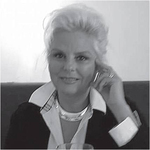
Elena A.R. Martinelli
Elena Anna Rita Martinelli is Alfredo Catarsini’s granddaughter. A graduate of Milan, she is an associate professor at the University of Florence. Since the 1970s she has worked on Catarsini exhibitions and catalogues and has promoted cultural initiatives for the study of the Maestro’s work. Asked in 2002 by the Mayor of Viareggio to reinstall the Alfredo Catarsini Atelier at the Civic Museums of Palazzo Paolina Bonaparte, she also reordered the Historical Archive and opened it to the public. With her mother Mity and her uncle Orazio Catarsini she chose the 30 works by the Maestro that the family gave to the City of Viareggio, and set up the annual Alfredo Catarsini prize. In memory of her mother, together with her husband Gianvittorio Serralunga, in June 2020 she founded the Fondazione “Alfredo Catarsini 1899”, which she now chairs.

Gianvittorio Serralunga
1937 – 2022
Gianvittorio Serralunga, married to Elena Martinelli, is a founding member of the Fondazione Alfredo Catarsini 1899. A graduate in economics and business of the Catholic University of Milan, he studied at Freiburg University in Germany. Product manager at Vandemberg in Milan, he went on to a distinguished management career in large Italian and foreign companies, holding the most senior posts. He is a lover of art, philosophy, literature and music.
Board of Directors
President
Elena A.R. Martinelli
Biography
Elena Anna Rita Martinelli is Alfredo Catarsini’s granddaughter. A graduate of Milan, she is an associate professor at the University of Florence. Since the 1970s she has worked on Catarsini exhibitions and catalogues and has promoted cultural initiatives for the study of the Maestro’s work. Asked in 2002 by the Mayor of Viareggio to reinstall the Alfredo Catarsini Atelier at the Civic Museums of Palazzo Paolina Bonaparte, she also reordered the Historical Archive and opened it to the public. With her mother Mity and her uncle Orazio Catarsini she chose the 30 works by the Maestro that the family gave to the City of Viareggio, and set up the annual Alfredo Catarsini prize. In memory of her mother, together with her husband Gianvittorio Serralunga, in June 2020 she founded the Fondazione “Alfredo Catarsini 1899”, which she now chairs.

Vice president
Monica Dal Pino
Biography
Monica Dal Pino, a law graduate of the University of Pisa, has practised as a lawyer since 2004. She advises and represents clients in and out of court in family law, civil liability, debt recovery, insolvency and commercial law, and succession law.

Board member
Federico Bini
Biography
Federico Bini, a graduate of the University of Pisa, is a journalist and writer. He writes for the daily Il Giornale and was a correspondent for “il Giornale.it” covering the Senate from Palazzo Madama. To this he added a short spell with the business desk of “Libero”.
As a writer he likes to tell the stories, anecdotes and lives of great figures of the past:
- E Montanelli fondò il Giornale. I 50 anni controcorrente di un quotidiano che ha scritto la storia d’Italia. Tutto nacque da «una rivolta e sfida», 2024 (Elsa Major edizioni)
- «Il Cagnone». Giancarlo testimone di due secoli. Dagli incontri con Brera all’amicizia con Montanelli, 2024 (Minerva)
- Grande Italia. Volume I. Vite, storie, aneddoti, vizi e virtù di alcuni grandi personaggi italiani incontrati e raccontati, 2023 (Edizioni We), 40 chapters
- All’ombra di Enrico Cuccia. Potere e capitalismo nel Novecento italiano, 2022 (Historica), with a preface by Giancarlo Mazzuca
- Una democrazia difficile. Partiti, leader e governi dell’Italia repubblicana, 2022 (Albatros)
- Un passo dietro Craxi, 2021 (Edizioni We)
- Roberto Gervaso. L’ultimo dandy, 2020, written with Giancarlo Mazzuca (L’Universale)
- Montanelli e il suo Giornale (2016-2020), 2020 (Albatros)
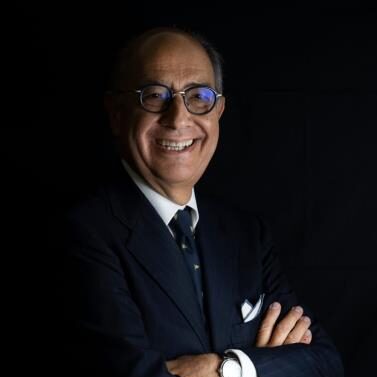
Supervisory Body
No photograph available Andrea Palestini
Scientific Committee
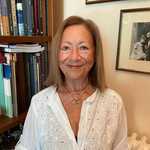
Chair
Gloria Chiarini
Biography
Gloria Chiarini, from Florence, a professional journalist since 1985, has been an editor and section head for the culture and entertainment pages of several newspapers in Florence, Brescia and Turin.
Active on the web since 1995 as a partner in the Mega Review portal, she wrote an online guide to Florence — awarded the Perseo prize at the 1996 edition of the Tuscan regional multimedia festival MediARTech — and other printed guides for Edizioni Medicea (the first, in 1998, translated into 5 languages).
She has worked on the editorial staff of periodicals in Milan, Rome and Florence and with the Florentine heritage authorities on structures, flow-chart design and the content of hypertext inserts. Since 2000 she has been editor of the monthly arts and culture magazine ‘Toscana Tascabile Eventi’, sold at newsstands across the region.
A graduate in art history under Mina Gregori, she has published in the journal ‘Paragone Arte’ (1975 and 1985) and in the proceedings for the fourth centenary of the Uffizi Gallery (1982), and has worked on exhibitions and catalogues of works by Titian and Raphael in the Florentine galleries (Palazzo Pitti, 1978 and 1983) and on Cardinal Leopoldo de’ Medici’s collection of drawings (Uffizi Department of Prints and Drawings, 1976).

Cristina Acidini
Biography
Cristina Acidini was born in Florence and took her degree in art history there, and by her own choice spent most of her working life in the city, in the service of the Ministry of Cultural Heritage. From 2000 to 2014 she was superintendent in Florence, first of the Opificio delle Pietre Dure and then of the Florentine museum authority, which took in twenty-seven state art museums including the Uffizi Gallery, the Accademia Gallery, and Palazzo Pitti with the Boboli Gardens. Since 2015 she has been president of the Accademia delle Arti del Disegno in Florence: the oldest academy of art in the world, founded in 1563 by Giorgio Vasari in honour of Michelangelo.
Since 2019 she has been president of the Fondazione Casa Buonarroti, which holds sculptures, documents and drawings by Michelangelo. She has promoted, planned and directed restoration campaigns, museum extensions and reorderings, exhibitions in Italy and abroad, studies and publications. Her writings, often tied to her professional work, include contributions on Botticelli, Michelangelo, the Medici, gardens and other Renaissance subjects, and two novels. Alongside her international experience and recognition, she takes an active part in Italian cultural life.

Luisa Berretti
Biography
An art historian with the Ministry of Culture since December 2017, Luisa Berretti is currently director of the National Museums of Lucca (the Villa Guinigi National Museum and the Palazzo Mansi National Museum) and of the National Museum of Medieval and Modern Art in Arezzo.
She took her degree in museology and the history of collecting in Florence (2005), specialised in modern art history in Bologna (2009), and gained her doctorate in Pisa (2019).
She has worked in Florence with various institutions (Fondazione Memofonte, Biblioteca Marucelliana, the Rodolfo Siviero House Museum, and the former Special Superintendency for the Florentine Museums) on art-historical research, the organisation of exhibitions and the cataloguing of cultural property. She held a fellowship at the Louvre in Paris, in the Département des Arts graphiques (2007).
Within the Ministry she served at the Palatine Gallery of Palazzo Pitti as a museum assistant (2010–2015), then as an official in Turin (2017–2022), becoming head of collections and deputy director of the castles of Agliè and Moncalieri, head of the development office, and deputy head of the Unesco office and the exhibitions office.
Since 2006 she has published scholarly work on Italian artistic heritage, chiefly from the sixteenth to the eighteenth century, and she is a recognised expert on drawings who also works with the Uffizi.
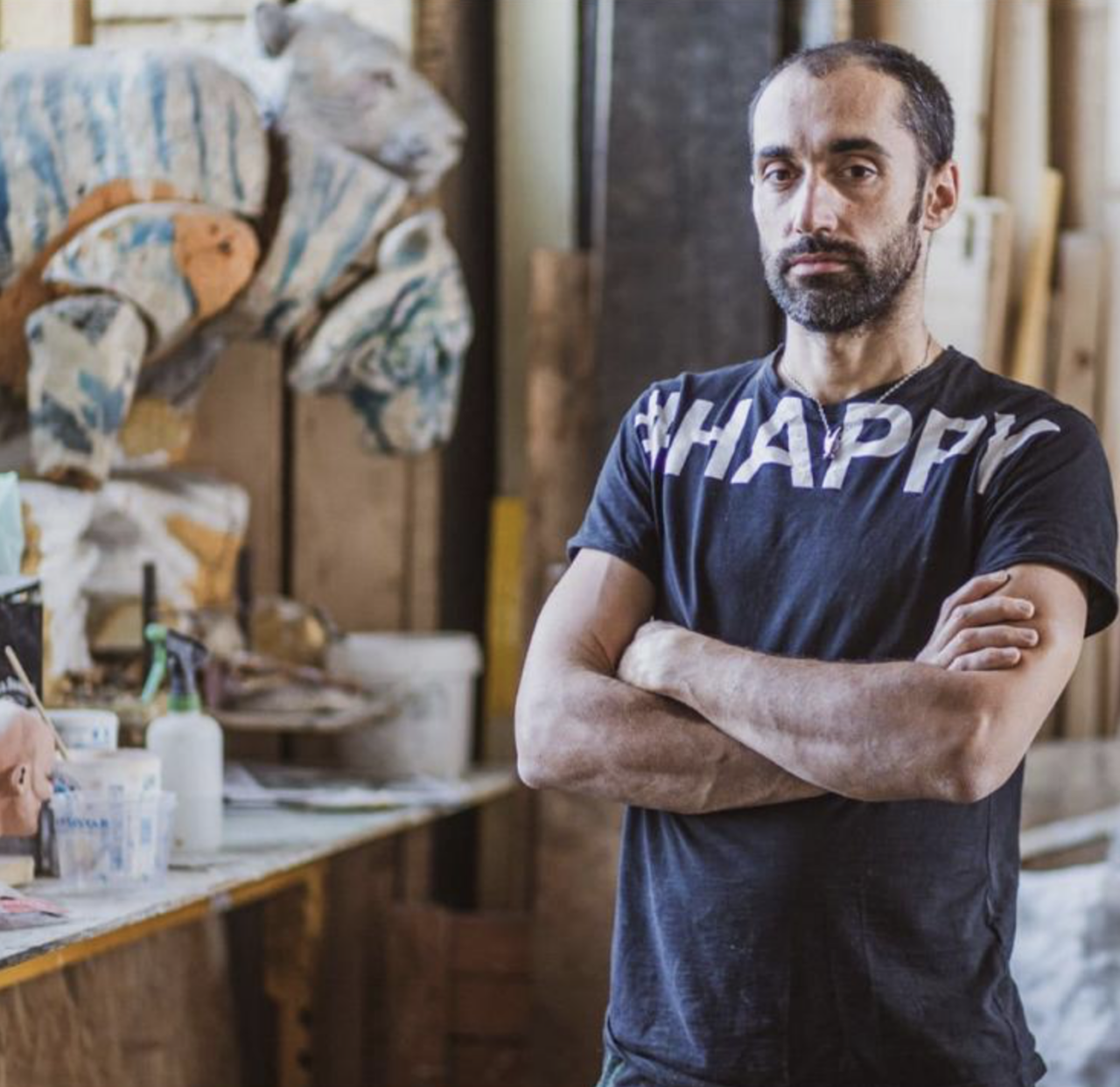
Luca Bertozzi
Biography
Luca Bertozzi was born in Pietrasanta on 8 May 1985. He studied at the ‘Stagio Stagi’ art institute, today a high school of art, where Alfredo Catarsini taught decoration and mosaic design and figure drawing until 1969. While still a student, in 2002 Bertozzi won the first edition of the Catarsini Prize, the regional prize for painting and graphic art reserved for students of art academies and art schools. His career has unfolded entirely within the Viareggio Carnival competition. Bertozzi has been building allegorical floats since 2007, starting in the category of single masks. From 2013 to 2017 he made group masquerades, taking first prize every time. His path took him into the first category in 2021, after three years in the second. In his first year among the big names he won the competition outright with the float “Sotto sotto”. At the heart of his work is modelling, the necessary strength in every branch of sculpture and set-building: models, enlargements, advertising mock-ups, mascots, large-scale pieces, fashion events, theatre sets and work for wedding planners.
Rajae Bezzaz
Biography
Rajae Bezzaz was born in Tripoli, Libya, and moved to Italy at the age of nine; in 2024 she was granted Italian citizenship.
A wide-ranging performer, her experience runs from television and radio presenting, where she offers original and stimulating material and draws viewers in with liveliness and charisma, to acting on stage and screen.
A reporter for Striscia la Notizia since 2015, where day by day she takes on current affairs, including awkward subjects, bringing to light stories that are often overlooked and encouraging constructive dialogue.
Her investigations all share one thread: the delicate balance between welcome and hospitality towards immigrants, the “intracultural” differences between the West and Islam, and giving a voice to those who have none — subjects that stir and divide public opinion, with no distinction of origin, culture or social condition.
Rajae is actively engaged in social causes, taking them up in person, working with non-profit organisations and using her voice to raise awareness of pressing issues such as social discrimination, the recognition of rights and violence against women.
Since September 2023 she has presented the programme Fantastico Week-end, live on Radio 101 every Saturday and Sunday morning from 7 to 10 am.
In 2021 she wrote the book “L’araba felice — La vita svelata di una musulmana poco ortodossa”, published by Cairo, in which she tells with irony and shrewdness her own view of being a woman on the border between two very distant worlds and cultures.
Over the years she has appeared on major stages, hosting events and conventions of international standing.
Always to the fore on social issues, she is an ambassador for the Fondazione Francesca Rava and for the association “Senza Veli Sulla Lingua”, working actively to raise awareness of human rights and gender equality. Her work has brought her many awards and honours over time.
Margherita Casazza
Biography
Margherita Casazza, a registered journalist. Organiser of events and art exhibitions. Vice president of the artistic and cultural association REALITYARTSTUDIO. Since 2008 she has been editor of Reality Magazine, a publication covering art, entertainment and culture in Tuscany.

Stefano Casciu
Biography
Stefano Casciu: his field of study and his bibliography centre on late-Medici Florence, on Florentine art between the seventeenth and eighteenth centuries (still life in particular), and on collecting and patronage among the old Italian dynasties. In 2006 he became director of the Medici villas of Poggio a Caiano, Petraia and Castello. From 2010 he served as a senior official of the Ministry of Cultural Heritage and Activities, as superintendent for the historical, artistic and ethno-anthropological heritage of Modena and Reggio Emilia, Mantua, Brescia and Cremona, and directed the Galleria Estense in Modena and the Ducal Palace of Sassuolo. In 2015 he was appointed director of the Tuscan museum authority and, representing the Ministry, a member of the boards of the autonomous museums of Florence (the Uffizi Galleries, the Bargello Museums and the Accademia Gallery). He sits on the board of the Fondazione Casa Buonarroti in Florence.
Paola Chini
Biography
Paola Chini, granddaughter of the artist Galileo Andrea Maria Chini (painter, decorator, graphic artist and ceramicist, a leading figure of Art Nouveau in Italy). After her art diploma she enrolled in the Faculty of Architecture. Over the years she has continued to bring her grandfather’s work to light, gathering new documents and promoting exhibitions on the artist’s different activities. She is now curator of the Galileo Chini Archive, a point of reference for scholars and for the wider public interested in the artist and in Art Nouveau.
Tiziano Lera
Biography
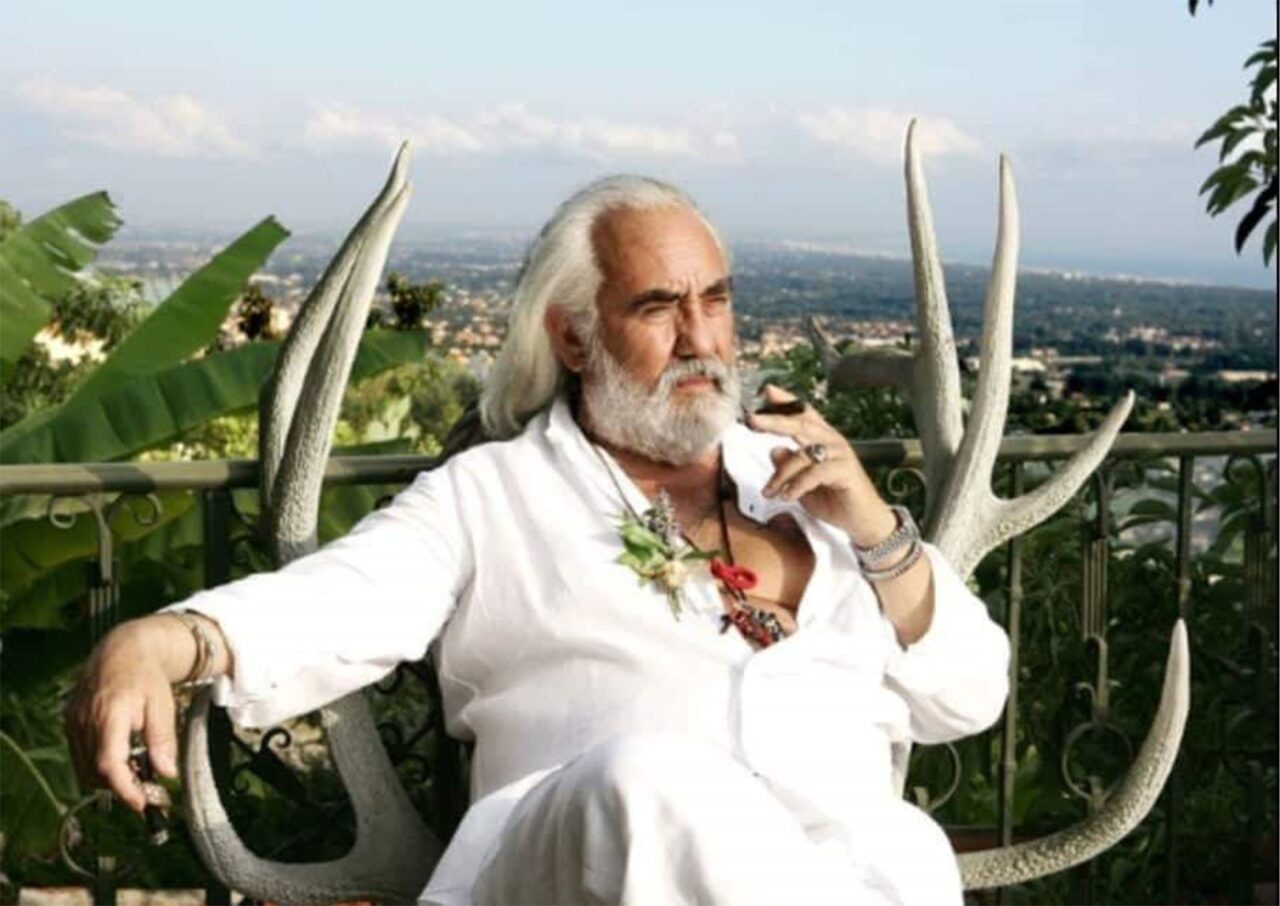
Tiziano Lera formed his sensibility and his culture through study and through turns in his life that built in him a way of being and of designing. He was born in Lucca, a city of art, where love for the family foundry, in business since the 1500s, contact from childhood with great artists such as Petroni, Dazzi and Barbieri, and the harmony — unique in the world — of the spaces of its historic palaces and churches, a true marriage of architecture, painting and sculpture, left an imprint on him that has never rusted or come undone. So did its gardens, the intimate and enclosed ones as much as the grander, open ones.
He is knowing: the intimacy and the perfection with which he chooses plants, and his collecting — camellias, azaleas, bamboo, irises, roses and so on — verge on obsession.
He spent his first twenty-five years in Viareggio, where he learned love of colour from Galileo Chini and, from the Art Nouveau villas, a new kind of garden: intimate like those of Lucca, but with a different “sacredness”, shaped also by the need to fend off, politely, the Libeccio and Tramontana winds, so that particularly delicate and frost-tender plants could be brought in — bougainvillea, citrus, palms, by now naturalised.
He attended the Politecnico in Milan, where he learned the complexity of the urban, and took his degree in town planning at the University of Venice, where he fell in love with the magic of water.
He is now in his final year at the University of Natural Sciences in Pisa.
He lives in Forte dei Marmi, where he has taken in the message of the great spaces of the villas of Roma Imperiale and of the Mediterranean scrub of the Dannunziana.
Through all this, through the studies he has done and those he is doing, he paints, sculpts and designs in search of spaces, in a continual balance between built architecture and the architecture of the environment, within which — according to size and geographical setting — he always creates secret places in sequence, where the visitor can gather naturally into meditation. That is the idea.
The aim of each of his works is to join everything naturally, by creating infrastructure set into the environment: soft, intelligent and modern. This can be achieved only through integrated design that respects history, nature, art, architecture, identity and poetry.
Adolfo Lippi
Biography
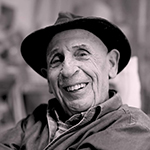
Adolfo Lippi, journalist, writer, and director for cinema, television and theatre. Trained in Tuscany on newspapers such as “Il Telegrafo” of Livorno and “Politica” of Florence, he moved to Rome while still young and wrote for “Il Mondo” and many other titles. For Rai he has signed hundreds of programmes. He presented the weekly geography programme “Atlante” and has directed documentaries, drama, concerts and festivals. He directed two feature films (“Ottobre rosa” and “I ragazzi di Via del Corso”, produced by Istituto Luce and Medusa Cinematografica respectively) and has written several plays. He became a board member of Ente Cinema (Cinecittà and Istituto Luce) and of the Centro Sperimentale di Cinematografia. He has served on the expert committees of the Ministry for Tourism and Entertainment from Minister Signorello to Minister Veltroni. He writes on local history, and has published “I viareggini”, “Racconto Giacomo Puccini”, “Quando la Versilia aveva la bussola” and “Luoghi Magici!”. He lectures on historical and artistic subjects.
Renzo Maggi
Biography
Renzo Maggi, painter and sculptor, was a pupil of Alfredo Catarsini. A teacher of sculpture and visiting professor at the Bullis School in Potomac, near Washington.
Elena A.R. Martinelli
Biography
Elena Anna Rita Martinelli is Alfredo Catarsini’s granddaughter. A graduate of Milan, she is an associate professor at the University of Florence. Since the 1970s she has worked on Catarsini exhibitions and catalogues and has promoted cultural initiatives for the study of the Maestro’s work. Asked in 2002 by the Mayor of Viareggio to reinstall the Alfredo Catarsini Atelier at the Civic Museums of Palazzo Paolina Bonaparte, she also reordered the Historical Archive and opened it to the public. With her mother Mity and her uncle Orazio Catarsini she chose the 30 works by the Maestro that the family gave to the City of Viareggio, and set up the annual Alfredo Catarsini prize. In memory of her mother, together with her husband Gianvittorio Serralunga, in June 2020 she founded the Fondazione “Alfredo Catarsini 1899”, which she now chairs.
Andrea Pucci
Biography
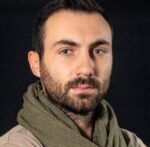
Andrea Pucci took his diploma at the Artemisia Gentileschi state high school of art in Carrara and his five-year specialist degree at the Academy of Fine Arts in Carrara, in the sculpture department. He works as a modeller with the leading float-builders of the Viareggio Carnival, and in the single-mask category has taken ten consecutive places on the podium in twelve years of entries, including 2 first prizes and a Critics’ Prize. In February 2020 he opened his first solo painting exhibition at Palazzo Paolina, “Storiche Prospettive, da Maria Luisa a Lorenzo Viani”. He currently teaches art at the Ugo Guidi school in Forte dei Marmi and the Michele Rosi school in Lido di Camaiore.
Mario Quadraroli
Biography
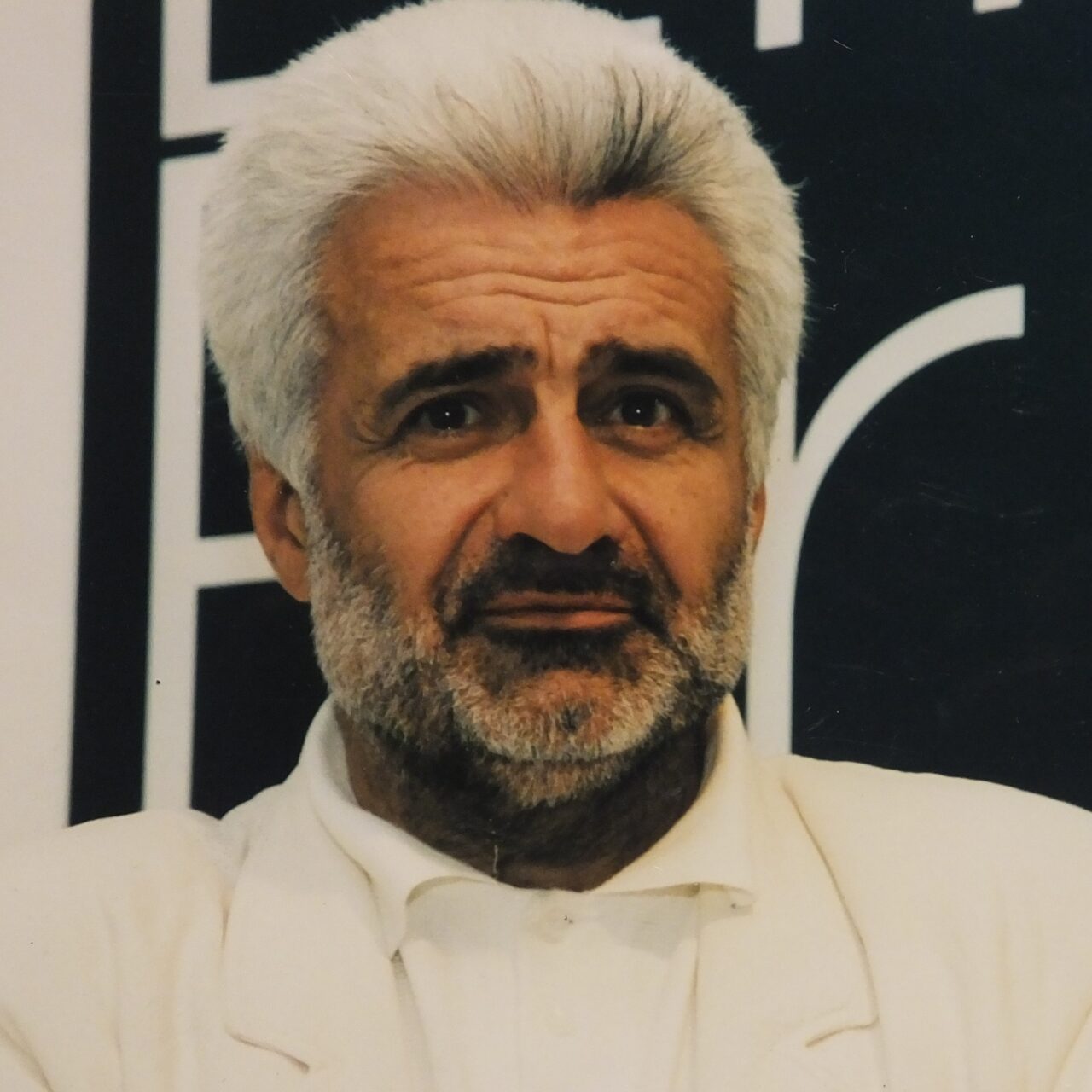
Mario Quadraroli, a graduate in architecture of the Politecnico di Milano. As head of the exhibition events service in the culture department of the Province of Milan he curated exhibitions at Spazio Oberdan, Spazio Guicciardini, Palazzo Isimbardi and Teatro Dal Verme. His focus is cultural heritage, environmental protection and the care of artistic and historical heritage. He organises large exhibition events, overseeing their design and image. A registered journalist since 1998, he coordinates the Naturarte project, art itineraries in the Lodi area, an event of the Province of Lodi that reached its twenty-second edition in 2020. In 2010 the City of Lodi gave him its Civic Award for services to culture. In 2013 he began working with the “Mario Sironi” Academy of Sassari and later with the Brera Academy and the Politecnico di Milano on projects in environmental sculpture, art and nature, art and the city. He is currently curator of the Province of Lodi’s Collection of Modern and Contemporary Art.

Walter Sandri
Biography
Walter Sandri, Touring Club Italiano consul for the province of Massa Carrara
Maria Santulli
Biography
Born in Bari on 10 June 1948, Maria Santulli spent her childhood and early youth in Venezuela, where her parents had moved and where she studied up to the Bachiller en ciencias. Back in Italy, she chose Tuscany for her university studies, graduating in biological sciences at the University of Pisa and then specialising in the science and technology of medicinal plants at the same university’s Faculty of Pharmacy.
After working as an analyst and researcher at the San Martino Hospital in Genoa, she settled in France for family reasons. There she gave herself wholeheartedly to social work, as an active volunteer in many sports and cultural associations, where she also served as treasurer and president.
Since 2012, the year of her return to Italy, she has carried on that voluntary work with the same commitment. For the Fondazione Catarsini she coordinated and promoted the first training course for volunteers working in the hands-on workshops, which she now heads. Her skills and her command of languages (she speaks Spanish, French and English fluently) make her presence on the Scientific Committee central both to recruiting and training volunteers and to building ties with the area.

Giovanni Sardisco
Biography
Giovanni Sardisco, who works as Giovanni da Monreale, was born in Monreale (Palermo) on 16 June 1980. After his diploma at the Mario D’Aleo art institute in 1999, he attended the sculpture department of the Academy of Fine Arts in Palermo. In 2002 he moved to Carrara, took his degree in sculpture at the Academy of Fine Arts and specialised in the arts of performance. After his studies he began working in Pietrasanta with well-known sculpture workshops, art foundries and local and foreign artists.
Since 2013 he has run a project of urban and social renewal through sculpture: he installs fibreglass works in cities in Italy and abroad, choosing run-down areas. Many of the figures, made life-size, are children or young people caught playing a video game or browsing on a smartphone, and are meant to prompt thought about how the young use new technology.
In 2014 he opened the “Officine Giovanni da Monreale”, where he still lives and works.
Teresa Sichetti
Biography
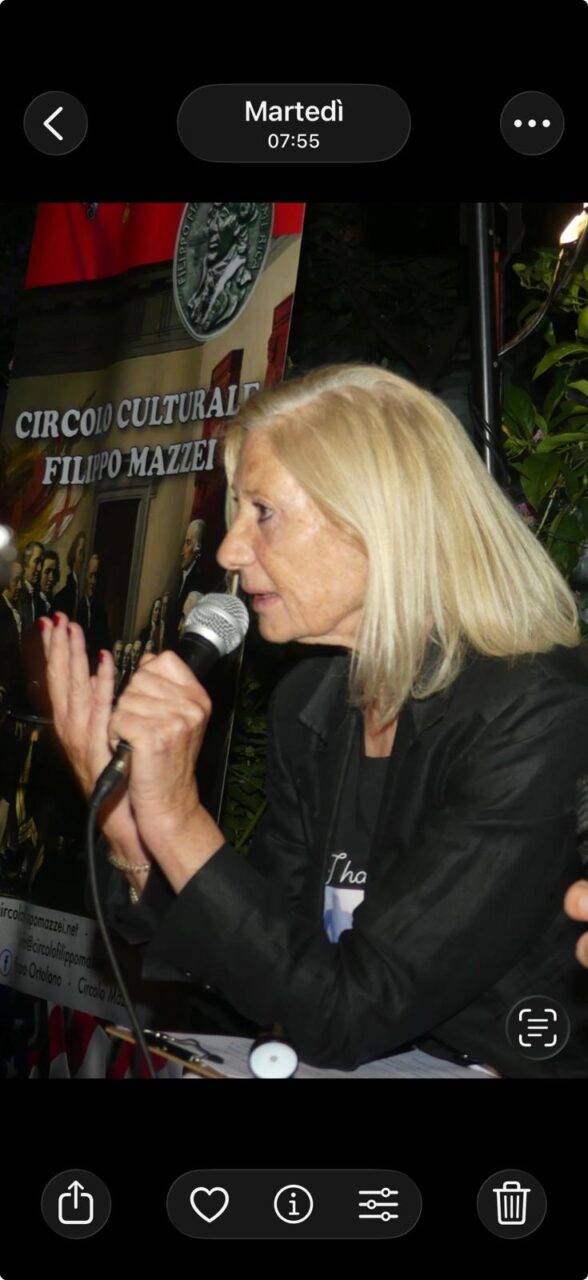
Teresa Sichetti. Born in Abruzzo, Tuscan by adoption.
A graduate in medicine and surgery. Specialist in dermatology and in spa medicine.
Vice president of the Filippo Mazzei cultural circle.
Head of Mazzei Art — Alla ricerca della felicità, the workshop of the Filippo Mazzei circle where good ideas become real.
A traveller, always in search of the different souls of places and people.
Ready for a crossing of dreams and plans.
Elena Torre
Biography
Elena Torre, journalist and writer, published her first novel 10° personale di Julie Valmont in 2006, followed the next year by Al largo di strane convinzioni. A prolific and versatile author, she moves with passion between theatre and literature, taking in the most varied genres, from the short story to the essay, from crime fiction to fairy tales and children’s stories. Her 2005 story Prima dell’alba was among the winners of the Racconti nella Rete prize and was published in the Newton & Compton anthology, and Gli indovinelli della Principessa Turandot, a children’s book, came out in 2006. In 2008 came Giorgio Gaber. L’ultimo sileno, an essay paying tribute to her own experience of the singer-songwriter. The following year she began publishing the trilogy devoted to the adventures of Commissioner Biagini — Erode e la psicopatia dell’allenamento, L’eroe and E3 — written with the writer Anna Marani. The same co-author joined her for Storie dei Cinque Elementi (Darwin Edizioni), a collection of children’s stories awarded the Un bosco per Kyoto prize at the Campidoglio in 2012. In 2015 she published the historical esoteric thriller Il segreto dei custodi della fede, and in 2017 its natural sequel Seguendo antiche rotte. She writes for the culture pages of the daily Il Tirreno.