Description of paintings in San Martino
7 – DESCRIPTION OF THE WORKS IN SAN MARTINO
Visit the site Catarsini fra di noi which holds the virtual tour of the frescoes in the churches of San Martino and of San Tommaso at Castagnori, made in the school years 2022–2023 by the students of the Giacomo Puccini lower secondary school at San Martino in Freddana (Pescaglia).
The virtual tour can be found under San Martino and Castagnori in the site’s menu.

THE CYCLE OF FRESCOES AT SAN MARTINO IN FREDDANA
In an interview given in 1991 the ninety-year-old artist recalls: «… The people of the village, when they learned I was a painter, decided to take advantage of my stay there and asked me whether I would beautify their church; they paid me with a sack of chestnut flour, a sack of fine white flour, oil, wine and a few coins … and I portrayed them all among the figures of the frescoes, and I put my son in as well…»
These are the years of the Second World War, during which many people from Viareggio left the coast to take refuge inland. So did Catarsini in 1943, taking shelter with his family in the small community of San Martino in Freddana. Despite the war — which in Versilia was particularly bloody in this period, sadly famous for massacres, round-ups, bereavement, danger and privation — the inhabitants did not let slip the chance to have him beautify their church, built between 1898 and 1904 in an eclectic style by the Lucchese architect Gaetano Orzali. So it was that Catarsini frescoed in the apse basin «The Immaculate Virgin between Saints Martin the Bishop and Paulinus» and two further, smaller frescoes on the side walls: «The meeting of Jesus with the Samaritan woman at the well» and «The Supper at Emmaus». The side walls are separated from the apse by an arch above the altar. The painter travelled many times to Florence, heedless of the considerable risks the journey involved, in order to buy the best raw materials. The church very soon became a place of pilgrimage for the local people and the evacuees, and Catarsini chose with care the people who would play his figures and portrayed them, catching their expressiveness to fix it in the story he meant to tell. And so the Madonna has the face of Renata the baker; Saint Martin is the post office clerk; the boy has the face of his son Orazio; and Saint Paulinus is a portrait of Catarsini himself.
The years between 1943 and 1945 are the most intense and productive period of Alfredo Catarsini’s work in the fresco painting of large-scale sacred subjects.
Catarsini handled the fresco technique following the old and demanding traditional methods, that is by transferring onto the still-damp plaster of the wall, by incision, the preparatory sketches drawn on paper (fresco cartoons). Some of those cartoons are on display in the Town Hall of Camaiore.
FRESCO OF THE APSE
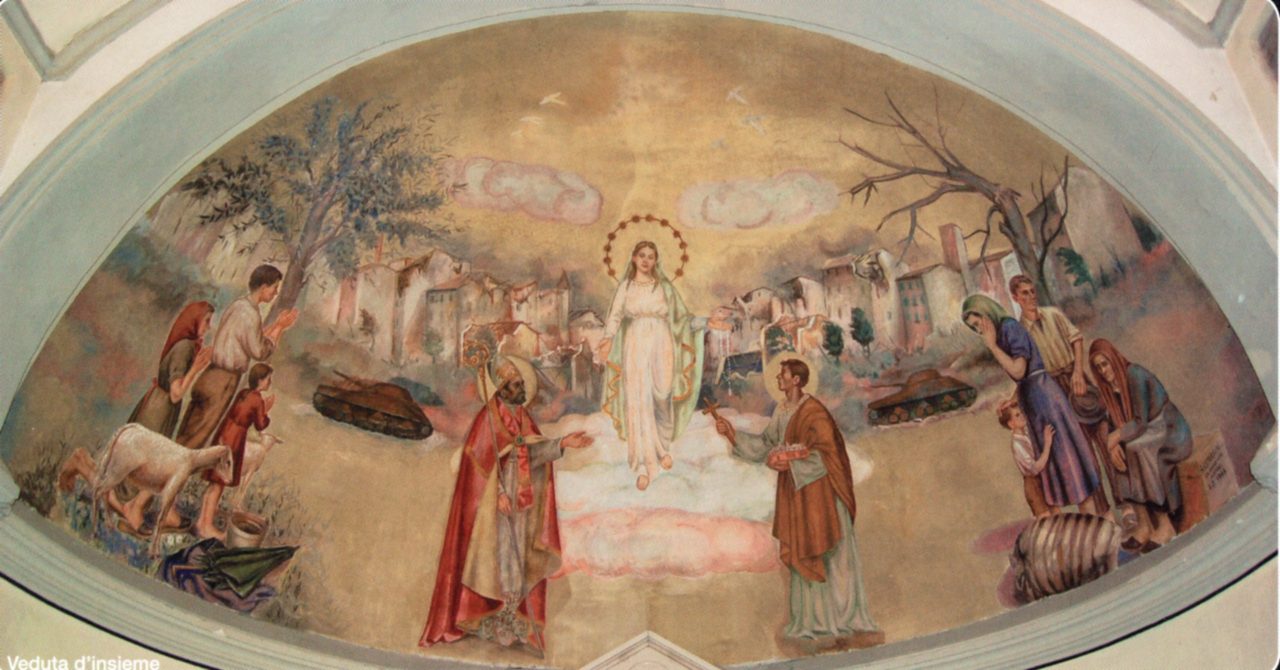
- L’Immacolata fra i santi Martino vescovo e Paolino, 1944, height 4 metres at the crown, width 10 metres

The Madonna, beautiful and hieratic — Catarsini painted her with the features of the most beautiful girl in the village — is at the centre of the fresco, her head crowned with a circle of golden stars, her fair hair barely covered by the wide, very pale green mantle edged with gold that reveals her simple pink dress, gathered at the waist by a belt with golden motifs; in her left hand she holds a long white rosary. She comes down from the clouds, calm and quiet, come to protect and console all those afflicted by the war. In the foreground, at her feet, are the figures in profile of Saint Martin the Bishop on our left and Saint Paulinus on our right.
Saint Martin wears a red chasuble, mitre and crosier and points to the Madonna; Saint Paulinus is dressed in a simple white tunic, with a mustard-coloured cloak over his shoulder; in his right hand he holds a crucifix turned towards the Madonna, and in his left the model of the city of Lucca, of which he is patron.
In the background a series of ruined, bombed buildings fills the whole apse from left to right; in front of the shattered houses are some brown tanks, and in the sky in the distance, bomber aircraft.
Behind the two saints, still in the foreground but at the sides of the fresco, are two groups of figures. On the right of the composition is a group of people without hope: an old, sad woman gazes lost towards the ground, a brown kerchief on her head — here Catarsini portrayed the village priest’s housekeeper; standing are a couple with a child: the woman looks at the ground and raises her hand to her face with an air of resigned grief, the child clinging to her skirt in search of comfort. The man’s gaze is far away, as if unable to see. The group is the image of despair and of the end of hope. Nature too shares this dismay: the tree behind them is dry and broken.
On the left the group is made up of a young boy, a girl standing and a young woman kneeling; near them a white sheep, symbol of innocence and of faith in God, and another, smaller, looking out towards the landscape. All hold their hands joined and turn their eyes to the Madonna; they have hope, and the tree behind them is green and thriving.
The colours Catarsini uses are pale and luminous: it is a fresco in pastel tones, signed on the seat where the grieving figure of the housekeeper sits: A. Catarsini da Viareggio dipinse A.D. 1944.
FRESCOES ON THE SIDE WALLS
The cycle of frescoes is completed by two works: cena di Emmaus on the right-hand wall and La samaritana al pozzo on the left-hand wall.
The scale sketches are on display in the Town Hall of Camaiore.
2. LA CENA DI EMMAUS, 1944, fresco, 1944, height 200 centimetres, width 150 centimetres.

In this vertical fresco Catarsini paints the famous episode told in the Gospel of Luke, in which two disciples are walking to a village called Emmaus after witnessing the opening of the tomb. The two, one a young man and one older, meet Jesus after the Resurrection but do not recognise him; they walk with him and talk over the incredible event they have witnessed. When evening comes they invite him to stay with them. And only when Jesus breaks the bread and blesses it do they recognise him.
Catarsini sets the event in a simple, bare interior. Facing us, the young disciple sits on a stool and leans on a plain table covered with a white cloth. He is dressed in a kind of habit, with a traveller’s flask of a fine blue tied at his belt. Slightly behind, the figure of Jesus stands out in profile before a large window open onto a landscape of hills in the palest colours; he wears a rose-coloured habit, is barefoot, almost luminous, his left hand resting on the table, before him a glass and a loaf cut in two, his right hand raised in blessing. On the left, a little further back, is the other disciple, the older one, his face expressing vivid surprise. Jesus is shown before a window, which becomes a symbol of the passing to the other life: shortly, as the scriptures say, his figure will vanish from the disciples’ sight. The window full of light, his barefoot and diaphanous figure, represent the moment of Jesus’s final farewell to his disciples.
3. LA SAMARITANA AL POZZO, fresco, 1944, height 200 centimetres, width 150 centimetres

In the left-hand fresco Catarsini tells of the meeting of Jesus with the Samaritan woman at the well. The space is almost entirely filled by the great stone well at the centre of the scene and by the two figures. Jesus, shown full length, has a young, serene face with a beard and long dark-blond hair; his robe is white and long, and he is partly wrapped in a mantle of a fine bright red; on his feet are open sandals of dark leather. The figure of the Samaritan woman bends her face towards the earthenware jar she is about to lower into the well to draw water. In the background a brick wall and some mountains that look bare and sunlit but in the palest tones, as the light in Galilee sometimes makes things appear. The symbolic meaning of this episode is not the request for plain water, but for the water of life, the spring of eternal life that Christ preaches and promises to all, even to non-Jews. The water Christ offers is also a symbol of the new law, of the new Good News.