Inland route and from Viareggio to Massarosa
10 – INLAND ROUTE THROUGH THE TOWN AND FROM VIAREGGIO TO MASSAROSA
FROM VILLA PAOLINA TO THE FLYOVER
This part of the Cammino crosses the heart of old Viareggio, where the squares and some of the town’s most significant monuments stand.
After stopping at Villa Paolina and visiting Alfredo Catarsini’s atelier, you take Via IV Novembre towards the Burlamacca canal and come to Piazza Giuseppe Garibaldi, known in Viareggio as the Square of Fears. The people of Viareggio renamed it so after the square received, in 1927, Domenico Rambelli’s monument, made with the decisive support of Lorenzo Viani to honour the fallen of the First World War. The large bronze sculptural group, expressionist in cut, is certainly atypical against the rhetoric of the various war memorials made in those years, and it was not understood by the townspeople, who found it decidedly ugly and nicknamed the square accordingly.
For his part, Catarsini always considered Viani his ideal master, and Viani called Catarsini the best painter of his generation. Even after the master’s death Catarsini stayed in touch with his widow, and from that period the archive of Palazzo Paolina today holds a correspondence and several writings on Viani’s poetics.
Crossing the square, you take Via Rosolino Pilo, following the canal inland and admiring the spectacle of the boatyards, the hulls under construction and the small fishing boats moored at the quay, with the light reverberating in the water.
Catarsini always loved the darsena and wrote about it on various occasions: «… in those days I too haunted the boatyards. I was not looking to sign on to anything; I simply explored them in every direction. I was a boy with a heart swollen with passion, and I felt an intense attraction to those vivid, luminous colours. It was a delight to see those colours in the evening hours catch fire and sink into the waters that mirrored them …»
On the other side of the canal, just before the iron bridge that leads to the Darsena, stands the Alberto Gianni Maritime Museum, which keeps relics and mementoes of the great history of Viareggio’s shipbuilders and sailors.
In front of the bridge is the Camera del Lavoro, a symbolic place of the town’s union struggles, which originally stood on the great square of the Old Market.
Just after the bridge, Piazza Manzoni opens on the left, where in the early years of the last century the sail-menders worked through the summer season, and the sailors, back from their voyages or waiting to sign on, would leave love notes in the hollows of one of the great plane trees that shaded the square. In Via Regia, almost facing Piazza Manzoni, stood the Town Hall, in what had been the old Casino Regio, which also housed Alfredo Catarsini’s studio until the bombings of the Second World War damaged the building, later demolished.
Returning along the canal you then take Via della Foce, admiring on the right the eighteenth-century Palazzo Fanucci-Bernardini Mansi, which flanks the canal, and you soon reach the Torre Matilde, an old defensive structure built in the sixteenth century by the Lucchese government to control the Republic of Lucca’s only access to the sea, and in time a symbol of Viareggio. Facing the tower opens what was once the market square, today Piazza Santa Maria, described thus by Catarsini in one of his stories:
“«The square of the Old Market, in the early 1900s, was a place of popular gatherings, and sometimes not peaceful ones. Various categories of striking workers came together there to hear the agitator-leaders of Viareggio’s trade unionism, among whom we recall the violinist Narciso Fontanini, Ovidio Canova, known as «il Presidentino», and Lorenzo Viani too. On those occasions the speakers climbed, one at a time, onto a small table placed outside the door of the Camera del Lavoro, and from that improvised platform spoke to the crowd gathered for the protest. The entrance to the Camera del Lavoro was on the south side of the old palace of the Commissioner of the ancient Vicariate of Viareggio, which stood near the Ancient Tower and housed an infant school. Above the doorpost there loomed an oval sign cut from sheet metal, on which were painted the bony faces of men with hollow eye sockets, by Viani.…Much of Viareggio’s history was lived in this old square of ours. On feast days the farmers from the hinterland, after hearing Mass, would meet there, discuss their affairs, buy seed, farm tools, onions for planting, firedogs for the hearth, fire shovels, grilled stoves, and a pair of stout ordinary shoes…»
Here, on 25 March each year, the great fair was held to celebrate the Santissima Annunziata, patroness of Viareggio.
Here, near the Tower and the Old Market Square, is a small square: Piazza Ragghianti, where Alfredo Catarsini’s birthplace stands; and a little further on we can visit the Sanctuary of the Santissima Annunziata, the first church of Viareggio, which keeps on its high altar a large painting by Catarsini of the Annunciation itself, a remaking of the great eighteenth-century Bolognese-school canvas that was kept there and destroyed during the Second World War. The painting is still much venerated by the people of Viareggio.
At this point, to leave Viareggio, you take the great railway flyover that begins on the east side of the square.
FROM THE FLYOVER TO MASSAROSA
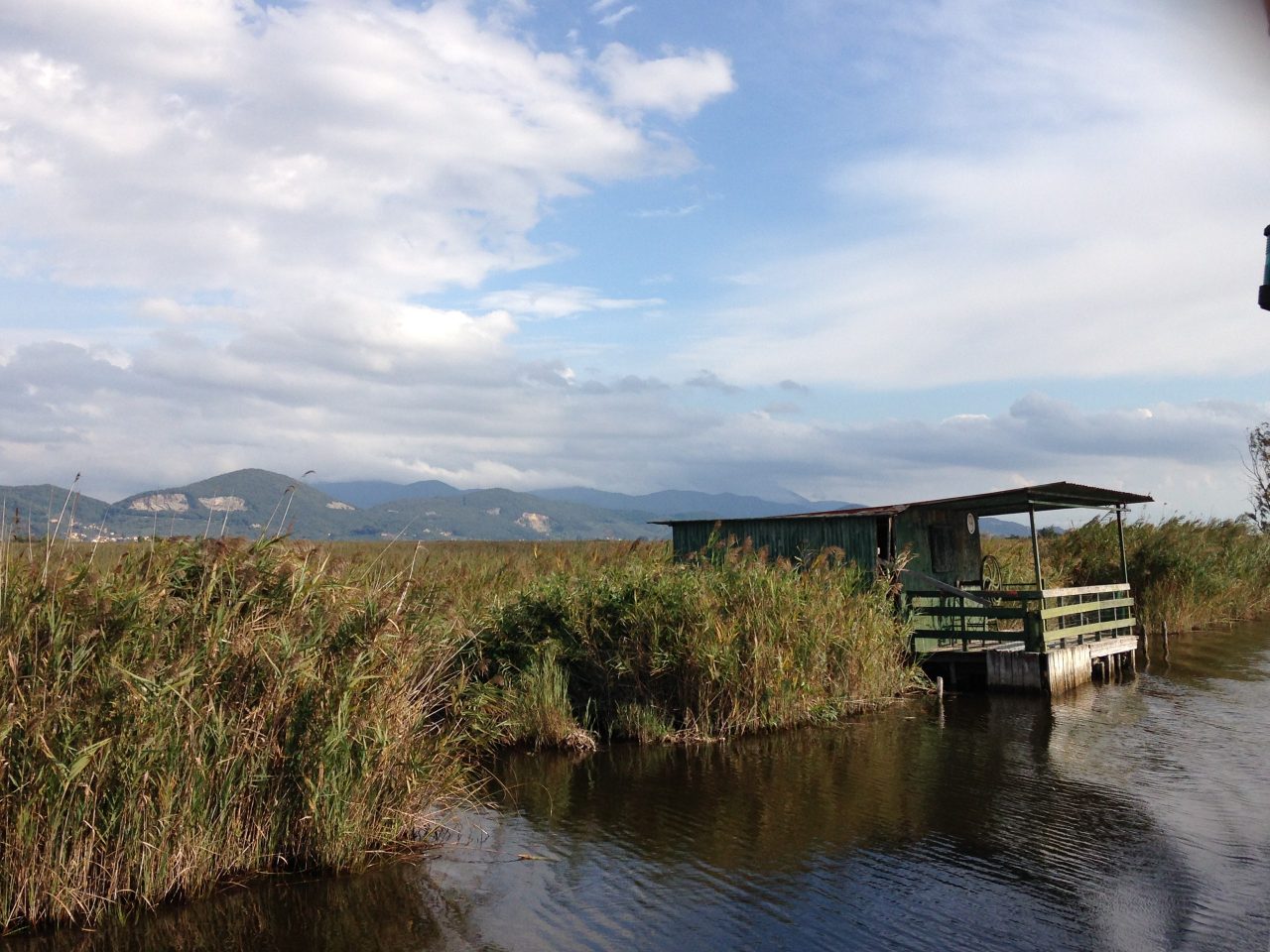
The old road that runs from Viareggio to Montramito follows the Burlamacca canal and then a series of canals and sluices that are an integral part of Lake Massaciuccoli.
On the Montramito road you can still see, on the right, the view Catarsini painted in the large picture Il grano della bonifica lucchese, on display in the Palazzo Ducale in Lucca, the starting and finishing point of the Cammino I luoghi di Catarsini.
This stretch of road retraces centuries of history, having always been an extraordinary point of passage between the sea and the inland roads, both along the north-south axis and towards the hinterland. The landscape of the first Ligurian and then Etruscan settlements, which for centuries traded at the site of San Rocchino, must have been strikingly beautiful, with the lake flowing into the sea and the hills and the Apuan Alps behind. In these places, even earlier, Neolithic hunters and fishermen certainly met.
Even today the precise line of the Roman roads is uncertain — whether there was a road along the sea or only the one at the foot of the hills, or both — but the lake was certainly reachable from the sea, and the first hills were in communication with the shore, whether across thin strips of land or the marsh canals, the famous Fosse Papiriane (drainage channels for the standing water); and certainly, for its strategic position, the hill of Montramito, later the site of medieval castles and seigneurial villas, was a fundamental point of connection between the sea and the interior. On maps of past centuries it is easy to make out a thin strip of land among the marsh waters which, from the site where the castle of Viareggio stood (later the Salov works), runs along the first part of the Burlamacca canal to the site of San Rocchino and then on towards Montramito. There, on the remains of the castle destroyed by the Lucchese, the villa of the Trenta family rose in the eighteenth century, the work of the architect Giacomo Sardini, which unfortunately has lost its architectural features over time.
We are moving into the southernmost part of Versilia. The Apuan Alps stand solemn against the sky, and where the mountain turns into the soft profile of the hills and goes down to plunge into the calm waters of Lake Massaciuccoli, we find the canals that lead to the lake and link Viareggio to Massarosa.
Here the landscape keeps much of its charm and its original character, with a structure articulated by several constituent elements, alternating woods with traditional tree rows, rotational farming systems, meadows and pasture, and, on the hills, extensive terraced olive groves.
Nowhere is the work of man in building that landscape more evident than here — a landscape now increasingly threatened by summer fires.
The historic roads of Viareggio and the Montramito road are lined with clusters of houses that have grown up in numbers between one village and the next, hiding from view even the period villas which instead hold landscape treasures: Italian gardens, or gardens mixing Italian and English, enriched with box, roses, oleanders, pines, bougainvillea, aromatic plants, hydrangeas and lemon trees along the terraces. Around the villas where in past centuries the Lucchese gentry, without going too far from the sea, protected themselves from mosquitoes and summer heat, and around the villages that look like eyes in the regular, ordered green of the olive groves, speculation has crowded houses which, by their presence, break a balance as delicate as it is elegant.