Inland route from Massarosa to Lucca
10 – ROUTE FROM MASSAROSA TO LUCCA
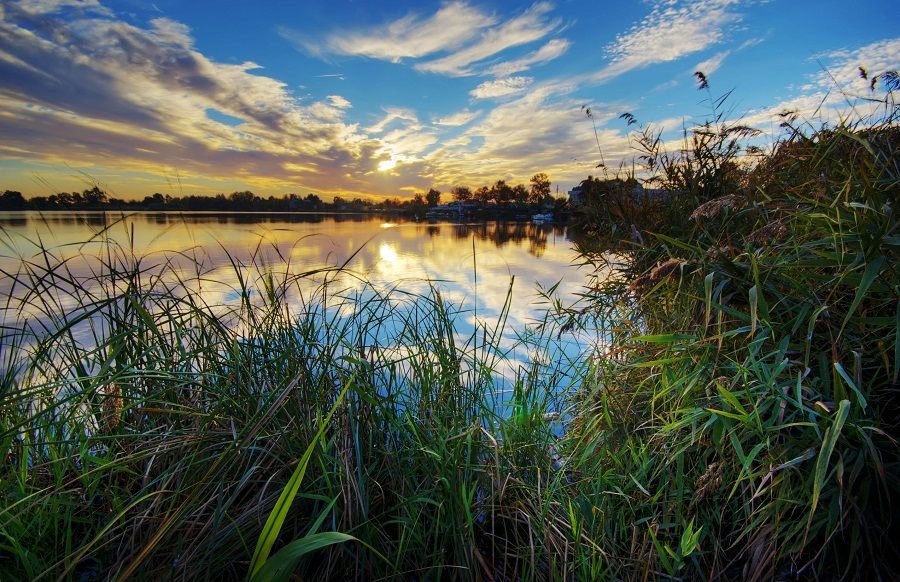
The road that passes in front of La Brilla leads to the old harbour of Massaciuccoli, where the LIPU Oasis now stands and where a path sets out along the lake to the hides for watching the wildlife that lives on the lake and stops there during migration. The path is full of charm, above all at sunset and in the early hours of the morning, when nature wakes. The area is also of great interest to nature photographers — and to poets. At the Oasis they also hire out canoes and small boats for exploring the lake from the water.
The village of Massaciuccoli looks out over the lake. Already inhabited in the second century AD, it keeps the remains of a Roman villa of the Venulei family and the baths, with mosaics restored in the last years of the twentieth century, along with an archaeological museum, on a site that is part of the San Rossore–Massaciuccoli nature park. There is a beautiful natural oasis open to visitors, with walkways and hides over the lake. Public interest in the Roman antiquities dates back to 1819, at the wish of Maria Luisa di Borbone. After 2000 the municipality of Massarosa intervened with the new museum pavilion.
Leaving the small village of Massaciuccoli, which runs along the lake as far as the boundary with Pisa (Via per Massaciuccoli), you leave the flat ground and carry on among hills.
The road climbs, and from the Pieve di San Lorenzo, in the upper part of the village, you can admire a superb view over the lake and the marsh, and out to the sea. Built in the ninth century, it was originally a small oratory, later enlarged like the other parish churches of Versilia in the Romanesque period. Since the end of the 1700s the Pieve has come under the Diocese of Lucca.
At the top, towards Lucca, which we glimpse in the distance, we meet various buildings among woods and olive groves, and the hamlet of Balbano.
Balbano lies on flat ground and is mentioned as early as the tenth century as a fortified settlement. In the twelfth century it was a fief of the noble Balbani family. Here we find the Church of San Donato at Balbano, already recorded before the year 1000. It once belonged to the territory of Massaciuccoli. Later it became a Pieve, and so acquired a baptismal font, in 1642. Since 1789 the church has been part of the Diocese of Lucca.
NOZZANO
The village, with its castle at the summit, stands on a rocky rise. The historical record goes back to the ninth century. It was fortified by the Lucchese to defend the territory from Pisan attacks, together with the fortification of Ripafratta, still clearly visible today with its watchtowers. The castle of Nozzano has crenellated walls with a gateway, destroyed several times by Pisan troops. After 1500, before becoming a hamlet of Lucca, Nozzano also grew important in civil terms, with a podestà and an independent commissioner for the administration of the territory between the Serchio and the Val Freddana. In the first two decades of the nineteenth century, important hydraulic works were carried out by the architect Lorenzo Nottolini to protect the area from the flooding of the river Serchio.
You follow the embankment of the river Serchio until you rejoin the road that comes from Monte Quiesa and goes to Lucca, the last stage of our Cammino.