News about Massarosa
4 – NEWS ABOUT MASSAROSA
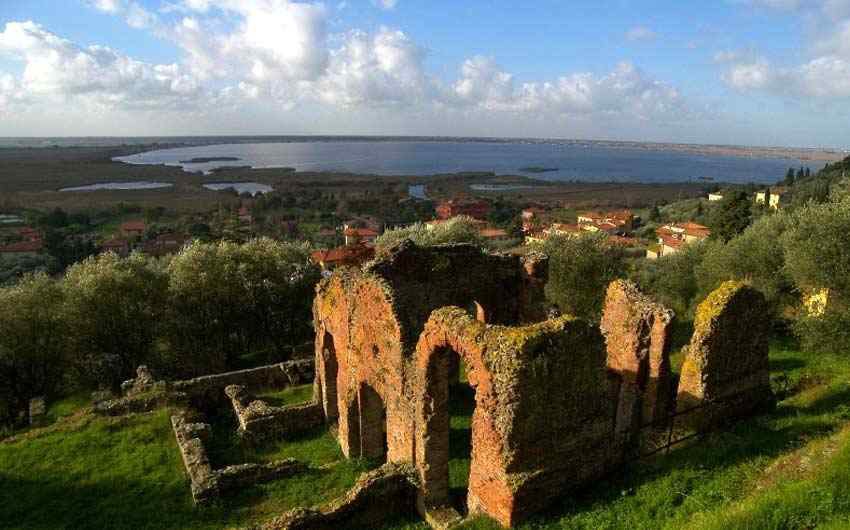
he territory that makes up today’s Municipality of Massarosa lies in Versilia, in northern Tuscany. Of these places Raffaello Bertoli writes: «Geographically, Versilia is a strip of land set between two lakes, the western slope of the Apuan Alps and the Tyrrhenian Sea. To the north, Lake Porta, and to the south Lake Massaciuccoli.»
Massarosa covers 69.25 square kilometres, has about 20,000 inhabitants in all and is divided into sixteen hamlets between hill and plain. It lies in a pleasant position at the edge of the coastal plain, eight metres above sea level and seven kilometres from Viareggio. This hill country is marked by the continuous weave of farming settlements, generally modest in size, which here form the centre of gravity of the human and territorial structure.
The Municipality of Massarosa is very large. Coming from Viareggio, to the left of the spur of Montramito — an ancient sea landing, today jutting from the mainland kilometres from the coast — the hillsides take on a gentler slope and give more breathing space to the plain and to the inhabitants of the panoramic hamlets of Stiava, Bargecchia, Corsanico and Mommio.
To the right, along the route we are about to take, you can see the hill hamlets at various heights: Pieve a Elici, Gualdo, Montigiano. This hill country is marked by the continuous weave of farming settlements, generally modest in size, which here form the centre of gravity of the human and territorial structure.
The present name, Massarosa, suggests a medieval settlement of Germanic derivation. The term «Massa Grausi», the old name of Massarosa, comes from joining the word massa, a large agricultural property, with the Germanic personal name «Grauso», owner of the fundus. The place name therefore recalls a Lombard agricultural holding, borne out by documents attesting the presence of a curtis at the end of the tenth century. Massarosa has a culture thousands of years old and keeps traces and remains of every civilisation. At Quiesa, for instance, there was an important Lombard-Frankish monastery, active from the ninth or tenth century until 1406.
The prehistoric phases are attested in the caves of Piano di Mommio and by finds from the flint quarries near Lake Massaciuccoli. From the late Iron Age to the Hellenistic Age, human presence took the form of an Etruscan settlement on the shores of Lake Massaciuccoli, serving the trade routes opened by the main centres of southern Etruria towards the nearby French coast. From the Roman period there remain a great many finds across the whole area between the lake shore and the first hill slopes, as well as two monumental complexes belonging to a villa ofotium, of which a small quarter, some service rooms and an imposing bath complex are visible today. To the Roman period are traced also the first land-reclamation works, whose traces remain in the place names, and the very use of the olive in this territory; still today, the presence and arrangement of old specimens seem to mark the ancient centuriation, when not earlier road lines.
The events between the end of the tenth and the beginning of the eleventh century, with the Versilian coast often dominated by conflicts, battles and raids, led to the building of a series of castles and to the redistribution of the territory among the local noble families. Most of the churches were built in the same period.
Towards the end of the fourteenth century the Republic of Lucca definitively secured its dominion over this portion, including Camaiore, leaving Pietrasanta to the Florentines. The territorial division was then confirmed in the arbitration of Pope Leo X in 1513. To these events can probably be traced the germ of the long-running dispute over Historic Versilia, or Versilia of the River, which lasts to our own day.
Seigneurial country houses, almost all raised between the sixteenth and the nineteenth century, mostly by wealthy Lucchese merchants, reflecting a shift in the city’s entrepreneurship. When the silk industry began to falter, investment in land was seen as a safe refuge for the substantial capital accumulated with proverbial thrift and foresight. From the seventeenth century, villas also began to be built as «houses of delight», or for reasons of prestige and display.
Among the twenty-seven worth admiring is today’s Villa Baldini at Compignano, famous for having hosted Paolina Bonaparte from 3 March to 5 June 1815, the «hundred days» of her gilded imprisonment.
The villas hand down today the centuries-old history of a community that lived «in the shadow» of the houses of intelligent and far-sighted entrepreneurs; in no case, indeed, were they built without the calculation of a satisfactory profit from the farming estate. On the hills, only the poorest and least workable land was left to woodland; on the plain, grain and vegetables were grown on the reclaimed land, and rice — which once held the record for quality among all the rice-growing regions of Italy — in the lowest part. The rest of the uncultivated flat land was marsh. Not a few families lived by fishing and hunting, once abundant in that very marsh.
To the Congress of Vienna of 1815 is owed the birth of the Duchy of Lucca, entrusted to the line of Maria Luisa di Borbone, Infanta of Spain, while in 1861 the Province of Lucca definitively took in the whole Versilian coast. At that date Massarosa was part of the Municipality of Viareggio; autonomy was then granted in the years from 1870 to 1875, leading to the final approval of the Municipal Statute.
In an extraordinary and inseparable union, the remains of Roman buildings in the Archaeological Area sit within the wider setting of the Migliarino–San Rossore–Massaciuccoli Nature Park. The area of Lake Massaciuccoli, which keeps its natural, wild beauty intact, is the largest wetland in Tuscany; among the best-known Italian sites of ornithological interest since the last century, when the maestro Giacomo Puccini took part in great coot and duck shoots, today the eastern shore of the lake, in the Massarosa district, is an ideal habitat for the survival of rare plant species as well as a great natural oasis for birdwatching, with more than 260 bird species recorded and protected. The Oasis, run by the LIPU under agreement with the Park Authority, can be visited along a system of raised walkways that cross the marsh and allow a close view of the lake’s most characteristic habitats.
THE GIORGINI DYNASTY IN THE HISTORY AND CULTURE OF MASSAROSA
Massarosa has historically lived through some singular events. For over eight centuries, and until the year 1799, it was the principal and administrative centre of the so-called Jura of the canons of the chapter of San Martino of Lucca, a kind of lordship, a remnant of the medieval feudal system. In substance a curtis that also took in the communities of Riceto, Gualdo and Fibbialla. That state of affairs ceased to exist with the arrival of the French in Lucca, who brought the canons to surrender. Even so, only by a Royal Decree of 1869 did Massarosa obtain the right to constitute itself an autonomous municipality, separating from Viareggio together with eleven other hamlets. Yet precisely in the span between the fall of the iura and the winning of administrative autonomy, Massarosa found itself at the centre of historical and cultural interests of national standing. The great credit for this goes to the Giorgini family, who had become related to Manzoni through the marriage of his daughter Vittoria. The Giorgini originated at Montignoso, but the grandfather, having moved to Lucca for political duties, chose Massarosa first as a country house, as was the custom among the Lucchese nobility, and then as a permanent and final residence. Here the Giorgini formed a small dynasty, united and close-knit, made up of the grandfather Niccolao (Montignoso 1773 – Massarosa 1854), who for over half a century served the state of Lucca, beginning with the Aristocratic Republic, through the French period and on into the Bourbon Duchy, of which he was Minister of the Interior and President of the Council, until Lucca’s incorporation into the Grand Duchy of Tuscany. His name is tied to the deep urban transformation of the city, to the building of the great aqueduct designed by Nottolini and to the founding of the Cassa di Risparmio di Lucca. Retired in 1848, he settled definitively at Massarosa. Married first to Giovanna Fortini, by whom he had an only son, Gaetano (Montignoso 1795 – Florence 1874). As a small child Gaetano was taken as a page by Elisa Bonaparte, in the time of her rule in Lucca. She then sent him to Paris to study at the polytechnic, where every year, a foreigner among the French, he came first in his class. As a hydraulic engineer he distinguished himself with various works, among which the bridge at Castiglione della Pescaia is still remembered, with an advanced system for separating fresh and sea water, which still bears his name. Called by the Grand Duke of Tuscany to hold various prestigious posts, he distinguished himself particularly, as Minister of Education, for the reform of the Tuscan universities. Married to Carolina of the Paleologo counts of Massa, he had four children: Giorgio, Giovan Battista, Carlo and Giovanna. Giovan Battista (Lucca 1818 – Montignoso 1908), a man of letters, a graduate in law and a university teacher, was also a political figure. While still a youth he showed an extraordinary poetic gift, drawing the admiration of many intellectuals of his time. Frequenting in Pisa, together with the poet Giuseppe Giusti and others, the cultural salon of Luisa Blondel, second wife of Massimo d’Azeglio, he met Vittoria Manzoni, whom he married at Nervi on 27 September 1846. The honeymoon was meant to take the couple to Florence, but having reached Livorno by boat they changed their minds and made for Massarosa, to the grandfather’s house, where they arrived entirely unexpected. To list Giovan Battista’s works and activities here would be hard, and there is no room for it. It is worth recalling only that, as a senator of the newborn Kingdom of Italy, he was named rapporteur of the law that conferred on Victor Emmanuel II the title of King of Italy. On that occasion he gave a speech that has remained memorable and is often still quoted. For further detail see the Dizionario Biografico degli Italiani — Treccani, vol. 55, where his forebears named above are also mentioned.
Vittoria Manzoni (Milan 1822 – Massarosa 1892), daughter of the celebrated writer and poet Alessandro, was certainly decisive for the cultural growth of Massarosa in the mid-nineteenth century, well seconded in this by her husband. The Giorgini family welcomed Vittoria so lovingly that she was able to have her younger sister Matilde, already in poor health, join her. The years after the marriage were politically turbulent and the Giorgini found themselves in the thick of it. Meanwhile the two Milanese sisters had long been waiting for their father to come and visit Massarosa, which he finally did at the end of the summer of 1852. Back in Milan, Manzoni never failed to praise the members of the Giorgini family, as young Matilde also did very often, in her letters and in her short diary.
A relative and namesake is Giovan Battista Giorgini (1898–1971), the great-grandson of that Carlo who had been a deputy in the Kingdom of Italy. Nicknamed Bista, he was the Florentine entrepreneur and able businessman to whom we owe the birth of Made in Italy fashion. At a time when the shows were held only in Paris, he grasped the potential of Italian fashion, then almost unknown in the world. Giovanni Battista Giorgini took the initiative of organising the «First Italian High Fashion Show» at his private residence in Florence, Villa Torrigiani. The show was held on 12 February 1951 in the presence of six important American buyers who, as he himself said in various interviews, had gone to Florence as a mere courtesy call. It was the springboard for the first fashion show, in July 1952, in the sumptuous Sala Bianca of Palazzo Pitti, again directed by Giorgini.
THE BOURBONS IN VERSILIA
Versilia and the Lucca area hold numerous sites of historical and cultural interest tied to the life and to the public and private affairs of the Bourbons in Tuscany. These sites — in particular publicly and privately owned villas that belonged to the family and its descendants — are mainly in the municipalities of Camaiore, Massarosa and Viareggio. Among the best known villas are Villa Borbone at Viareggio, Villa Le Pianore at Capezzano Pianore, Villa La Vallina in the municipality of Camaiore on the road to Viareggio, and Villa Corona di Conca di Sopra, which Maria Luisa di Borbone bought as a wedding gift for her son Carlo Lodovico on his marriage to Maria Teresa of Savoy. There are also La Certosa, the Ravera and Picchiani estates — home of H.R.H. Alicia di Borbone, Infanta of Spain — at Bargecchia, and Villa Toscano, again in the municipality of Massarosa. Then there are various farmsteads and holdings once part of the Bourbon properties, today given over to farming or of natural interest.
The presence of the Bourbon family in Versilia. The Congress of Vienna in 1815, intending to maintain the autonomy of the State of Lucca after the fall of Napoleon and therefore of his sister Elisa Bonaparte, Princess of Lucca and Piombino, decided to turn it into a Duchy, entrusting it in 1815 to Duke Carlo Lodovico di Borbone who, being only sixteen, appointed his mother regent: Maria Luisa di Borbone, Infanta of Spain, daughter of Charles IV of Spain, who while still a child had been married to Ludovico di Borbone, Duke of Parma and Piacenza.
In every case it was established that after the death of Maria Luigia of Habsburg-Lorraine, Duchess of Parma and Piacenza, the Duchy of Lucca would be absorbed into the Grand Duchy of Tuscany.
La Vallina and Villa Borbone at Capezzano Pianore
In 1820 Carlo Lodovico married the daughter of Victor Emmanuel I, King of Sardinia, Maria Teresa of Savoy, who with the money of her dowry bought from the Orsucci counts of Lucca La Vallina, an estate with a park of 50 hectares on the road from Camaiore to the sea, and the Tenuta delle Pianore at Capezzano di Camaiore.
From the 1880s the estate became the usual residence of his grandson Roberto di Borbone Parma; in 1888 he had his own larger residence built there, beside the Orsucci house, and in 1892 Princess Zita was born there.
In 1952 the estate was sold to the Cavanis Fathers.
In 1923 the Stiava farm, bought by Carlo Lodovico from the Sardi counts in 1825, was sold to the Toscano counts.
In 1966 La Vallina was sold to the surveyor Secci.
Villa Borbone at Capezzano Pianore
The complex of Villa Borbone delle Pianore is made up of buildings from different periods: the central block was built at the end of the eighteenth century, while the south wing dates from the end of the nineteenth. In 1964 a new building was added on the north side. The central block, the oldest part of the villa, is a modest building, the result of converting a mill sold by the Orsucci family to Maria Teresa of Savoy, Duchess of Lucca and wife of Duke Carlo Ludovico di Borbone, who in 1826 turned it into a villa.
From the 1880s it became the usual residence of his grandson Roberto di Borbone Parma; in 1888 he had his own larger residence built there, beside the Orsucci house, and in 1892 Princess Zita was born there. In 1952 the estate was then sold to the Cavanis Fathers and it now belongs to the Municipality of Camaiore.
The most important works therefore took place between 1878 and 1888. The Lucchese architect Domenico Martini worked on the villa and, commissioned by Roberto di Borbone, grandson of Carlo Lodovico Duke of Lucca, built the imposing three-storey block and altered the eighteenth-century chapel, taking up certain Renaissance architectural themes, as can be seen in the rusticated decoration, the curved pediments above the windows and the plan of the building, whose central block is set back.
The laying out of the park is the work of the architect and landscape designer Dechamps, carried out at the same time as the nineteenth-century building, and it is extremely interesting: native and exotic species mingle in its planting. Among the latter are the ginkgo biloba, several species of palm, the sequoia, the tulip tree, the sweet olive, the holly osmanthus, the osage orange and the mahonia. In 1893 the wooden facade of the chapel was built for the wedding of a daughter of the Duke di Borbone; today it presents a curious neo-Renaissance front, made of painted timber, with an architraved portal, a pediment and a carved lunette imitating Della Robbia ceramics. Inside there is a seventeenth-century wooden altar, from the chapel of the seventeenth-century Rinchiostra villa of the Cybo Malaspina at Massa.
The Bourbon estate at Viareggio
Maria Luisa, Infanta of Spain, began coming to Viareggio in 1818. She loved the sea, and had a large area assigned to her beyond the Burlamacca canal, in the middle of the Macchia, to breed a special line of horses called «Favorita».
In 1819 she bought the continuation of this land, known as Frassetti, which reached as far as Lake Massaciuccoli.
In 1820 Maria Luisa di Borbone raised Viareggio to the rank of City and called on the court architect Lorenzo Nottolini to draw up the town plan that still holds today.
In the area that took the name Tenuta Borbone, a hunting lodge was built — today’s Villa Borbone — right in the middle of the Viale dei Tigli.
The building went up in 1822 as a hunting lodge, an adjunct to the great park that the Duchess of Lucca Maria Luisa di Borbone had had Nottolini design for her royal residence at Viareggio; a residence created by enlarging the villa of the Lucchese noble Ferrante Cittadella.
Maria Luisa did not see the end of this ambitious project, for she died in 1824.
The Viareggio villa, protected by a fence that encloses the garden and facing the Viale dei Tigli through a monumental gate, stands at the centre of a large estate halfway between Viareggio and Torre del Lago. Villa Borbone is surely among the most fascinating historic places in Viareggio. Set in the evocative Macchia Lucchese, its particular position makes it a privileged entrance to the Migliarino–San Rossore–Massaciuccoli Nature Park.
The evocative cultural, historical and landscape setting of the complex is further enriched by the presence of the Mausoleum of the Bourbons of Parma.
The villa’s appearance today is the result of a series of successive works carried out throughout the nineteenth century. In 1985 Villa Borbone at Viareggio was sold by Margherita di Borbone to the engineer Benvenuto Barsanti, who later gave it to the City.
Roberto Luis Picchiani di Borbone y Borbon, whom we thank for contributing this information, lives with his family at Massarosa.