News about San Martino
4 – NEWS ABOUT SAN MARTINO
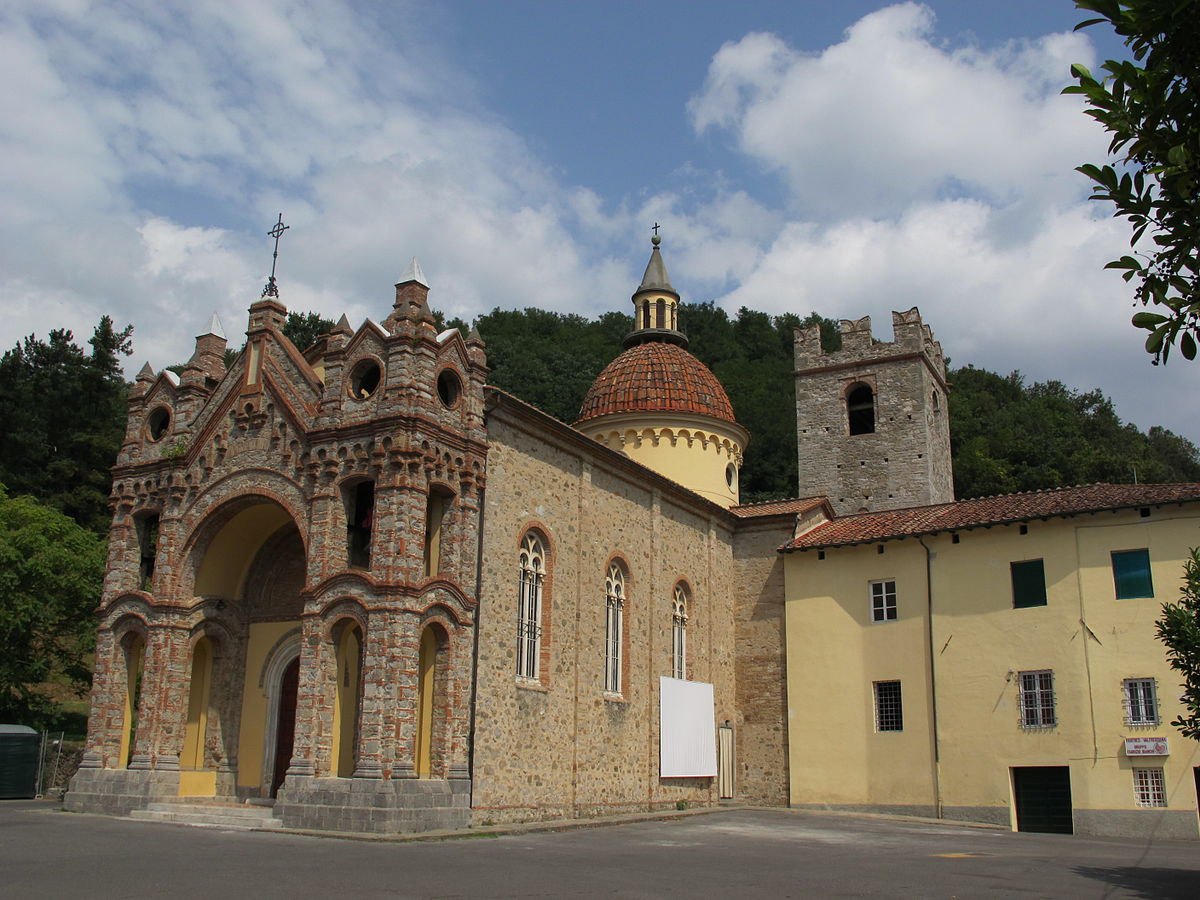
San Martino in Freddana is a hamlet of the municipality of Pescaglia, on the provincial road linking Lucca to Camaiore by way of Monte Magno, near the river from which the valley takes its name.
Pescaglia lies 504 metres above sea level, on an eastern spur of the Apuan Alps. Industry, and paper making in particular, is the main economic resource. Tourism is steadily growing.
The village was founded in the eleventh century by the Soffredinghi family, of Lombard origin, who ruled it until the second half of the thirteenth century. In 1272 Pescaglia became part of the possessions of the city of Lucca, which placed it in the Vicariate of Coreglia and entrusted the village to the Antelminelli family; Lucca also saw to the building of a ring of walls to meet the frequent enemy invasions. Even so, in 1440 Pescaglia too was taken by the Florentines in pursuit of their expansionist policies. Their rule lasted only a few years: in 1470 Lucca took the village again and made it the chief town of the Lucchese Vicariate. Lucca governed undisturbed until the invasion of the French troops in the nineteenth century, who remained stationed in the area until 1814. After the fall of the Napoleonic empire the territory returned to Lucchese hands, where it stayed until 1861, when it was annexed to the Kingdom of Italy.
Among the most important monuments at Pescaglia we should name first of all the Pieve di San Giovanni Battista, founded in 1102. Worth seeing too is the Teatrino di Vetriano, built at the end of the nineteenth century and entered in the Guinness Book of Records in 1997 as the smallest theatre in the world, with its 70 square metres.
Also worth noting are the Museo di Celle dei Puccini and the Chestnut Museum at Colognora, which holds a collection of old and modern tools for gathering, beating and milling chestnuts.
At the time of the Second World War, San Martino in Freddana was a very small village of scattered houses and a couple of villas rising from countryside entirely sown with wheat, among rows of vines and stretches of olive groves and vineyards on the south-facing hills; only higher up, and above all on the southern side of the valley, did the view present, as though framing it, vast and thriving pine woods.
Today, with the abandonment of farming, vineyards and olive groves have almost disappeared and the landscape has changed radically, largely smothered by the overbearing growth of woodland made up mainly of invasive acacia plantations that all but embrace the village — which in the meantime has developed and, on the flat ground, has grown in building and housing terms, taking advantage of finding itself inside a mountain municipality such as Pescaglia, and so benefiting from the tax concessions the law provided for mountain and depressed municipalities.
Thus the whole middle zone of the Val Freddana belonging to the municipality of Pescaglia, in close contact with the municipalities of Lucca and Camaiore, has become the only centre of attraction in the whole valley, helped by the new industrial area of Monsagrati, which has radically changed the valley’s entire economy and brought about, besides a process of building development and growth in resident population, an important development of the service sector too.
The change in the landscape can easily be seen by comparing views of the village of San Martino in Freddana taken in the 1950s, a few years after the painter Alfredo Catarsini had lived there. It is worth noting that the village has also benefited from lying at the centre of the Val Freddana, favoured for communications with the outside by the important Provincial Road no. 1 linking Lucca to Versilia and by the road joining the area to Pescaglia and the Middle Serchio Valley. Another road links the village to the Lucchese hills on the southern side, such as Castagnori, Vecoli and Pieve San Stefano.
San Martino is also the village whose parish, with twelve others around it, today forms a very extensive ecclesial community, that of the North-West Val Freddana.
The area boasts, finally, a past of more than a thousand years of history, the earliest religious records that have come down to us in the Lombard charters of the Diocesan Historical Archive of Lucca going back to the eighth century.
It is in the will of Tassilo (or Tassilone) of the year 768 that, among the property the vir devotus leaves to various pious places, there appears the church of Santa Reparata in Frigdana, a church of which only a few ruined foundations remain today and which stood a few hundred metres from the present modern church of San Martino in Freddana, a building notable for the facade designed at the end of the nineteenth century by the well-known Lucchese Liberty architect Gaetano Orzali. In his will, to name the church benefiting from part of his property, Tassilo uses the phrase: ecclesia Sancte Reparate ad monasterium Sancti Martini quondam Sicheradi, meaning that the church stood near a small monastery or xenodochium dedicated to Saint Martin which a priest named Sicheradus had founded in the very place where the parish church of San Martino in Freddana now stands. From Monasterium Sicheradi comes the name Monsagrati, whose new parish church was built on the hill above the valley in the year 1102.
On the southern side of the valley, even before the year 1000, there stood a church dedicated to Saint Thomas, not far from the castle of Castagnori, a fortified stronghold of which much masonry still survives today, though smothered by particularly dense vegetation. The castle was destroyed by the Lucchese in 1100 to punish the feudal lords who held it, accused of having plotted with the enemy Pisans.