News about Viareggio
4 – NEWS ABOUT VIAREGGIO
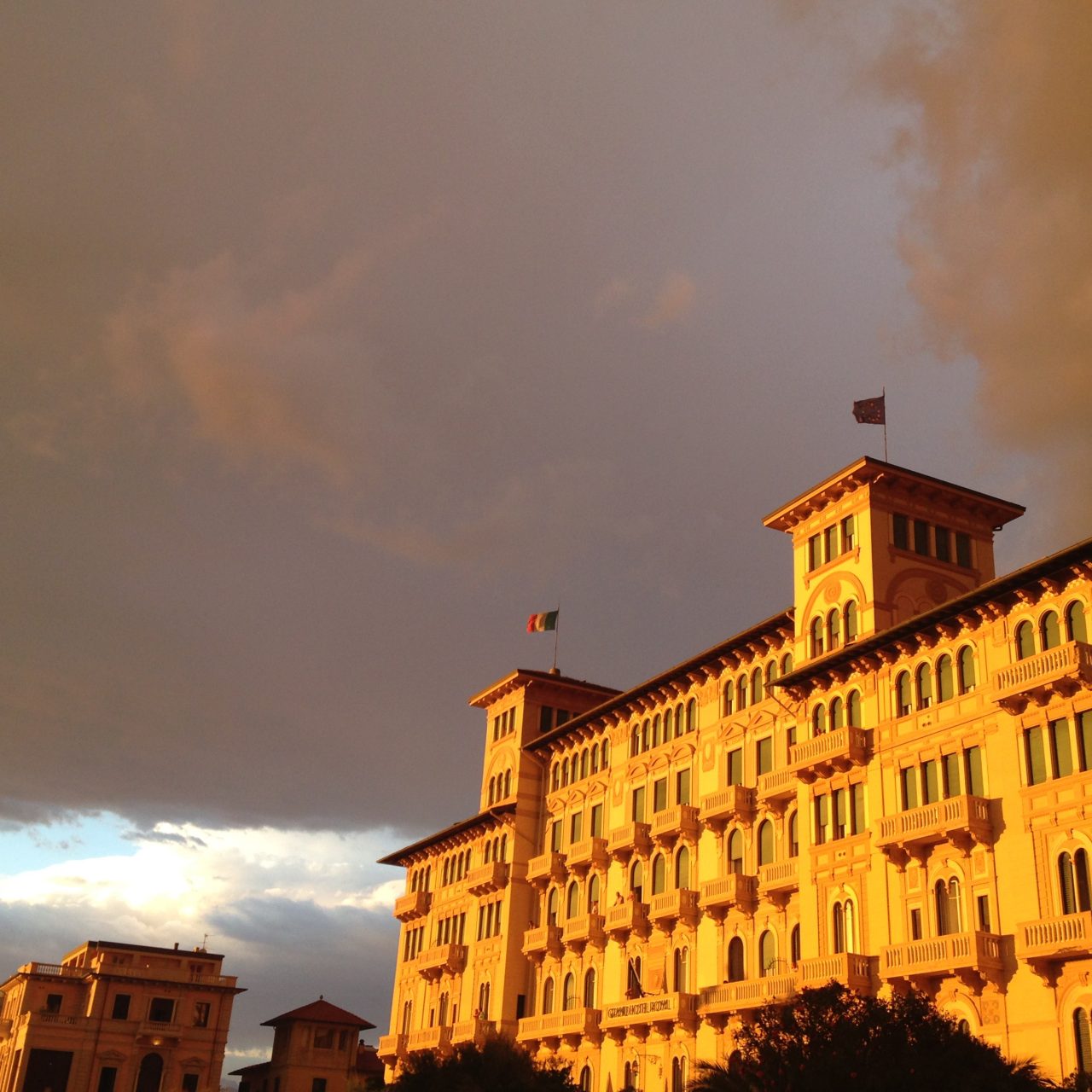
The story of Viareggio’s birth is closely tied to the Republic of Lucca and to its pressing need to find a new outlet to the sea, after Leo X de’ Medici, with the famous award of 1513, had assigned the castle of Motrone — then the most important landing on this stretch of Tyrrhenian coast — to the Florentine state.
The Lucchese were left with only one resource, the small canal harbour of Viareggio, where as early as 1172 they had built a fortified castle and a road, called the Via Regia, joining the beach to the inland area of Montramito. From the name of this road comes the place name Viareggio.
The abundance of marsh and standing water, the malaria that raged there, and living conditions that were dangerous and extremely uncomfortable had however discouraged the growth of human settlement and, as a result, the attention of the Lucchese nobility to its expansion: in the sixteenth century the area was practically uninhabited. The change brought by the shifting of the borders forced Lucca to look anew at the castle of Viareggio: it became essential to enlarge and improve the Viareggio landing; moreover, over the centuries the sea had withdrawn and the coastline had moved fully 600 metres from the old defensive castle. The need to protect the coast from frequent Barbary raids therefore made the building of a new defensive tower fundamental, and around it the first small settlement arose: the great tower — called «Matilde» and completed by 1541 — still dominates the old part of Viareggio with its strong, massive structure. Human settlement was slow to grow, however, because of the centuries-old cause of malaria, and despite the various attempts at improvement made by the Republic it was only in 1735 that the engineer Bernardino Zendrini, with his insights, managed to improve the air appreciably.
Zendrini separated the fresh water of the lake from the brackish water of the sea by means of balanced sluice gates, and decided to clear much of the marsh scrub that blocked the circulation of air and encouraged standing water and the consequent breeding of the anopheles mosquito.
The air became healthy again, and the Lucchese nobility, taken by the beauty of the sea and the beach, began to frequent the shore, building the first villas, starting the first trade and drawing up the first town plan. But one must come to the nineteenth century for the real change that made Viareggio the most important seaside resort in Italy and one of the most important in Europe.
Already in a letter of July 1814 the maire of Viareggio notes that the sea was calm and the holidaymakers had taken their usual bathe. A few years later, in 1822, the first rules of conduct on the beach were laid down: the ladies had the eastern stretch and the gentlemen the western. In the same year Paolina Bonaparte had a fine palace built near the sea, and on the eastern beach the body of the great English poet Percy Bysshe Shelley was found, drowned while returning from Livorno to San Terenzo in his sailing boat; today the square in front of Paolina’s palace is dedicated to him.
In 1827 the first true bathing establishments arose, the Dori and the Nereo, open from July to September. Over time ever finer establishments were built, of wood on piles over the sea, with fanciful entrances and bars and dance floors above the water; the promenade filled with houses and dream villas, the tram clattered along the seafront, the sunsets were poignant. By the end of the century everyone wanted to come to Viareggio in summer; people met in the many refined haunts along the promenade, where one might come across the finest names of the literary and artistic world, actresses and singers, nobles and the newly rich — all of them pouring onto the beaches, the avenues, the cool pine woods; the theatres and the cafés chantan offered the latest hits every evening and the shops were full of the newest fashions. In 1917 a great fire unfortunately burned almost all these marvellous wooden buildings, and many of the new masonry ones were adorned with the ceramics of a great Florentine artist, Galileo Chini. The atmosphere changed, but the charm of Viareggio was not lost, and even in our own day the town is still a welcoming and much frequented holiday place.
Of great importance for Viareggio has been, and still is, its shipbuilding, born in the Darsena Lucca in the early years of the nineteenth century. From the first yards, where expert craftsmen worked — blacksmiths, carpenters, blockmakers, mastmakers, sailmakers — came sailing ships admired all over the world. Viareggio’s sailors and captains were moreover renowned for their skill, their bold mastery of navigation and their courage. The tradition carries on today with the building of large yachts, which bring the town prestige and a strong economic impact.
Besides the sea, the pine woods, the boats and the pleasures of the holiday season, Viareggio is also famous for its Carnival, officially born on the distant 24 February 1873, as a rare document of the period shows.
At first it was not floats that paraded but decorated carriages, and only at the end of the century did the first floats appear, made of wood and scagliola. When, at the beginning of the twentieth century, the parade moved to the Promenade, the allegorical floats grew larger; papier-mâché began to be used, whose lightness allowed construction on a grand scale, and the fame of the parades spread rapidly across Italy. In 1930 the painter Uberto Bonetti devised Burlamacco, the official mask of the Carnival, accompanied by Ondina, symbol of the summer season; since then Burlamacco has been known throughout the world.
Another unmissable event in the area is the Puccini Festival, held at Torre del Lago since 1930. Giacomo Puccini fell in love with the lake at the end of the nineteenth century, settled there and wrote many of his famous melodies there. In the silence and the beauty of the lake he found inspiration for his music and pursued his great passion for shooting. His house facing the lake, full of relics and mementoes, holds his remains and can be visited all year round.
Along the fine tree-lined avenue that joins Viareggio to Torre del Lago stands Villa Borbone, built in the nineteenth century for the Duchess of Lucca Maria Luisa di Borbone and surrounded by a large park. Raised in 1822 as a hunting lodge, it was reworked until it took its present form at the hands of the architect Lorenzo Nottolini. In the park are the lemon house and the chapel with the monumental tombs of many nobles of the Bourbon house, among them that of Carlo III.
Today the villa hosts concerts, exhibitions and events tied to the area.
THE VIAREGGIO PROMENADE
Coming from Forte dei Marmi and crossing the Fossa dell’Abate we reach Viareggio, the birthplace of Alfredo Catarsini.
Just past the Fossa dell’Abate on the left, following Viale L. Einaudi as far as the Via Aurelia, stands the Cittadella del Carnevale. Opened in 2001, it holds the enormous hangars where the giant floats are built that have made the Carnival of Viareggio famous around the world. In 2023 the event celebrated its first 150 years. In this great space there are also two museums, on the history of papier-mâché and of the Carnival.
We are in Viareggio, the birthplace of Alfredo Catarsini. On the seafront heading for the town centre, on the left, is the so-called «Garden City», marked by tall buildings of the 1950s and 1960s, built in place of a thick pine wood felled by the Germans at the end of the Second World War; of that wood there remains the strip of public park separating it from the Marco Polo district, with the seat of the Fondazione Alfredo Catarsini 1899 and the square named after him.
A short way off, in the Municipal Monumental Cemetery, is the tomb of the Catarsini family, surmounted by the fine statue the sculptor Mario Carlesi made, very young, in 1914. Catarsini and Carlesi exhibited at several editions of the Kursaal summer exhibitions in the 1930s.
Past the «Garden City» you come to Piazza Puccini where, at the crossing with Viale Buonarroti, stands Giacomo Puccini’s villa, built between 1919 and 1921, the last house the great composer lived in. Carrying on, we reach the historic heart of Viareggio’s famous Promenade, which even today, despite some later architectural intrusions, keeps a great number of buildings and decorations from the town’s golden age. It was the time when, for fashionable society, coming to Viareggio was almost an obligation: the pleasantness of life here, the beauty of the sea and the mountains, and the cultural and social crossings made it one of the most sought-after places in Europe. Here the most famous stars of the day met: Francesca Bertini, Eleonora Duse, Maria Melato, Ettore Petrolini and Totò, and Italian and foreign writers — Gabriele D’Annunzio, Luigi Pirandello, Grazia Deledda and Rainer Maria Rilke. And then artists and musicians, such as Galileo Chini, whose ceramics decorated the finest buildings of the Promenade, and Giacomo Puccini, in love with the lake and with Viareggio; and figures from culture and science, among whom Guglielmo Marconi stood out; and the nobility, Italian and central European: the Duke of the Abruzzi, Duke Salviati, the Marquis Cavalcanti, the Count of Turin and Donna Franca Florio, and then New York heiresses and exotic figures from the Middle East.
The liveliness of Viareggio life was mirrored in its buildings, many of which we can still admire today. The first building of interest you meet on Viale Carducci is the Grand Hotel Principe di Piemonte, formerly the Select, designed in 1922 by the engineer Goffredo Fantini and reshaped into its present lines in 1925 by the engineer Ugo Giovannozzi. It has an interesting «hinged» structure, its two fronts joined by the cylindrical entrance block, recalling the Hotel Carlton at Cannes; it was, and is, the hotel of choice for fashionable society. On the opposite side of the square, named after the great composer Giacomo Puccini, is the Hotel Excelsior, designed and built by the architect Alfredo Belluomini between 1923 and 1925, adorned with ceramics from Galileo Chini’s Fornaci San Lorenzo works and with a fresco on a marine subject by the painter Domenico Ghiselli. On the same side of the square, at the crossing with Viale Buonarroti behind, stands Giacomo Puccini’s villa, built between 1919 and 1921, the last house the great composer lived in.
Carrying on along Viale Carducci, at the corner with Via Giusti we find the Villino Brunetti, known as the Villino Amor omnia vincit, from its beautiful ceramic decoration, again from the Chini works, with neo-Renaissance putti holding up garlands of flowers. Facing it is the Hotel Imperiale, designed by the Lucchese architect Gaetano Orzali, almost a great Swiss chalet painted blue, its entrance on Via Giusti. Back on Viale Carducci are the Chizzolini villini, one opposite the other, also designed by Gaetano Orzali; then, at the corner with Via Saffi, is the Hotel Villa Tina, of 1927–28, with a loggia over the sea closed by a fine multicoloured window by the De Matteis firm of Florence. On the other side of the street rises the imposing bulk of the Grand Hotel Royal, which marks the Viareggio skyline with the twin turrets added during the 1926 rebuilding. This hotel too was frequented by the fashionable world of the day: Donna Franca Florio, Queen Margherita, the princes of Savoy, the Count of Turin, Pirandello and Marta Abba, and later the great poet Pablo Neruda. In its wide halls, in 1930, Leonida Repaci organised the first Premio Viareggio. Beyond the Hotel Royal, where there is now a large white building, stood the Kursaal, one of the most interesting buildings on the Promenade: its architectural singularity, the mixture of styles that composed it, its terraces over the sea and its gardens made it at once one of the best loved and most frequented places on the seafront. Inside were a casino and a great ballroom, and then cafés, restaurants and even a skating rink; it hosted concerts, grand receptions, theatrical performances and important art exhibitions, among them the famous Summer Exhibitions in which, from 1934 to 1939, Alfredo Catarsini also took part, alongside the great names of the painting of the day, including Plinio Nomellini, Moses Levy, Galileo Chini, Mario Carlesi, Lorenzo Viani and Primo Conti.
A little further on is the Villa Rospigliosi-Cerpelli, of 1907, of simple, clean lines and with an unusual roof of green ceramic tiles, followed by a further series of eclectic villas and villini that take us back to that early twentieth-century atmosphere; among them stands out the Hotel Palace, rebuilt into its present form in 1922 by Alfredo Belluomini, with a handsome classical scheme of pilasters, pediments and small balconies. Going on towards Piazza Mazzini you come to the villino bearing D’Annunzio’s motto Memento Audere Semper, then the Villino Flora, of 1912, with ceramic panels by Chini in Secessionist taste, and the Villino Domenici of 1920.
One block from Piazza Mazzini lies the hidden Via D’Annunzio; walking along it with the seafront behind you, you meet some of the most interesting Liberty buildings in Viareggio. The first is the delightful Villino De Angelis, known as Il Guscio, built in 1914 by Oreste Lenci. At the corner with Viale Buonarroti is the Villino Tomei, today Matteucci, designed in 1915 and decorated with marvellous ceramic panels by Galileo Chini showing putti holding festoons, alternating with others in geometric motifs; it faces, on the other side of the street, the fanciful, orientalising Villino Nistri of 1912–13. Piazza Mazzini, which follows, is closed on the landward side by the Palazzo delle Muse, of 1861, today the seat of the Lorenzo Viani Gallery of Modern and Contemporary Art.
On the ground floor, in a room of the Civic Library, the stage of the Cammino is laid out, with a selection of works from the gift that Alfredo’s children, Mity and Orazio Catarsini, made to the Municipality of Viareggio in 2001.
Past the square, on the seaward side, the Bagno Martinelli of 1930 is notable, with a dome of red and white scales and a decoration, made in sand-coloured cement, representing fish, jellyfish and seahorses; further on is the entrance to the Bagno Balena, with a majestic Moorish arch decorated with large ceramic eyes recalling semi-precious stones.
On the landward side, instead, we meet numerous other villas with their characteristic ceramic decoration, again the work of Galileo Chini: Villa Sofia, now Tolomei, the Hotel Liberty and Villa Crastan Arrighi. At the end of the next block, the Hotel Plaza closes the scene to make way for the great Piazza D’Azeglio. Facing the square stands one of the finest buildings on the whole Promenade, the Gran Caffè Margherita, built in 1928 by Alfredo Belluomini and Galileo Chini, of vaguely oriental line. In the old Gran Caffè Margherita building by Goffredo Fantini the intellectuals and artists of the day used to gather — above all the great Giacomo Puccini. The new premises too have hosted events and art exhibitions: Catarsini held solo shows here and animated many cultural initiatives, including during Carnival, and organised meetings between intellectuals thanks to his friendship with the musician Michele Orselli, who ran the place. Orselli, from Lucca and some years older than Catarsini, an elegant and cultivated cellist, tied his gift for composition to the Viareggio Carnival from 1923 onwards and left an indelible mark on the town: the trumpet fanfares that signal the beginning and the end of the masked parade are his. Today the splendid halls hold a restaurant, a café and a bookshop, keeping the atmosphere that has always been theirs.
Beside the Gran Caffè Margherita stands the only wooden building left in Viareggio from the old Promenade of the early 1900s, the Chalet Martini, almost a small Swiss chalet; and a little further on the Duilio 48 building, of 1927, so named because at the time everything sold there cost 48 centesimi. Particularly fine is the great «butterfly» window on the first floor.
Behind Piazza D’Azeglio another, smaller square opens: Piazza Shelley, where a statue honours the great English poet Percy B. Shelley, whose body was found in 1822 on the shore at Viareggio after the tragic wreck of the schooner Ariel, which was returning from Livorno to San Terenzo, near Lerici, where the poet lived. The square is closed by an elegant building of simple neoclassical lines, Villa Paolina, commissioned in 1822 by Napoleon’s sister Paolina Bonaparte; today the building houses the Civic Museums, and in its attics is the atelier where Alfredo Catarsini worked from the years after the Second World War until the end of his life. The studio, with its suspended atmosphere that still seems to be waiting for the artist, holds documents, drawings, palettes, paints and mementoes.
After the visit to the atelier the route carries on to the Burlamacca canal. Beyond it begins the Viareggio of the boatyards, the fishermen and the seafaring people, so loved by Catarsini, who wrote:Of my town I love above all that working-class atmosphere, typically Viareggina, seafaring; I love its boatyards, which I have painted from my earliest youth to the present day; I love its colours, at times full of light, heightened by the vigorous Versilian sun.»
THE ALBERTO GIANNI MARITIME MUSEUM OF VIAREGGIO
On 7 December 2006 the Maritime Museum of Viareggio was officially opened, ideally tying the date of this institution’s birth — awaited by generations of Viareggio people — to 7 December 1930, when the salvage ship Artiglio blew up in the waters of Saint-Nazaire in Brittany. In that disaster twelve of the crew died, among them the Viareggio divers Alberto Gianni, Aristide Franceschi and Alberto Bargellini, as well as the sailor Romualdo Cortopassi.
The Museum is indeed named after the chief diver Alberto Gianni and is housed in the historic building of the former Fish Market, designed by the chief engineer of the Municipality of Viareggio, Carlo Riccomini, and opened in 1933.
The Museum is at present laid out in several sections: Shipboard equipment; Shipyards; Seafaring people; Master shipwrights and caulkers; Seafaring in art; The Italian Navy; Model making; Diving and underwater work; Fishing; Nautical instruments; Sail.
Most of the items in all the sections come from the generosity of the people of Viareggio, who regard this museum as a place where the memory of the epic of sail and of the legendary feats of the Viareggio divers is kept almost religiously, but also where one can take stock of the latest developments in Viareggio’s boatbuilding.
Over time the museum has acquired further items of interest, among them an English marine telescope whose history is closely connected with the tragic death of the English romantic poet Percy B. Shelley, off Torre del Lago on 8 July 1822.
For about seven years, too, the skull of a fin whale has been on show, from the University of Pisa, with a new section devoted to the marine mammals of the protected «Pelagos» sanctuary, a marine area of 87,500 square kilometres born of an agreement between the Principality of Monaco, France and Italy.
Through the Gold Medals for long service at sea, the museum holds on loan from the Harbour Office of Viareggio more than 3,000 seamen’s record books from the Viareggio maritime district, established in 1908, which have been catalogued and are available to scholars.
By the gift of Elena Martinelli, the gold medal for long service at sea that belonged to Attilio Catarsini, a master mariner and brother of Alfredo Catarsini, is also kept here.