Route from Forte dei Marmi to Lido di Camaiore
10 – ROUTE FROM FORTE DEI MARMI TO VIAREGGIO
Vittoria Apuana
Villa Bertelli stands in the small district of Vittoria Apuana, which grew up at the end of the nineteenth century when a factory for civil explosives, destined for the nearby marble quarries, was opened on the uncultivated land here. After various troubles and accidents, the works was bought by the Milanese company SIPE, which also bought much of the surrounding land to build housing for its employees. A pier for shipping by sea was also built, along with a small boatyard and a villa for the management, now Villa Bertelli.
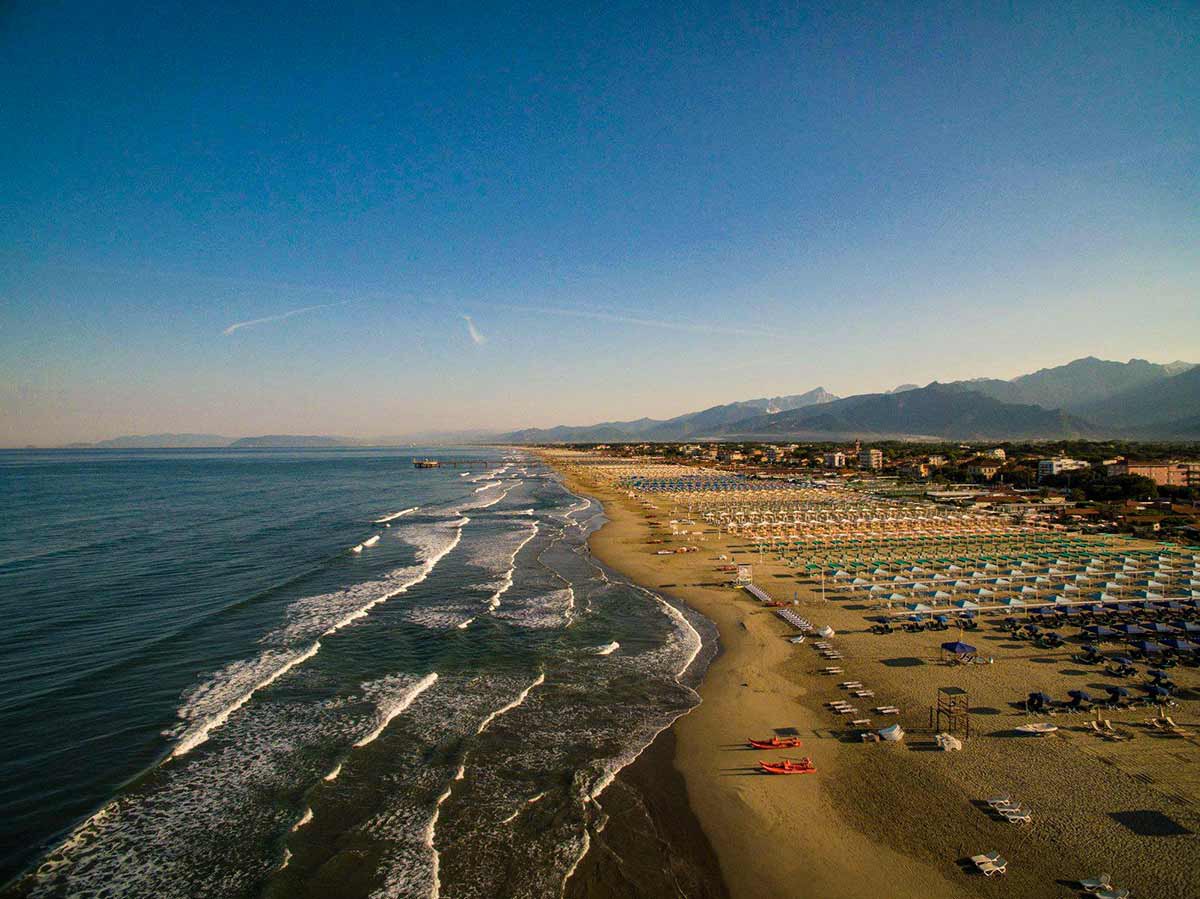
The route follows the seafront southwards. It is worth noting, though, that by making a short detour northwards you can reach the WWF Oasis of the Forte dei Marmi Dunes, a marvellous natural oasis protected by the WWF. The area is always open, at any hour of the day, but you can also join guided visits to learn all its secrets and features. This area still keeps the old natural landscape of Versilia, before seaside tourism entirely changed its aspect. The site, of about 3 hectares, holds several species of local fauna and vegetation.
Returning to the route and carrying on towards the centre of Forte dei Marmi, we come to the famous Pier, without doubt one of the town’s symbols, from which you can admire a unique panorama: arriving at the end of the «Bridge», as the people of Forte dei Marmi affectionately call it, you feel plunged into the blue of the sea, and turning your eyes to the mountains you find yourself protected by the embrace of the Apuan Alps, of Monte Altissimo, the Corchia and the Pania della Croce. Fabio Genovesi, the well-known writer from Forte dei Marmi, writes: «We people of Forte dei Marmi, without the pier we lose the horizon.»
During the Second World War it was bombed and destroyed; it was then rebuilt in reinforced concrete, and so it has come down to us with its 275 metres of length and its charm d’antan.
Carrying on our way towards Viareggio we pass beside one of the most famous places in Forte dei Marmi: La Capannina. The club opened in August 1929, founded by Achille Franceschi, a local hotelier, who set up a hut on the beach with small tables, a counter for serving drinks and a wind-up gramophone.
It is said that Franceschi founded the place to play cards with his friends and pass pleasant hours in their company. The origin of the name is said to lie in the phrase «What a lovely spot, it really does look like a little hut», said to Franceschi by a countess friend of his.
The club was a great success from the start. At the Capannina gathered nobles and intellectuals who were regular guests for an aperitif before sunset. Italo Balbo liked to glide down in his seaplane right in front of the club and was among the first to sip the famous Negroni (a cocktail born in the bars of Florence some hundred years ago and called «an Americano in the manner of Count Negroni»). In short, La Capannina became one of the most prestigious haunts of the Italian summer.
In the years of the economic boom the club hosted performances by the most fashionable national and international artists and had the whole jet set of the day as its guests.
La Capannina of Forte dei Marmi holds the record as the oldest dance club with a restaurant in the world and, though it has changed owners, it has never changed its name since it opened..
Walking along the seafront we come to the Parco della Versiliana which stretches between the built-up areas of Forte dei Marmi and Marina di Pietrasanta, the true green lung of the Versilian coast. The Park is a considerable forest heritage able to offer extraordinary natural and environmental richness, from the areas of old dunes where holm oaks and pines grow with a dense, dark undergrowth, to the sunlit clearing where with a little luck you may glimpse the elegant hoopoe. From the evocative Fiumetto ditch, rich in reeds and alive with turtles and moorhens, to the mixed deciduous wood, so varied through the seasons, or the more unexpected half-marshy landscape of the lame, the last left in northern Versilia. The Park is the only trace in Versilia of the ancient Macchia di Marina, a wood of oaks, holm oaks and alders that ran along the coast from Cinquale to Motrone.
In 1785–86, for military needs, the bridge still known today as the «Ponte del Principe» was built over the Fiumetto ditch in honour of the Grand Duke.
At the beginning of the nineteenth century, on the sandy soils formed by the retreat of the sea, stone pines were sown and planted to form a windbreak protecting the wood inland. This is the first record of the artificial introduction of the stone, or pine-nut, pine in this area.
During the nineteenth century the counts Digerini Nuti became owners of some portions of land near the mouth of the Fiumetto, creating a large seigneurial estate, and in 1886 they had their manor house built there, named La Versiliana by the writer Renato Fucini, often a guest of the owners. Used above all as a summer residence, the house faced the sea and by the early twentieth century had a landing stage on piles.
In 1906 Gabriele D’Annunzio stayed here. He loved to ride among the sunlit dunes and along the water’s edge, but he also prized the cool, restful landscape just behind the shore, where «the wood is crossed by wide soft avenues along which one gallops without a sound, as in a dream».
Following agreements between the owners and the Municipality of Pietrasanta, from 1951 and for about ten years the first summer performances were held in an open-air theatre set up inside the estate. On 24 June 1980 the estate was bought by the Municipality of Pietrasanta and, by the same act, designated a Public Park. Since then this evocative natural space has hosted the Versiliana Festival every summer and is used for health and recreational activities.
Three itineraries — «Un bosco per noi», «Percorso vita policrosalus» and «Versiliana bike» — allow, each in its own way, an acquaintance with the area and an appreciation of it that respects and safeguards its environmental resources. To spread knowledge of the main features of the Park’s flora and fauna, since 2001 the IterNatura initiative has run each year in July and August: a series of free guided nature walks, open to the wide public of residents and visitors.
At the end of the Parco della Versiliana you cross the district of Fiumetto. The name of the place comes from the river that runs through the area — which can in fact be classed as a small ditch, given its minimal flow. Its history is not very ancient, although the ground on which it stands was a Roman settlement. This zone was the object of clashes, sieges and conquests by Pisa, Florence, Genoa and Lucca. In the eighteenth century Peter Leopold of Habsburg-Lorraine created the Vicariate of Pietrasanta, into which Fiumetto was placed.
After the Napoleonic period, Grand Duke Leopold II began a second work of reclamation on the coastal plain of Fiumetto. In the more inland zone, until the modern and contemporary age, the watercourses and the kind of vegetation made Fiumetto a damp, unhealthy marsh. Thanks to the reclamation the first shrubs began to appear, and from there arose the coastal Mediterranean scrub. The scrub was a vast green expanse of oaks, alders and holm oaks, stretching for about 9 kilometres, from Cinquale to Motrone. The pines were introduced by man at the end of the nineteenth century and were the basis of the newborn pine-nut industry. With the founding of the municipalities, Fiumetto was placed in that of Pietrasanta. The coastal zone is marked, like the surrounding strip, by low sandy shores formed by the accumulation of alluvial sediment and scattered with dunes. That process halted at the end of the nineteenth century for physical and human reasons: the erosion of the coast on the one hand and the building of bathing establishments on the other.
Carrying on we come to Tonfano, originally «Tonfalo», one of the four places into which the district of Marina di Pietrasanta is divided, together with Fiumetto, Le Focette and Motrone. The name comes from the river that ran through the area and was later filled in. The river was fed by the «polle di Vaiana», the springs near Caranna at Forte dei Marmi: from there the Tofalo ran parallel to the present «Fiumetto» that flows through the place of that name, then turned south along what is now Via Tonfano.
Tonfano was, in the nineteenth century, the first of the four places of Marina di Pietrasanta to be settled. The first inhabitants were fishermen, who settled by the river mouth. Later, those who had owned land in the area since the eighteenth century built villas and holiday houses where they came in the summer months to take the sea-bathing cures then in fashion. After the First World War, Tonfano became a seaside resort. During the Second World War the small wooden pier that marked the area was blown up by the Germans, afraid it might serve for unloading goods. Later the American soldiers settled at Villa Rebua and Villa Battelli, from where they could monitor the landings of the small aircraft used for reconnaissance over the Gothic Line. This landing strip was created precisely by filling in the stretch of the Tonfano river that passed through that area. With the river gone, the bridge linking Viale Carducci to Via Versilia, over which the tram line ran, was also destroyed. The territory of Tonfano,, like that of the neighbouring areas, was originally a marsh. The first reclamation works came in the sixteenth century under Cosimo I, and further reclamation was later carried out under Leopold II. Tonfano’s main attraction is its pier, built for tourism and recreation and opened in 2008. On the pier stand various sculptures, in honour of the artistic vocation of the town of Pietrasanta; it ends in a ten-sided square with a sumptuous fountain at its centre.
Fosso Motrone
South of the district of Tonfano lies the Motrone ditch, which flows into the sea. The Motrone bounds historic Versilia to the south, while to the north it is bounded by the river that crosses Seravezza. Today the whole coastal strip as far as south of Viareggio is called Versilia.
In antiquity it was a harbour at the mouth of the river of Seravezza, called the Fosso delle Prade or Fiumetto, formerly the Old River of Versilia. It was inhabited by the Lombards, and the first certain records of the harbour date from 1084. In 1159 the Lucchese built a stone fortress there, later destroyed by Barbarossa in 1162 at the request of the Pisans. The Lucchese, with Genoese support, rebuilt the fort; in return the Genoese were granted some warehouses in the harbour. Salt arrived at Motrone carried by Genoese ships and destined for the city of Lucca. For almost four centuries the fortress was the object of continual quarrels between Florence, Pisa and Lucca. In 1403 the Florentines obtained from the Lucchese the right to use the Port of Motrone. From then on the most illustrious Florentine merchant families made it a place of flourishing trade; great was the variety of goods landed there, arriving from and departing for the whole Mediterranean and beyond, since the routes reached as far as northern Europe. Following the division of territories under Leo X’s award of 1513, Motrone passed from the Lucchese to the Florentines; to this too is owed the later growth of the town of Viareggio, which had become the only sea outlet of the Republic of Lucca.
The decline of this hub began when Florence decided to develop the port of Livorno, easier to defend by Florentine forces who did not have to cross the malarial zones; while the definitive end of the harbour came with the reclamation works of the seventeenth century across the whole of the plain, with the diversion of canals that raised the harbour bed and brought the final decline of merchant traffic.
The working life of the port of Motrone ended in 1813, when the fortress was destroyed by the English. The stones of the fort were reused for building the Motrone sluices, and today nothing remains of the old fort but a portion of wall built into a house.
Carrying on we come to a club that made the musical and social history of the golden post-war years in Versilia: La Bussola, opened by Sergio Bernardini in June 1955. A man of show business, brilliant and dynamic, from 1948 he had already been successfully running several dance clubs in Viareggio: the Capannina del Marco Polo (where in 1948 the «National Festival of Italian Song» was born, which three years later would move to Sanremo), the Gatto Nero, the Caprice and the Carillon. With his running of La Bussola, Bernardini became a legend. For the opening night he called on Renato Carosone and his famous orchestra. Carosone, like other artists, would stay closely attached to Bernardini’s club.
La Bussola thus became one of the most fashionable clubs in Italy; within a decade almost all the great figures of Italian and international popular music passed across its stage: Louis Armstrong, Neil Sedaka, the Platters, Adriano Celentano, Peppino Di Capri, Don Marino Barreto Jr, Milva, Ella Fitzgerald, Domenico Modugno, Gilbert Bécaud and Mina, who was always deeply attached to Bernardini and his Bussola. Adjoining La Bussola, Bernardini opened Il Bussolotto, devoted to jazz, where Chet Baker also played.
In 1976 Bernardini created Bussoladomani, a larger venue a short distance away in the Lido di Camaiore district: a marquee suited to shows and concerts. It was here that, in the summer of 1978, Mina gave her farewell to the stage with a series of live concerts. Bussoladomani was later closed and the marquee demolished in 2000.
Lido di Camaiore grew above all from the early 1900s; before that it was a quiet, silent place inhabited by a few solitary souls and by flocks of sheep and mouflon. From those years the idea of a «linear seaside resort town» took shape, through the building of the seafront avenues. Meanwhile from Viareggio, which since the nineteenth century had seen strong building growth, part of the bourgeoisie began to arrive in search of freer, quieter space. Here the painters Plinio Nomellini and Galileo Chini found a pleasant refuge: a letter of Nomellini’s dated 31 December 1907 is famous, in which the painter invites his friend Galileo Chini to buy the «Pineta» where his beloved «Casa delle Vacanze» would be built. The design of the new settlement is simple: the dune zone with the bathing establishments, a seafront avenue and a band of blocks for hotels and villas. The blocks alternate with streets giving access to the sea, and with squares. At the beginning of the last century one of the few existing buildings was the fine Villa of Senator Rolandi Ricci, now turned into the Hotel Ariston, a kind of castle by the sea. Today Lido di Camaiore is a seaside resort much frequented in summer and still a quiet place in winter. It has a beautiful pier, opened in 2008, which, unlike the other two, holds a bar and restaurant with a view over sea and mountains.
ARRIVAL AT THE VIAREGGIO PROMENADE
Coming from Forte dei Marmi and crossing the Fossa dell’Abate we reach Viareggio, the birthplace of Alfredo Catarsini.
Just past the Fossa dell’Abate on the left, following Viale L. Einaudi as far as the Via Aurelia, stands the Cittadella del Carnevale. Opened in 2001, it holds the enormous hangars where the giant floats are built that have made the Carnival of Viareggio famous around the world. In 2023 the event celebrated its first 150 years. In this great space there are also two museums, on the history of papier-mâché and of the Carnival.
Past the «Garden City» you come to Piazza Puccini where, at the crossing with Viale Buonarroti, stands Giacomo Puccini’s villa, built between 1919 and 1921, the last house the great composer lived in. Carrying on, you reach the historic heart of Viareggio’s famous Promenade, which even today, despite some later architectural intrusions, keeps a great number of buildings and decorations from the town’s golden age.
It was the time when, for fashionable society, coming to Viareggio was almost an obligation: the pleasantness of life here, the beauty of the sea and the mountains, and the cultural and social crossings made it one of the most sought-after places in Europe. Here the most famous stars of the day met: Francesca Bertini, Eleonora Duse, Maria Melato, Petrolini and Totò, and Italian and foreign writers — Gabriele D’Annunzio, Luigi Pirandello, Grazia Deledda and Rainer Maria Rilke. And then artists and musicians, such as Galileo Chini, whose ceramics decorated the finest buildings of the Promenade, and Giacomo Puccini, in love with the lake and with Viareggio; and figures from culture and science, among whom Guglielmo Marconi stood out; and the nobility, Italian and central European: the Duke of the Abruzzi, Duke Salviati, the Marquis Cavalcanti and the Count of Turin, and then New York heiresses and exotic figures from the Middle East.
The liveliness of Viareggio life was mirrored in its buildings, many of which we can still admire today. The first building of interest you meet on Viale Carducci is the Grand Hotel Principe di Piemonte, formerly the Select, designed in 1922 by the engineer Goffredo and reshaped into its present lines in 1925. It has an interesting «hinged» structure, its two fronts joined by the cylindrical entrance block, recalling the Hotel Carlton at Cannes; it was, and is, the hotel of choice for fashionable society. On the opposite side of the square, named after the great composer Giacomo Puccini, is the Hotel Excelsior, designed and built by the architect Alfredo Belluomini between 1923 and 1925, adorned with ceramics from Galileo Chini’s San Lorenzo works and with a fresco on a marine subject by the painter Domenico Ghiselli. On the same side of the square, at the crossing with Viale Buonarroti behind, stands Giacomo Puccini’s villa, built between 1919 and 1921, the last house the great composer lived in.
Carrying on along Viale Carducci, at the corner with Via Giusti we find the Villino Brunetti, known as the Villino Amor omnia vincit, from its beautiful ceramic decoration, again from the Chini works, with neo-Renaissance putti holding up garlands of flowers. Facing it is the Hotel Imperiale, designed by the Lucchese architect Gaetano Orzali, almost a great Swiss chalet painted blue, its entrance on Via Giusti. Back on Viale Carducci are the Chizzolini villini, one opposite the other, also designed by Gaetano Orzali; then, at the corner with Via Saffi, is the Hotel Villa Tina, of 1927–28, with a loggia over the sea closed by a fine multicoloured window by the De Matteis firm of Florence. On the other side of the street rises the imposing bulk of the Grand Hotel Royal, which marks the Viareggio skyline with the twin turrets added during the 1926 rebuilding. This hotel too was frequented by the fashionable world of the day: Donna Franca Florio, Queen Margherita, the princes of Savoy, the Count of Turin, Pirandello and Marta Abba, and later the great poet Pablo Neruda. In its wide halls, in 1930, Leonida Repaci organised the first Premio Viareggio. Beyond the Hotel Royal, where there is now a large white building, stood the Kursaal, one of the most interesting buildings on the Promenade: its architectural singularity, the mixture of styles that composed it, its terraces over the sea and its gardens made it at once one of the best loved and most frequented places on the seafront. Inside were a casino and a great ballroom, and then cafés, restaurants and even a skating rink; it hosted concerts, grand receptions, theatrical performances and important art exhibitions, among them the famous Summer Exhibitions in which, from 1934 to 1939, Alfredo Catarsini also took part, alongside the great names of the painting of the day, including Plinio Nomellini, Moses Levy, Galileo Chini, Mario Carlesi, Lorenzo Viani and Primo Conti.
A little further on is the Villa Rospigliosi-Cerpelli, of 1907, of simple, clean lines and with an unusual roof of green ceramic tiles, followed by a further series of eclectic villas and villini that take us back to that early twentieth-century atmosphere; among them stands out the Hotel Palace, rebuilt into its present form in 1922 by Alfredo Belluomini, with a handsome classical scheme of pilasters, pediments and small balconies. Going on towards Piazza Mazzini you come to the villino bearing D’Annunzio’s motto Memento Audere Semper, then the Villino Flora, of 1912, with ceramic panels by Chini in Secessionist taste, and the Villino Domenici of 1920.
One block from Piazza Mazzini lies the hidden Via D’Annunzio; walking along it with the seafront behind you, you meet some of the most interesting Liberty buildings in Viareggio. The first is the delightful Villino De Angelis, known as Il Guscio, built in 1914. At the corner with Viale Buonarroti is the Villino Tomei, today Matteucci, designed in 1915 and decorated with marvellous Chini panels showing putti holding festoons, alternating with others in geometric motifs; it faces, on the other side of the street, the fanciful, orientalising Villino Nistri of 1912–13. Piazza Mazzini, which follows, is closed on the landward side by the Palazzo delle Muse, of 1861, today the seat of the Lorenzo Viani Gallery of Modern and Contemporary Art.
On the ground floor, in a room of the Civic Library, the stage of the Cammino is laid out, with a selection of works from the gift that Alfredo’s children, Mity and Orazio Catarsini, made to the Municipality of Viareggio in 2001.
Past the square, on the seaward side, the Bagno Martinelli of 1930 is notable, with a dome of red and white scales and a decoration, made in sand-coloured cement, representing fish, jellyfish and seahorses; further on is the entrance to the Bagno Balena, with a majestic Moorish arch decorated with large ceramic eyes recalling semi-precious stones.
On the landward side, instead, we meet numerous other villas with their characteristic ceramic decoration: Villa Sofia, now Tolomei, the Hotel Liberty, the Hotel London and Villa Crastan Arrighi. At the end of the next block, the Hotel Plaza closes the scene to make way for the great Piazza D’Azeglio. Facing the square stands one of the finest buildings on the whole Promenade, the Gran Caffè Margherita, built by Alfredo Belluomini and Galileo Chini, of vaguely oriental line.
The Gran Caffè Margherita was for many years an important meeting point for the intellectuals and artists of the day. Above all we recall the great Giacomo Puccini, who in 1919 had moved to the town, where he worked on his last opera, Turandot, sadly unfinished at his death. To commemorate the composer, a plaque was placed in his honour in 1949, and today a bronze statue stands before the entrance. In more recent times the premises have hosted events and art exhibitions: Catarsini held solo shows here and animated many cultural initiatives, including during Carnival, and organised meetings between intellectuals thanks to his friendship with the musician Michele Orselli, who ran the place. Orselli, from Lucca and some years older than Catarsini, an elegant and cultivated cellist, tied his gift for composition to the Viareggio Carnival from 1923 onwards and left an indelible mark on the town: the trumpet fanfares that signal the beginning and the end of the masked parade are his. Today the splendid halls hold a restaurant, a café and a bookshop, keeping the atmosphere that has always been theirs.
Beside the Gran Caffè Margherita stands the only wooden building left in Viareggio from the old Promenade of the early 1900s, the Chalet Martini, almost a small Swiss chalet; and a little further on the Duilio 48 building, of 1927, so named because at the time everything sold there cost 48 centesimi. Particularly fine is the great «butterfly» window on the first floor.
Behind Piazza D’Azeglio another, smaller square opens: Piazza Shelley, where a statue honours the great English poet Percy B. Shelley, whose body was found in 1822 on the shore at Viareggio after the tragic wreck of the schooner Ariel, which was returning from Livorno to San Terenzo, near Lerici, where the poet lived. The square is closed by an elegant building of simple neoclassical lines, Villa Paolina, commissioned in 1822 by Napoleon’s sister Paolina
Bonaparte; today the building houses the Civic Museums, and in its attics is the atelier where Alfredo Catarsini worked from the years after the Second World War until the end of his life. The studio, with its suspended atmosphere that still seems to be waiting for the artist, holds documents, drawings, palettes, paints and mementoes.
After the visit to the atelier the route carries on to the Burlamacca canal. Beyond it begins the Viareggio of the boatyards, the fishermen and the seafaring people, so loved by Catarsini, who wrote:Of my town I love above all that working-class atmosphere, typically Viareggina, seafaring; I love its boatyards, which I have painted from my earliest youth to the present day; I love its colours, at times full of light, heightened by the vigorous Versilian sun.»