The coastal landscape of Viareggio
8 – THE COASTAL LANDSCAPE
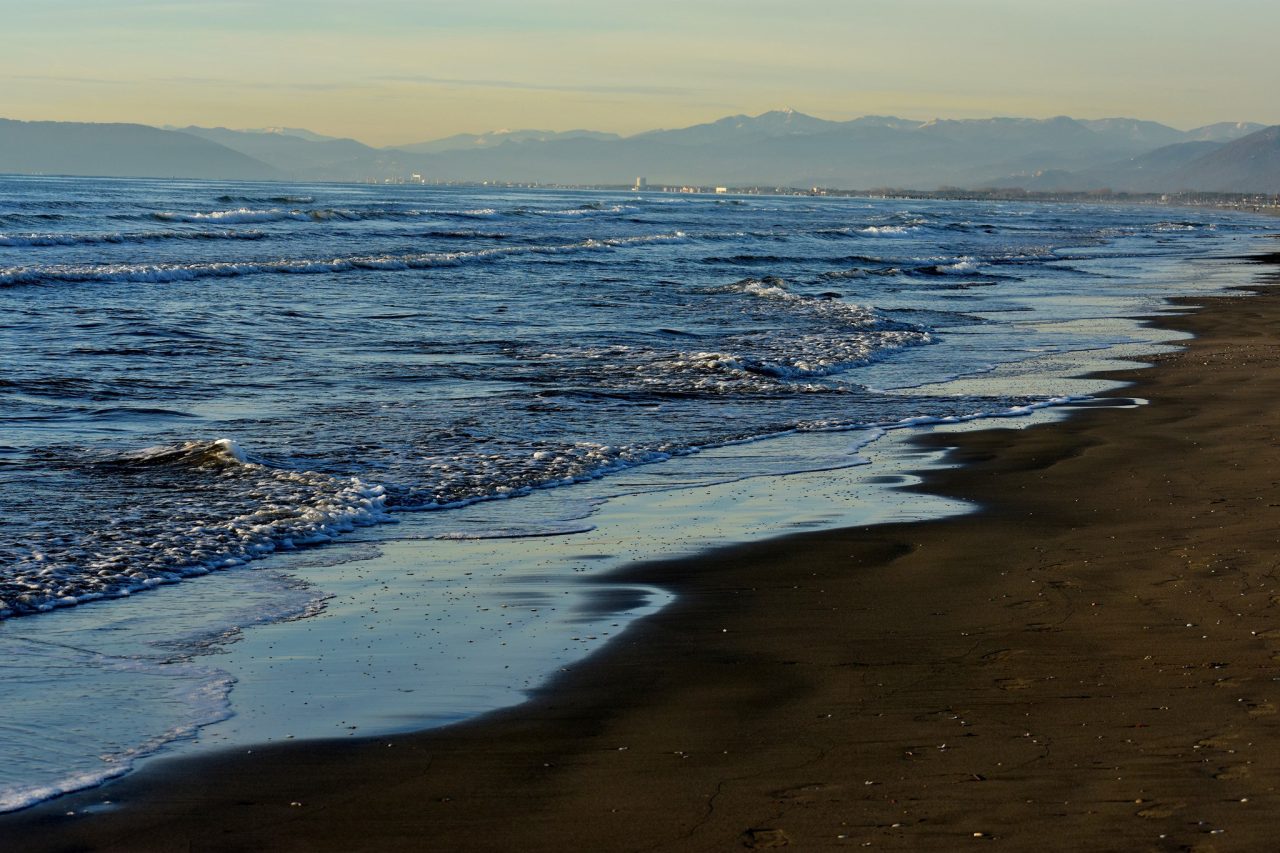
The view is dominated by the Apuan Alps, which historically have been both a barrier and a magnet for human settlement because of the wealth of quarrying, water and forest resources. The combination of steep forms and mineral resources has produced a highly specific territorialisation, by now well known worldwide, with cultivated zones alternating with vast wooded areas, notable for their geological character and for their remarkable biodiversity (about 50% of Tuscany’s biodiversity).
The coastal zone from the municipality of Forte dei Marmi through the whole coastal territory of the Municipality of Viareggio, which carries on south of the town as far as the hamlet of Torre del Lago, forms a grand natural picture running from the sea to the superb peaks of the Apuan Alps, with Monte Altissimo in the foreground, clearly visible from the pier of Forte dei Marmi together with the Corchia and the Pania della Croce, and further south dominated by Monte Gabberi and the Prana. The coastal landscape has characteristic environmental and ecological features of aesthetic and traditional value, represented by the dunes of Forte dei Marmi and of the Lecciona beach south of Viareggio, part of the Migliarino San Rossore Massaciuccoli Park. They are the only relict trace, though altered, of the original dune system. Here the dunes and their vegetation survive in the WWF oasis at Vittoria Apuana, where it is still possible to see the old Versilian landscape as it was before the growth of seaside tourism — and likewise in the protected area of the Lecciona. The coastal vegetation is rich in sea lilies, Cyperus kalli and other typical sand-loving plants, among them juniper, phillyrea, holm oak, tamarisk, alaternus and cistus; here too the camiciolo is widespread, an aromatic plant to which we owe, among other things, a particular kind of wildflower honey, also called «beach honey».
Along the coastal route, now marked by bathing establishments, the vegetation is of tamarisks and mulberry trees.
A feature of value and scenic importance is given by the pine woods, chiefly of stone pine: you can enjoy the spread of the pine canopies which, in the northern part of the coast, almost entirely hide the height of the houses and rise above them, leaving the eye free to range over the green as far as the inland hills and beyond, to the peaks of the Apuan Alps, which at sunset turn pink and in winter are snow-covered.
Walking out along the mole of Viareggio, we have the harbour and the boatyards on our right and, on our left, the view of the Apuan Alps and the skyline of Viareggio’s promenade.
THE PARKS
Along our route lie several parks; we mention the three main ones: to the north the Apuan Alps Regional Nature Park, to the south the Migliarino, San Rossore and Massaciuccoli Regional Park, and the whole coast looks out onto the International Sanctuary for Marine Mammals.
The Apuan Alps Regional Nature Park
Since 2012 it has been part of the UNESCO Global Geoparks network. This protected natural area takes in Garfagnana (the parts of the province of Lucca on the inland side of the Apuan Alps), Massa Carrara (the parts belonging to the province of the same name) and Versilia (the parts of the Province of Lucca on the seaward side of the Apuan Alps). Four fifths of it belong to the province of Lucca. In 2003 the Park also established the Museum System of Mining Archaeology of the Apuan Alps, and among the sites of historical interest are traces of the Gothic Line, of the partisan struggles and of the Second World War, such as the National Peace Park of Sant’Anna di Stazzema and the Resistance Park at Monte Brugiana. Part of the park are the famous marble quarries, which also yield the white statuary marble preferred by Michelangelo. Versilia has a long mountaineering tradition and excursions are organised in every season. For hiking, climbing and caving the Apuan Alps are a precious territory, rich in paths, via ferrata routes (the one on Monte Procinto, opened in 1893, is the oldest in Italy), climbing routes and karst cavities, often threatened by the quarries. The Antro del Corchia draws cavers from all over the world. In 2021 the Italian Alpine Club proposed establishing a Cultural Park of the Apuan Alps.
The International Sanctuary for Marine Mammals (Pelagos Sanctuary)
Contrary to what is commonly thought, Versilia looks out onto the Ligurian Sea and not the Tyrrhenian, and the waters in front of it belong to the International Sanctuary for Marine Mammals (Pelagos Sanctuary), as does the Tuscan Archipelago National Park, considered the largest marine park in the Mediterranean because it includes seven islands and numerous islets and rocks emerging across a wide stretch of the Tyrrhenian Sea. The Pelagos Sanctuary is an international protected area established in 1999 under an agreement between Italy, France and the Principality of Monaco, by which the three signatory countries undertake to safeguard marine mammals and their habitat, protecting them from the direct and indirect harm of human activity. It is a marine area in the north of the Tyrrhenian Sea of 96,000 square kilometres, quadrilateral in shape, extending around the islands of the Tuscan Archipelago and bounded by Provence (the Giens peninsula in France), by Punta Falcone in north-western Sardinia, by Capo Ferro in north-eastern Sardinia and by Fosso Chiarone in Tuscany. Thanks to the abundance of plankton and pelagic life, during the summer months there is an extraordinary presence of cetaceans of every species that frequents the Mediterranean. In 2012 Viareggio was the second signatory in Italy of the Pelagos Sanctuary Partnership, which brings together 51 Italian coastal municipalities. Sighting trips are organised from the port of Viareggio in spring and summer.
San Rossore Migliarino Massaciuccoli Regional Park
A protected natural area established in 1979, safeguarding more than 23,000 hectares in all. Its territory extends along the coastal strip of the provinces of Pisa and Lucca, taking in the municipalities of Pisa, Viareggio, San Giuliano Terme, Vecchiano and Massarosa. It also includes Lake Massaciuccoli, the mouths of the rivers Serchio, Arno and Fiume Morto, the former presidential estate of San Rossore, the forests of Tombolo, Migliarino and the Macchia Lucchese, and it manages the Secche della Meloria marine protected area.
The park is divided into a few main areas: the Macchia Lucchese, to the north, enclosed between Viareggio, Torre del Lago Puccini and the coast; the Massaciuccoli area, comprising the lake and the marshland around it; and the vast reclaimed areas taken from the lake, in the municipalities of Vecchiano and Massarosa respectively. Along the coast lie the important estates of Migliarino, San Rossore, Tombolo and Coltano, partly given over to farming and partly to woodland.
Completing the park’s managed areas are the Secche della Meloria, an important system of shoals with two emerging rocks, whose seabeds are of considerable natural value.
It holds various kinds of natural environment. Woodland predominates: a third of the Park’s surface is covered by woods, with poplar, alder, ash, holm oak and pine
(stone pine and maritime pine). There are also dunes and marshy areas, home to a rare flora (sundews, periploca, royal fern, rose hibiscus).
The fauna includes a rich variety of birds (the park has a LIPU oasis), among them the mallard, the herons (grey heron, great egret and little egret), the waders, the gulls, the ducks and the cormorants. There are also the buzzard, the black-winged stilt, the bee-eater, the moorhens and the kingfisher. In the wood it is easy to come across the green and the great spotted woodpecker. It is a nesting area for the Kentish plover. Notable too is the presence of amphibians and reptiles, including the viper.
Pretty much all the freshwater fish typical of the Italian plains are present (carp, pike, tench), as well as the fish that come up the rivers from the sea, such as eel and mullet; these last also enter Lake Massaciuccoli. Worth mentioning is the Louisiana red swamp crayfish, which has spread from the lake to the marsh and then to every wetland environment, not only those neighbouring the park.
Several medium and small mammals live in the Park as well, among them the fallow deer, the wild boar, the wild rabbit and the red fox. For some years the wolf has been sighted.