Description of paintings in Viareggio
7 – DESCRIPTION OF THE WORKS IN VIAREGGIO
Fifteen of the thirty works given by the family to the Municipality of Viareggio are on display, provisionally, in the rooms of the Civic Library, on the ground floor of the Palazzo delle Muse in Piazza Mazzini, which also houses the Gallery of Modern and Contemporary Art..
Catarsini wished carefully chosen works to remain with his town, together with a selection of works representing his favourite subjects, his original stylistic devices and his various pictorial researches over a span of some sixty years. And among these a self-portrait, which for him was the finest.
In this space, then, besides the self-portrait, fourteen other works will be shown in rotation, so as to offer, over time, the chance to see them all.
Vittorio Sgarbi writes: «… Perhaps there is a Catarsini still wholly to be discovered, still more compelling than the one he was — the one he might have been… What scholars must do is put the Catarsini object at the centre of their interests, in the aspect of his artistic output as in the evidence of the extra-artistic documents, so as to help us better understand the development of his personality through the succession of time.»
THE GIFT OF MITY AND ORAZIO CATARSINI TO THE MUNICIPALITY OF VIAREGGIO
The gift consists of thirty carefully selected works given to the Municipality of Viareggio, by official deed of 2001, by Mity and Orazio Catarsini, the artist’s children.
It is a precious collection, in that it allows us to follow Alfredo Catarsini’s stylistic path and the great variety of graphic and painting techniques he used — evidence of the complex work of research that marked his artistic profile.
At the same time the bequest brings out the history of Viareggio, of its places and its people, across much of the twentieth century.
Landscapes and portraits, still lifes and pictorial compositions, nudes and figures are the motifs of the drawings and paintings now kept in the stores of the «Lorenzo Viani» Gallery of Modern and Contemporary Art, and shown in rotation in the same building, in a room of the «Guglielmo Marconi» Municipal Library, for the occasion of the Cammino I luoghi di Catarsini.
Through the variety of languages the artist used, they trace a path of genuine figurative exploration which, from a naturalist root, arrives at the invention of original expressive forms such as Riflessismo and Simbolismo meccanico, passing through Cubo-Futurist and Surrealist suggestions.
The thirty works of the gift therefore form a genuine figurative self-portrait of the artist, across 65 years of painting, from the early 1920s to the mid-1980s.
The boatyards, boats, docks and canals of Viareggio are the places where Catarsini, at the outset, developed his passion for art, drawn by their perspectives and their spatiality but above all by their colours, which he then captured, together with the emotions, already in the paintings and drawings of the 1920s, in charcoal, ink or watercolour, as we can see in a group of graphic works belonging to the collection.
Here, in the places that keep Viareggio’s secrets, the painter met caulkers, master shipwrights and men of the sea like those we can see in Pescatori, of 1934, or in Giovane con berretto, of 1930 — drawings that give us back the attention to work and to the people of Viareggio, developed on Viani’s example, even if Catarsini shows himself more inclined to a less dramatic view of society.
At the close of the 1920s, indeed, his views alternate with paintings peopled by figures at work; but despite a shared social and existential attention, the differences from Viani are evident and deep, above all where the master tears at his figures and pushes the analysis of human interiority to extremes, while Catarsini looks at reality with a more participating and moved emotion. He belongs to the generation of Rosai, Soffici and Primo Conti, and from that world he kept his rootedness in his own land and the love for a painting that mirrors the human condition, expressing its deepest essence.
Viani had been his beacon in the years of his training at the Royal Institute of Fine Arts of Lucca, where in 1919 he took his diploma in mural painting, and later, during his time in the studio of Domenico Ghiselli, one of the leading decorators then working in Versilia.
At Viareggio, in August 1918, he had met Marinetti at the Kursaal exhibition devoted to Italian avant-garde painting, where Metaphysical art was set against Futurism and De Chirico and Carrà conversed with Conti, Depero and Prampolini. Futurism intrigued him and offered him the chance to look at the new things of the time, beyond the Viareggio atmosphere — to go beyond Viani and to try to interpret modernity in his own way, turning his gaze to the wider contemporary artistic panorama.
From Viani, who had at once glimpsed his abilities, Catarsini had also learned to be a universal artist: to feed on everything the culture of the moment put at his disposal, to love the troubled humanity of his town, while keeping within the bounds of the real with millimetric concessions to grotesque deformation.
Many portraits of the master survive, among them, in the selection of works from the gift, the ink drawing of 1930. The previous year Viani had won the first edition of the Premio letterario Viareggio, created by Leonida Rèpaci on the model of the Bagutta, and 1930 also marks the beginning of the long, intense friendship between Rèpaci and Catarsini.
In the bequest we find other portraits of figures who embody the soul of working-class Viareggio and of that artistic and intellectual world which formed the complex, stimulating picture of Viareggio culture of the time — such as the 1935 portrait of Giuseppe Tabarracci, the best-known and most valued Viareggio doctor of the twentieth century, who from the beginning of the century had worked with the Public Assistance Society at the surgical clinic, becoming its president in 1925.
The portrait of Enrico Pea dates from 1938, the year he won the Premio Viareggio with Moscardino. A poet, writer, playwright and theatre impresario, Pea would create the Premio Lerici and be the tutelary spirit of the Caffè of the Quarto Platano at Forte dei Marmi, a famous place of conviviality and a meeting point for the great figures of the cultural scene from the 1920s onwards, which Catarsini frequented.
The splendid oil of his friend Carlo Vannucci, known as Bocco, one of the leading builders of the Viareggio Carnival floats, was painted in 1937 and lets us appreciate Catarsini’s gifts as a portraitist: with pictorial knowledge he catches the young painter with his brushes in hand, expressing with refinement the dignity of his expression, his determination and his consciousness of his own craft.
The 1930s are also the years of the return to order, in which one can see the process of solidification of his painting, with a brushstroke that grows broader and more constructive, as happens in the painting Catarsini presented at the Golfo della Spezia painting prize, which he entered at Marinetti’s invitation.
In these years Catarsini’s exhibiting activity is intense and marked by his constant presence at the Venice biennales, the Rome quadriennali, the trade-union exhibitions of the period and the Viareggio shows at the Kursaal, from the first edition of 1934 to the sixth in 1939, with paintings of quality that interpret the change of taste in Italian art in the mid-1930s.
During the third decade Catarsini’s painting develops towards compositions, of landscape and of figure, more structured in form and in the laying on of colour, reflecting in an original way the return to order that was marking much of the Italian painting of those years. The artist was indeed among those who preferred the solidity of forms to the eccentricities of the avant-gardes — solidity strengthened, if anything, by Cubist and expressionist examples which in this phase are translated into the underlining of perspectival planes and the dramatising heightening of colour.
The close of the 1930s records his artistic maturing and his participation in the main exhibitions of the period, from the Premio Bergamo to the Cremona, where in 1939 his large canvas was awarded a prize, illustrating the Discorso del Duce ascoltato alla radio dai paesani di un villaggio..
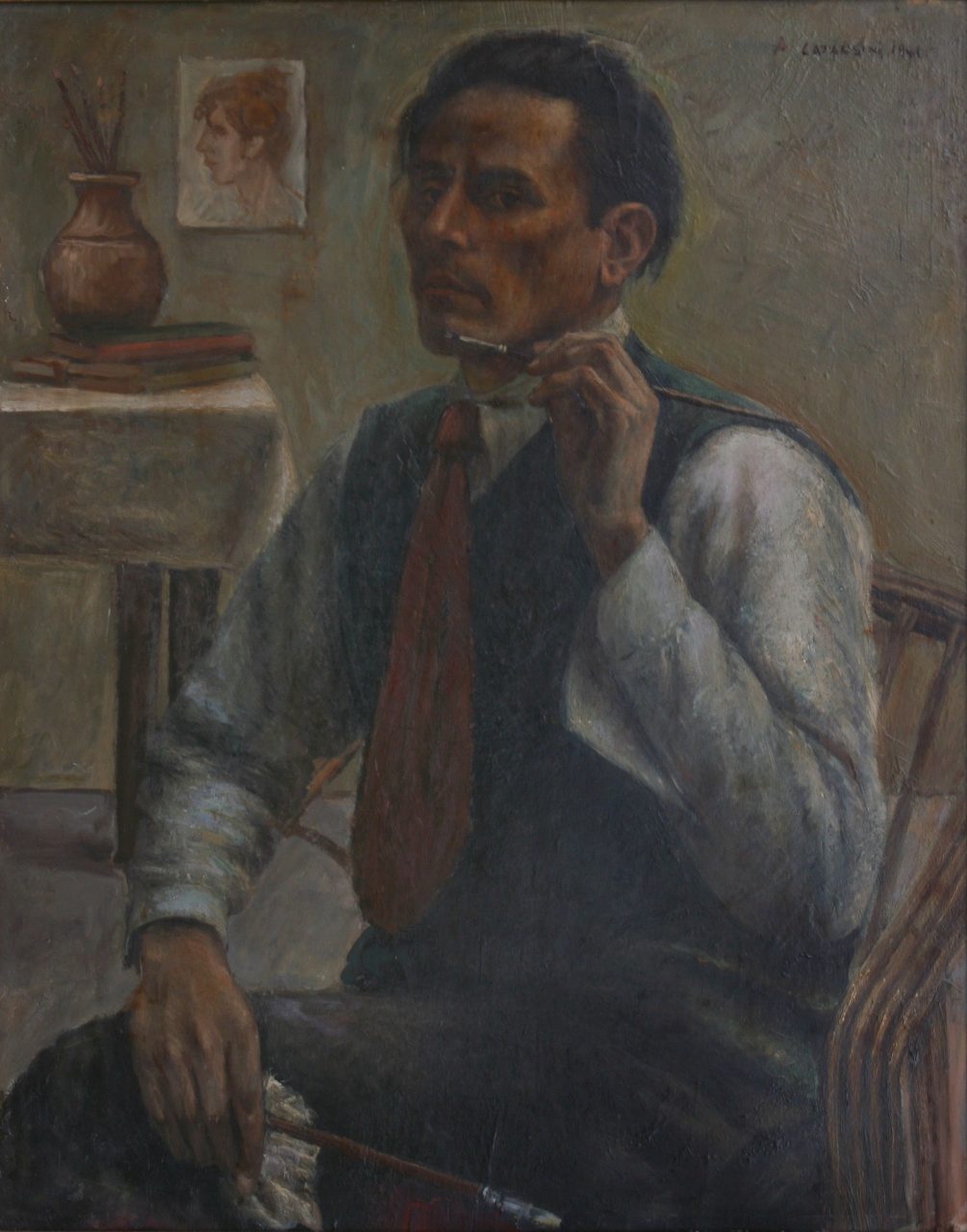
Catarsini would also take part in the Premio Cremona and in the related events in Hanover in 1940 and 1941, the year of the refined Autoritratto in oil in which the painter portrays himself in his atelier in the Town Hall in Via Regia, where he had moved in the summer of 1940. The artist shows himself seated, at the centre of the painting, looking at the viewer, his left arm raised and the tip of the brush before his chin, almost miming the act of painting. A female head drawn in profile stands out on the left, on the back wall. On a small table beside it are a vase with other brushes and some stacked books: an exercise in composition that bears witness to the need for study from life and to the centrality of drawing in the artist’s craft.
The splendid, strongly expressive oil reveals a solid technique and an iconographic complexity with which the artist, through the introspective depth of his gaze and his pose, declares himself aware of his professional maturity and of the successes he had won nationally.
From 1945 comes instead the intense portrait of his daughter Mity, framed frontally, with that very slight tilt of the face that breaks its magical symmetry. Her face stands out luminous against the dark, impenetrable, mysterious and almost hieratic ground, enclosed by hair parted at the nape, with that thin red ribbon binding it at the top and the white valves of the collar above the deep blue of the dress.
The war forced Catarsini and his family to evacuate to San Martino in Freddana, where in 1944 he left the splendid frescoes of the apse basin and the presbytery of the parish church. The following year he would paint in fresco again on either side of the high altar of San Tommaso at Castagnori, which stands at the foot of the knolls that ring the valley.
The tragic events of the summer of 1944 also inspired the novel Giorni neri, written from notes and memories put in order after the war and from drawings of the period; published in 1969, it was reissued in 2021 by La Nave di Teseo.
After the Liberation, Catarsini had moved his atelier to the attics of the Palazzo Paolina Bonaparte, where his historical archive is also kept today, now open to visitors on a further Viareggio stage of the Cammino.
In these years the places of his town return in his painting too, as in Il bozzone, of 1946, evidence of his affection for the places of working-class Viareggio dear to the artist, which he approaches with a renewed eye and spirit, deeply marked by the war and by the sufferings that had imposed on him dramatic trials and those reflections in which the sense of a new path was rearticulated into new researches.
At times, in his paintings, images surface that overlap and intersect in reflected forms which take on the same consistency as the real ones. In these works Catarsini develops a new expressive manner and tries out new geometries in that original language he would call «riflessismo», in which he paints the objects and the pictures hung on the walls of his studio broken up and recomposed in the reflection between different planes and perspectives.
Catarsini was indeed marked by the climate of figurative experiment of the immediate post-war years, in which demands for cultural and linguistic renewal were emerging. He answered from his Viareggio by making these paintings, born of the observation of the reflections of the room in their glass. He would recall it years later to his granddaughter, confiding that «looking at a picture hanging on a wall of the studio I noticed that the protective glass reflected what was around it, and so on the painting the composition was enriched with other superimposed forms».
In this short and significant phase, marked by experimental compositions of unusual perspectives on reality, his need to seek ambiguity in the fantastic everyday emerges, in an experience that leads him to a painting that is the mirror of the image and the image of the mirror. In 1981 it would be the Viareggio painter himself who recalled, quoting Breton, the importance of «digging
deeply into the things that remind us, that interest us», adding that this «new way of observing the world» would produce extravagant perspectives — not abstract, but resulting from a reflected reality.
At that time the painter described the many boatyard scenes on display as «works that are part of my old artistic experience», as one of the first attempts at Riflessismo bears witness, the Darsena he painted in 1945.
From the 1950s and until the 1980s, stimulated by the many variations of post-Cubist language and by the surrealism of Breton — from which he drew inspiration for some of his excursions into Surrealist territory — he developed a new and personal language in which he faced the complex theme of the relationship between man and machine, ever more pressing in the second half of the century, in a direction opposed to Futurist mythologising and not coinciding with Léger’s mechanism. Of this new expressive form, which he would later call «simbolismo meccanico», the gift holds three Composizioni dated to the later 1960s.
Catarsini never joined the movements or groupings that make up the varied artistic panorama of the period, but drew near the different avant-garde experiences in answer to a deep need for renewal, choosing each time what his state of mind and his formal urgency suggested. The Viareggio artist indeed never followed unitary, progressive or chronologically defined paths, but showed himself attentive to the languages and the new expressive forms that let him explore the real in unusual ways, alternating or fusing an analytical, rational line of enquiry with a more expressive and emotional one, returning assiduously to the sea, to the boatyards of his Viareggio — in which he stood as at the centre of a compass rose — and to figure paintings when he felt the need during his experiments.
At the various exhibitions, including the most important national ones, he always appeared with figurative works, reserving his experiments for a more intimate and personal dimension, almost as though they were a secret language awaiting the right moment to show itself.
To this wide output of more traditional subjects — though interpreted with a variety of technical and figurative solutions — belong many of the oil paintings in the bequest, dated between the 1950s and the 1960s, such as Vaso di fiori, Campanile o Marina invernale, or the monotype Cavallino or the Nudo femminile drawn in charcoal.
From the second half of the 1950s come three paintings that bear witness to his constant attention to the reality of his Viareggio, above all its more out-of-the-way and outlying zones, revealing its change in the years of the mechanisation of work, with a neorealist eye that links him to certain tendencies typical of those years. Draga, Gasometro e Fabbriche are signs of this new look at the real, as is Darsena viareggina, a pen drawing of 1966 in which he goes on contemplating the beloved places of his town, by then deeply transformed, still seeking the soul in them able to fascinate and surprise him.
These decades are also those in which his figurative and technical exploration carries on with Simbolismo meccanico and with works that begin to lean towards an original surrealism, through the influence of Breton but also of the Brazilian painter Aldemir Martins, who won a prize at the 1956 Biennale and was Catarsini’s guest in 1960. He made a series of pictures with fantastic figures and animals, some drawn in ink, with a line innovative in relation to his usual expressive manner, as we can see in the Gatto of 1960 or in Il cavaliere of the following year.
Begun in the early 1920s, Catarsini’s intense artistic activity found reasons and incentives in his work as a teacher of Life Drawing, which would end in 1968, as well as in other important professional experiences. In 1965, indeed, he worked for the monthly Viareggio Ieri, edited by Francesco Bergamini and, three years later, began the long collaboration — which would last until 1982 — with Versilia Oggi. For the monthly founded by Giorgio Giannelli, Catarsini made articles and drawings, often caricatures, for the column «Incontri con Catarsini».
These years saw growing interest in his work and the success, internationally too, of his works, which often portray female figures, as in the two oil paintings that recall the constant presence of woman in his life and in his artistic imagination, through two genres he particularly loved: the portrait and the nude.
Ritratto di ragazza of 1965 and Nudo di bagnante of 1986 enclose two decades of intense and fruitful artistic and literary activity that make Alfredo Catarsini one of the most significant figures of twentieth-century culture.
The collection of works kept at the «Lorenzo Viani» Gallery of Modern and Contemporary Art reveals how fundamental an experience art was for Catarsini — through which he managed to portray his own soul and that of the people he met in the course of his life, of the places he inhabited, of a colourful Versilia and of his beloved Viareggio, whose truest and deepest essence he can still reveal to us today.
- Autoritratto, 1941, oil on canvas, height 84 centimetres, width 66.5 centimetres.

In this intense self-portrait, the one he chose to leave to his town, Catarsini attests and in a way publicly declares the maturity he has reached as an artist. Catarsini is forty-two and at the height of his career: he has taken part in the Premio Cremona and the Premio Bergamo, he appears at all the most important exhibitions of those years, showing alongside the most illustrious artists, and his works have already crossed the national borders. He will have many years still before him, and further successes in Italy and abroad.
He shows himself in his studio, looking at himself in the mirror, seated on a wicker chair whose back can be glimpsed, set slightly in three-quarter view; the painter has an intense expression and looks at us, and in his raised left hand, near his face, he holds a brush, as though he had just dipped it in colour and were ready to make a stroke. The other hand rests on his crossed knee, and it too holds a brush and a small white rag. Catarsini has portrayed himself in formal clothes: a white shirt, a dark green waistcoat and lead-grey trousers, and at his neck a fine brick-red tie of soft form, as was the fashion in the 1940s. The tie is outside the waistcoat and one shirt cuff is open, signifying the freedom the artist always takes, even in a formal way of dressing.
Behind him, in the background on the left, is a table covered with a white cloth, on it three books and a pale brown vase with brushes; on the wall, just above the table, a drawing or canvas is fixed, portraying a woman’s head in profile with red curls tied in a tuft. Symbolically the three objects represent his three passions: painting, literature, and the eternal feminine as a constant source of inspiration.
- Viani, 1930, ink and pencil on paper, height 35 centimetres, width 25 centimetres.

This drawing shows the great painter and writer Lorenzo Viani, his master, to whom he was bound by esteem and friendship. Viani held that Catarsini was the best painter of his generation in Viareggio.
Viani is shown here in profile to the right, with his characteristic hooked nose. The face fills almost the whole sheet; the expression is frowning, the chin sharp, the mouth thin; the eyes, barely indicated, have a keen expression; the tousled hair is parted in the centre and falls long around the face. At his neck he wears the typical anarchist bow Viani often sported.
Catarsini writes of Viani in the article Il figlio del pastore,November 1968, monthly Versilia Oggi
“…«His human wrecks perched in the shade of a forest of red flags, exploited to the bone, at times held up to the derision of the well-placed, go beyond the illustrative datum and rise to a work of art suffered by the artist in the same measure in which these «spectres» suffered the injustices of their time. […] Faced with that social reality and that process of human debasement he was never indifferent: he studied it with an almost metaphysical spirit and drew from it a personal graphic manner, at times harsh, angular, thread-like, but always conclusive, the work of a patient researcher and a thinker, and in sharp contrast with society — which made restive and rebellious not only his poor characters, whose sorrows and hopes he depicted on his cartoons, but evidently himself as well.»
- Nudo femminile, 1950, charcoal on paper, height 71 centimetres, width 51 centimetres.

This large drawing shows a woman in profile, standing, in the act of drying herself after bathing. The figure is naked, the body powerful, the head barely indicated; the right leg is bent upwards in the act of drying a foot which we do not see; from the bend of the knee we notice a long cloth, the towel, hatched forcefully in a fine charcoal black. The whole drawing expresses strength and vigour of execution, the forms brought out by the warm chiaroscuro of the charcoal.
The nude mirrors Catarsini’s idea of woman, which is never vulgar or coy, but able to express her personality naturally.
- Giovane con berretto, 1930, drawing on paper, height 25 centimetres, width 22 centimetres.

The drawing shows the face of a boy with a beret over his hair. The paper has yellowed with the years and the quick, rapid black strokes of pencil and charcoal stand out vividly on it. The boy’s face, shown slightly in three-quarter view, is tilted downwards; his absorbed, quiet gaze seems to be looking at something far off — or perhaps he is not looking at all but daydreaming, as one often does when young.
- Darsena viareggina, 1966, pen on paper, height 38 centimetres, width 50 centimetres.

This rapid pen sketch on paper shows a part of the Darsena now changed: it is a canal of the Darsena Lucca, the oldest in Viareggio, shown in the area near the Ponte di Pisa. On the quay a bollard can be seen with a small gozzo tied to it and two barrels; on the other side of the canal a sailing vessel is moored, rigged with a furled lateen sail, its hull reflected in the water of the canal. Behind the vessel, the wooden hull of a boat under construction, and beside it a building with a pediment and two great doors: it was one of the old warehouses of the Darsena, and the building, a little altered, can still be seen today. This drawing is also an important record of what the Darsena was like up to the 1960s and of how wooden boats were built. Today important yards for the restoration of historic wooden boats remain in the area, the legacy of that old knowledge.
- Cavallino, 1953, monotype on paper, height 20 centimetres, width 27 centimetres.

This small monotype on paper shows a horse in profile to the right, grazing. The monotype is a particular kind of print, made by drawing directly on a matrix, which may be of various materials, and printing with a press. Generally the first impression is the best, whence the name monotype. Beyond the single impression others can be made, but not of the same quality as the first. In this monotype Catarsini renders the shape of the little horse with extreme freshness and speed, using a single colour, a pale grey that gives a soft, diffused vision.
- Darsena, 1945, oil on panel, height 19 centimetres, width 25.5 centimetres.

This work is one of the not very many paintings from the period Catarsini himself called Riflessismo, a period born around the middle of the 1940s from the painter’s chance observation of some objects reflected in the glass protecting one of his paintings. These observations, joined to his youthful experience in the second Futurism, led him to make a series of paintings in which objects or landscapes become ambiguous and seem to belong to a parallel world, where planes cross one another and objects have unreal dimensions. They are paintings that look like distorted dreams of great visual and emotional impact, always rendered in warm colours with heavy use of reds, blues and yellows.
In the painting, which shows a boatyard, we see in the foreground a blue strip and one in sand tones where a red boat lies; beside it, on the right, a small stylised figure in red that seems to be moving towards the edge of the picture; behind, an inclined plane from which two shed-like structures emerge. On the left another building in bright red. The painting, for all its modest size, has a strong surreal impact.
- Fabbriche, 1960, oil on canvas, height 60 centimetres, width 80 centimetres.

It is a surreal composition and shows some buildings, a gasholder and some imaginary blast furnaces in a setting made misty by the smoke from the chimneys.
In the foreground a strip of land in very dark tones with some wooden boards thrown on the ground and low plants, dark green bushes that almost form a screen of vegetation from which rise the shapes of a gasholder and two great chimneys typical of blast furnaces; in the background, progressively further off, five more chimneys, thinner, like long flues from which plumes of dark smoke escape, carried by the wind to the right of the gloomy sky, where only a few white touches manage to lighten the leaden tone of the painting.
The work seems to bear witness to the uncertainty the painter felt about a future that no longer considered nature, symbolically represented by the wood thrown down in the foreground and by the green hedge. With this painting Catarsini seems to issue a warning: where will all this take us? A question that after sixty years still has no answer.
Tommaso Paloscia writes: «… His painting cannot lend itself to simplistic interpretations; a suitably correct reading proves more complex than it may appear on the surface. His language is of international level, and the artist’s natural ability stands the comparison with the times and projects itself into the future…»”
- Capanno e barca, oil on panel, height 33 centimetres, width 50 centimetres.

This seascape in gloomy tones shows the beach in winter and dates from the 1950s. Abandoned among the poggioni (the dunes on the stretch of beach east of the town) and the dune grasses is a small boat, a gozzo. In the background the sea is stormy, with white waves and a low, leaden sky, and almost at the water’s edge a very simple house with no openings — certainly a shack. The whole painting is pervaded by a grey air; you seem to feel the cold and the wind and the melancholy the sea often has in winter.
- Gatto, 1960, ink on paper, height 30 centimetres, width 20 centimetres.

The ink drawing belongs to the series of fantastic figures Catarsini created during the period of his friendship with the Brazilian painter Aldemir Martins, whom Catarsini put up at his house during Martins’s stay in Italy on the scholarship awarded him by the Venice Biennale. Catarsini was influenced by Martins’s highly elaborate drawings and by his imagination, shaped by South American myth and folklore. This fantastic, surreal drawing is one of its most successful results. The great cat has an unsettling look: it is not a sweet purring kitten but a kind of deity recalling Aztec figures; it sits on its hind legs while the forelegs are poised to spring forward and attack. It looks at us indeed with ferocious eyes and its jaws are wide open; the body is made of circles, ellipses and triangles.
- Ritratto di Mity, 1945, oil on canvas, height 47 centimetres, width 36 centimetres.

This intense portrait of Catarsini’s daughter dates from 1945, when Mity was in the full flower of her youth and beauty. In the painting Mity is shown half-length, facing us; the girl’s gentle, vaguely melancholy gaze is not in dialogue with the viewer but absorbed in her own thoughts. A thin red ribbon with a bow gathered at the top holds her hair, long on her shoulders and dark blond. The red of the ribbon is taken up by her full lips. The demure shirt in copying-ink blue, closed with a white collar, brings out the intensity of the face.
- Simbolismo meccanico, mixed media on board, height 40 centimetres, width 49 centimetres.

The work belongs to Simbolismo meccanico, the pictorial movement Catarsini created in the 1960s and 1970s. After the war Catarsini was fascinated by the enormous advances of technology and science: wheels, pulleys, gears and mechanical objects became the protagonists of his canvases. He came, however, to the awareness that human ingenuity can also do serious harm, borne out by the anxiety, the loneliness and the unease to be felt in society. For this reason, from the 1970s the artist set into these canvases astonished faces and figures surrounded by mechanical gears — not desperate but as if surprised — to show man’s inability to master progress completely.
The painting shows forms in an almost dreamlike way: a kind of brown staff crosses the picture diagonally, and onto it at the centre is grafted a sort of cylinder with a handle in reddish tones; to the left of the cylinder a white rectangle in a kind of orange frame; between these two forms and the «staff» a semicircular blue-green halo.
- Fiori, 1950, oil on canvas, height 56 centimetres, width 41 centimetres.

This work is one of the not very many still lifes painted by Catarsini, who preferred figures and landscapes. In the painting, right at the centre, is a vase in white and blue tones holding a bunch of white roses; the ground is an indefinite mustard colour of great refinement, against which the green leaves of the roses stand out, while their whiteness lights the whole picture, played on soft tones.
- Don Chisciotte, 1961, oil on canvas, height 85 centimetres, width 60 centimetres.

This interesting work belongs to the series of stylised paintings in tones of grey and black that Catarsini painted around 1960. The subject refers to Cervantes’s Don Quixote, at the point where the protagonist surrenders to the windmills.
- Draga, 1956, oil on canvas, height 70 centimetres, width 99 centimetres.

A dredger is a movable float on which is mounted a special machine for excavating the sandy bed of a harbour when it rises too high and blocks the entry of boats. It is much used at Viareggio because the harbour entrance tends to silt up.
The dredger with its great bulk fills the whole space of the canvas. In the foreground we see two small boats moored to the large float, on which is mounted the pyramid-shaped structure of the dredger, where a series of red buckets follow one another.
The buckets serve to carry the sand that the dredger’s mechanism lifts from the bed, and which is then deposited on the float’s large deck or in the lockers provided; on the same side are some tackles and stays.
On the right of the dredger, the low red wheelhouse with its black funnel, from which grey smoke escapes. In the background, almost lost in the mist, houses can be made out, probably the buildings of the Viareggio seafront reflected in the water. The painting is without doubt a tribute to the strength of a machine that helps man in the hard work of the sea.