News about Villa Museo Paolina Bonaparte
6 – NEWS ABOUT VILLA MUSEO PAOLINA BONAPARTE
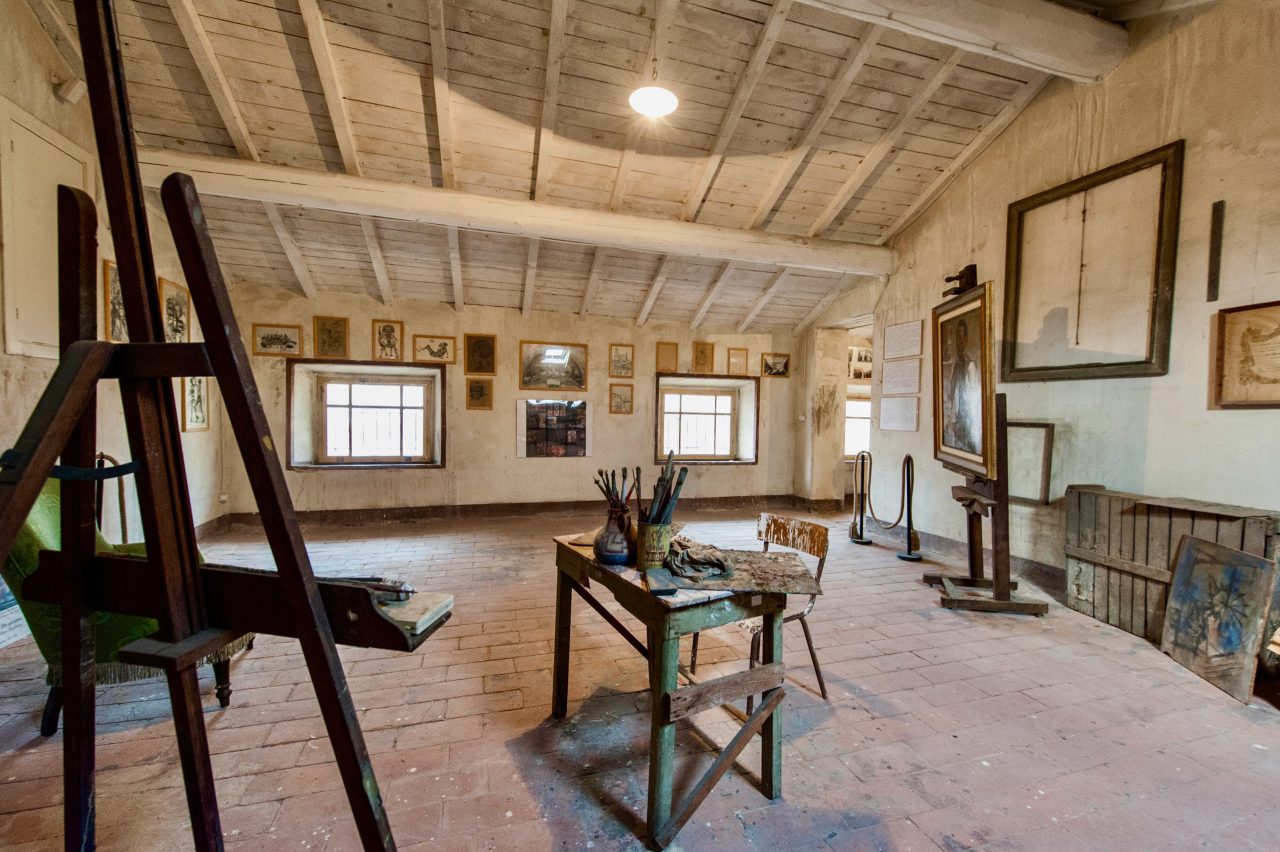
This stage touches one of the most interesting places on the Cammino: Alfredo Catarsini’s atelier, in the attics of the Villa Museo Paolina Bonaparte, which holds the artist’s important archive. Catarsini was given these rooms after his previous studio, in the Town Hall (the former Casino Reale) in Via Regia, was bombed during the Second World War.
The villa was built in 1822 for Paolina Bonaparte, Napoleon’s sister, who lived in it very little. Designed by the architect Giovanni Lazzarini in delicate neoclassical forms, it stood on the seashore, at that time much less far back than today. The building was made so that the view of the sea and of the winds should be in continual relation with the main rooms. The interior, with delightful frescoes of the period, has been restored, and today we can walk through its rooms, retracing in imagination the refined life that was led there.
On Paolina’s death it was inherited by her sister Carolina Murat and then, after various turns of fortune (it was even a middle school), it is now municipal property and hosts exhibitions and conferences. On the seaward side of the villa is Piazza Shelley, which holds one of the few monuments to the great English poet, whose body was found on the beach at Due Fosse, not far from the villa.
The atelier was rearranged by his granddaughter Elena with the Maestro’s furnishings kept after his death, and opened to the public in 2002; it holds the artist’s important archive and the traces of his work and his life: drawings, posters of his exhibitions, easels, palettes, brushes, documents, photographs, catalogues, articles, art books, letters, diplomas and honours, bound newspapers. Visiting it, one can reconstruct his personality and the salient events of a long life wholly given to art.
Alfredo Catarsini was not only a painter but also a man of letters and an attentive, sensitive man of culture. In the archive are the manuscripts of his stories, the drafts of his two novels, one of which has recently been reissued by La Nave di Teseo, his diaries and the articles he wrote for many years for the local papers and cultural magazines. In dedicated folders are kept the newspapers which, from the 1930s onwards, report his exhibitions and countless items of news from the artistic and cultural life of the twentieth century.
Of great interest is the collection of all the catalogues and brochures of the very many exhibitions he took part in from 1927 onwards, and the catalogues of other artists to whom he was particularly attached, as well as the correspondence he kept up with many of them.
There are numerous photographs of him and of his family, and telling images of his exhibitions, from those of the 1930s to the last retrospective of 1991. The archive holds all the documentation on the artist found to date and is constantly updated.
The fascination one feels in these rooms comes not only from the documents but from the atmosphere still to be felt within these walls; looking at his easel, his palette, the few furnishings, the traces of colour on the walls, we sense the intensity of a deep and sincere pictorial search to which Alfredo Catarsini gave his whole existence.
Description of the Atelier by the art historian Cristina Acidini
“…«… in the fine town villa that belonged to the Bonapartes, first to Paolina Borghese and then to Carolina Murat, from the state rooms long and carefully restored over several decades, the passage to the attic used as a painting studio is fluid and without contradiction. The nobly decorated and furnished apartments, where Paolina received the musicians, artists and writers of her small cosmopolitan court, find their complement in the quiet bohème of the atelier, which tells through objects and images the long biography of Catarsini. A life begun in the depths of Viareggio, in the shadow of the Torre Matilde and on the bank of the Darsena, later enriched by international and especially Parisian experiences and contacts, carried on between a local commitment to training the young and exhibitions across Italy, and ended at last in Viareggio, in an industrious commuting between the atelier under the Napoleonic roof and the house in the Marco Polo district…. My visit to the Catarsini studio dates from 2013, when the rearrangement project had just been successfully completed: a long and demanding project, strongly willed and brought to a good end with tenacity at the urging of Elena Martinelli, the painter’s granddaughter, in the ten years after her grandfather’s death. And which has its not immediately visible but commendable counterpart in the careful inventorying of the original documents of the Catarsini Archive; while for the artist’s work the public and private collections that hold his paintings are complementary, first among them the one at the Foundation’s premises in the Marco Polo district. In this connection I have the happy memory of the arrival of Catarsini’s 1934 Self-portrait in the famous collection of the Uffizi Gallery, in 2005, shortly before I took over its direction as Superintendent of the Florentine Museums (from 2006 to 2014)……» At the beginning of his occupancy of the atelier, the furniture was probably scarce: «Everything is almost put on the floor: tubes of colour, books, brushes, and then a dozen or so studies in black and white […] Then frames, stretchers, thrown about everywhere, and finally large fresco cartoons laid on the ground» (B.F., in Artisti nostri, Una visita allo studio del pittore Catarsini, in Il Tirreno, 7 August 1946).
And from the 1950s onwards the iconography of the studio settles into a subjective, evocative, inevitable disorder: «among palettes, easels, brushes and paintings heaped up everywhere, and shelves full of books and newspaper cuttings, […] rooms in which the noise of the town arrives as though muffled» (L.M., Note d’arte. Visita allo studio di Alfredo Catarsini, in La Nazione italiana — Cronaca di Viareggio, 13 March 1957, p. 4). «The floor trembles under the pressure of a step — Taglioli notes again — the noises of the classrooms below reach it faintly, almost a subdued hum that passes the obstacle of the walls. Along the walls the usual heaps of old and new paintings, arranged pell-mell…» (La pittura a Viareggio. L’inchiesta tra i nostri artisti e il «Personaggio» principale, in Il Tirreno, 17 November 1955, p. 4)
“….And while the painter’s figure loses its angles and, under the beret of Parisian profile, the hair turns white; while his career as teacher and artist leads him through personal and independent experiments (with Simbolismo meccanico and Riflessismo, without abandoning the figure and the Viareggio landscape), the studio takes on that lived-in look, crowded with tools and mementoes, that strikes visitors.…In the studio as it is today, the emotion of the encounter is strong: with a place that holds the testimony of an artist of strong, decided personality, of a longevity that let him cross most of the twentieth century, taking part in its fluctuating artistic currents. Works that come and go, cartoons kept after use on fresco sites, paintings chosen and prepared for exhibitions — in Florence, Venice, Rome and elsewhere — paintings that come back, drawings that pile up in reams, articles, reviews, leaflets (all material that seems important at the time and then ends up in a line of a curriculum or in oblivion) and of course canvases, frames and the tools of the trade. Painting possesses Catarsini and is present to him without respite: in his portraits there may appear a painted canvas on the easel, a picture within the picture, a fragment of the Viareggio studio incorporated for ever into a painting that will make its own way in the world. There, the plaster on the walls dims, the white paint of the roof flakes and shows patches of wood and brick…. The passage from use to museum has recreated, in the new terms of an ordered narrative, what was once a place lived in amid busy confusion.”.
SOME EXTRACTS FROM ARTICLES WRITTEN ABOUT CATARSINI AND THE IMPORTANCE OF VIAREGGIO AND ITS SURROUNDINGS IN HIS POETICS
It was easy to see him crossing the Burlamacca canal on his bicycle to go to the Darsena, and in the Darsena it was easy to meet him when he came out of the noisy lanes inside the boatyards, or when he stopped face to face with the sea and with the sheet of water of the harbour. His palette, rich and severe, darting and melancholy, seems drawn from the very reflection of colours on the metallic waters of the canal. And they are true colours only, because it was light that created and transformed them… (Raffaello Bertoli)
“And then, in sudden contemplative returns, once more to the fore that age-old relationship of man with the sea which remains the constant guide in reading that timeless painting of his…» (Tommaso Paloscia)
“Alfredo Catarsini stood in his Viareggio as at the centre of a compass rose, alert to Lorenzo Viani and to Soffici, to Carrà and the Fauves, to Matisse, to Cézanne, to Moses Levy, to the intellectuals, the poets and the artists who met in summer at the Quarto Platano of Forte dei Marmi… One can live in Viareggio, tell the stories of the darsena and the works and days of men, in the changing of the light and the hour, and be a great and true artist.» (Antonio Paolucci)