Route from San Martino to Camaiore and from San Martino to Massarosa
10 – ROUTE I FROM SAN MARTINO TO CAMAIORE AND ROUTE II FROM SAN MARTINO TO MASSAROSA
ROUTE I FROM THE VAL FREDDANA TO CAMAIORE (THE LONG WAY ROUND)
“«The horse was strong and sturdy; it pulled the cart crammed with household goods without sweating, without tiring; only now and then did the foam at its mouth, white as soapsuds, run down onto the hoof of one leg. The muscles of its chest were taut and prominent, and its slow, sure step was accompanied by the jingle of its bells. The road was long, monotonous, white with dust, with few shadows, which the mild sun of that April morning of 1943 laid out on the ground.
The carter, stretched out on top of the load, watched the wheat growing tall in the fields, the straight, early vines putting out their first shoots, and perhaps he thought too of who would one day reap, and who would harvest the grapes the coming autumn.
[…] But the fate of the evacuees was irredeemably sealed; it grew more uncertain, more painful with the order that had come from the German Command to leave their houses within the short space of three days.
[…] The town was dominated by the Apuan mountains, rich in white marbles which, for their rough plasticity, had set Michelangelo thinking — when he came to Versilia in 1518 to choose the marbles for the facade of San Lorenzo — of the possibility of drawing from them a colossal sculpture to serve as a landmark for sailors.
The carter was now leading the horse by the halter, spitting from time to time a yellowish, clotted saliva from the quid he chewed between his teeth, sometimes humming a long lament, a weary lament.
He watched flights of Stukas that were to dive into the open sea out there towards the island of Tino, beyond the Gulf of La Spezia.».
Giorni neri, ch. I, p. 15
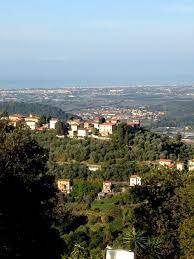
Leaving San Martino, the provincial road goes on climbing towards the summit of Monte Magno among chestnut woods and turnings that lead to old hamlets from which you can enjoy the view over the valley, both to the right and to the left of the road.
On the left is the old Andreini apiary.
Before reaching the monument to the massacre of Pioppetti — from which, keeping to the main road, you come to Camaiore (the short way round), while turning left brings you to Massarosa (the brief way round) — there is the turning on the right for Monsagrati, leading to Villa Mansi, where Puccini stayed in the summer of 1898 and where he composed the first and second acts of Tosca and orchestrated almost the whole of the first act.
Following the Francigena stretch to reach Camaiore, you come to Valpromaro, a roadside village where as early as 1121 there stood the small church of San Martino, with the hospital of San Donato beside it, founded in 1171.
You carry on to Montemagno, a small village below the eleventh-century castle whose ruins are still visible, which belonged to the powerful nobles of Montemagno.
The Church of San Michele, mentioned in 1094, welcomes us with its square, in front of which the statue dedicated to Giorgio Gaber recalls the Camaiore past of this great artist, owner of the nearby Villa La Padula.
Beside the church stood the hospital of the same name for pilgrims, recorded in a parchment of the year 1129.
From Montemagno to Malborghetto is a short step, and in this place a hospital was built in the fourteenth century, owned by the Benedictine monastery of the nuns of San Martino di Gello.
At the point where the old hospice stood you can see a small seventeenth-century oratory dedicated to San Rocco and, on the left, the building that housed the hospital.
ROUTE II FROM SAN MARTINO IN FREDDANA TO MASSAROSA (THE BRIEF WAY ROUND)
“«The horse was strong and sturdy; it pulled the cart crammed with household goods without sweating, without tiring; only now and then did the foam at its mouth, white as soapsuds, run down onto the hoof of one leg. The muscles of its chest were taut and prominent, and its slow, sure step was accompanied by the jingle of its bells. The road was long, monotonous, white with dust, with few shadows, which the mild sun of that April morning of 1943 laid out on the ground.
The carter, stretched out on top of the load, watched the wheat growing tall in the fields, the straight, early vines putting out their first shoots, and perhaps he thought too of who would one day reap, and who would harvest the grapes the coming autumn.
[…] But the fate of the evacuees was irredeemably sealed; it grew more uncertain, more painful with the order that had come from the German Command to leave their houses within the short space of three days.
[…] The town was dominated by the Apuan mountains, rich in white marbles which, for their rough plasticity, had set Michelangelo thinking — when he came to Versilia in 1518 to choose the marbles for the facade of San Lorenzo — of the possibility of drawing from them a colossal sculpture to serve as a landmark for sailors.
The carter was now leading the horse by the halter, spitting from time to time a yellowish, clotted saliva from the quid he chewed between his teeth, sometimes humming a long lament, a weary lament.
He watched flights of Stukas that were to dive into the open sea out there towards the island of Tino, beyond the Gulf of La Spezia.».
- Catarsini, Giorni neri, ch. I, p. 15
Leaving San Martino, the provincial road goes on climbing towards the summit of Monte Magno among chestnut woods and turnings that lead to old hamlets from which you can enjoy the view over the valley, both to the right and to the left of the road.
On the left is the old Andreini apiary.
Before reaching the monument to the massacre of Pioppetti — from which, keeping to the main road, you come to Camaiore (the short way round), while turning left brings you to Massarosa (the brief way round) — there is the turning on the right for Monsagrati, leading to Villa Mansi, where Puccini stayed in the summer of 1898 and where he composed the first and second acts of Tosca and orchestrated almost the whole of the first act.
After the left turn at the summit of Monte Pitoro we find the fork that leads right to Stiava and left to Pieve a Elici and Massarosa. The place name «elici» comes fromilex, the Roman name of the holm oak, which grows abundantly on the hill. The road is very fine, with views of Lake Massaciuccoli and out to the sea; you descend among olives, gardens and orchards until you reach the Romanesque Pieve of San Pantaleone with its superb panoramic terrace.
Known since the ninth century, the parish church was completed over the following centuries and holds works from the thirteenth century onwards. In the small square between the church and the presbytery is a basin of volcanic stone, perhaps Roman, probably tied in origin to some productive activity. Of great charm and beauty, it is among the best-known churches of Versilia. Since 1967 it has hosted each year an important season of chamber music concerts organised by the Associazione Musicale Lucchese.
The road goes on down to the plain and rejoins the route that comes from Viareggio and leads to Lucca, the last stage of the journey.